


From its humble beginnings in 1998, the nation's spa industry now offers world-class spa services and treatments, and holds a key position in the global supply chain of spa-related equipment and products, industry veterans said yesterday.
Now, it's looking to develop further through government support and the integration of its resources -- so Taiwan can become a top spa destination for foreign tourists.
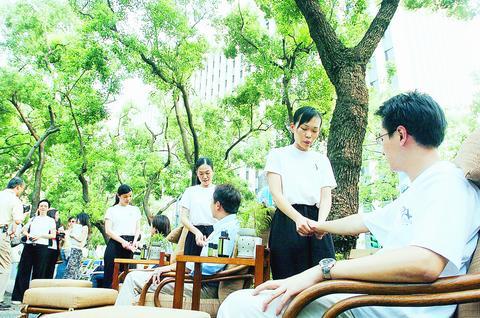
PHOTO: GEORGE TSORNG, TAIPEI TIMES
"Taiwan's spa industry has been flourishing, with more spa centers dotting the streets than convenience stores," said Candy Tang (
Tang, who is also president of Alexander Health Club (亞力山大俱樂部), made the comments while introducing this year's Taipei Spa Show, which starts Friday at the Taipei World Trade Center's Exhibition Hall III. Admission for the five-day event is NT$150 per person.
The concept of spa -- the acronym for solus par aqua in Latin, meaning "healing by water" -- was first introduced to the nation in 1998 when Orient Retreat (
The industry then saw the number of spa operators mushroom in 2000.
Now the industry has developed into a massive market worth nearly NT$10 billion (US$295 million) a year.
The exact figure is hard to estimate because the lack of grading criteria has led to a great variety of spa centers, from chain stores offering high-quality services to family-style workshops competing for the low-priced market, said Victoria Liu (
"Spa has become a lifestyle," Liu added. "It relieves pressure and will lead you to happiness."
With the help of essential oils, relaxing music, hot herbal tea and aromatherapists' magic fingers, industry veterans promise that customers in these exclusive facilities will be able to relieve all their stresses.
Spas are internationally categorized into seven types -- the day spa (more favored in metropolitan cities, such as New York and London), destination spa (such as those in weight-loss programs), cruise-ship spa, medical spa, resort or hotel spa, mineral springs spa and club spa (usually integrated with fitness centers).
Unlike spas in Thailand or the Indonesian island of Bali -- whose customers are 95 percent foreign tourists -- only 5 percent of the Taiwan spa industry's customers are non-Taiwanese.
Instead, female locals account for the bulk of the customer base, said Shenyn Wang (
According to ISPA Taiwan, the nation's day spas are ranked among the top three in the industry. But spas here have not been able to generate widespread publicity among foreign tourists and businesspeople, Wang said.
Tang lauded spa services as a perfect complement to the promotion of tourism, as they are now available in five-star hotels, shopping malls and resorts.
With the nation's industry growing at a breathtaking pace of 20 percent per year, Tang said that government support is vital in developing examination systems for aromatherapists and training other professionals needed in the booming business.
Taiwan has plentiful spa resources but is short of qualified therapists, which is the main factor preventing chain operators from quickly expanding, Wang said.
"Through the upcoming spa show, we hope to boost ISPA Taiwan's publicity and show our strength to the government, so that consumers and officials can get a better understanding of the industry," she said. "Spas are not a privilege for the rich -- we want everyone to come and enjoy a couple of pressure-free hours."

Singapore-based ride-hailing and delivery giant Grab Holdings Ltd has applied for regulatory approval to acquire the Taiwan operations of Germany-based Delivery Hero SE's Foodpanda in a deal valued at about US$600 million. Grab submitted the filing to the Fair Trade Commission on Friday last week, with the transaction subject to regulatory review and approval, the company said in a statement yesterday. Its independent governance structure would help foster a healthy and competitive market in Taiwan if the deal is approved, Grab said. Grab, which is listed on the NASDAQ, said in the filing that US-based Uber Technologies Inc holds about 13 percent of

The domestic unit of the Chinese-owned, Dutch-headquartered chipmaker Nexperia BV will soon be able to produce semiconductors locally within China, according to two company sources. Nexperia is at the center of a global tug-of-war over critical semiconductor technology, with a Dutch court in February ordering a probe into alleged mismanagement at the company. The geopolitical tussle has disrupted supply chains, with some carmakers reportedly forced to cut production due to chip shortages. Local production would allow Nexperia’s domestic arm, Nexperia Semiconductors (China) Ltd (安世半導體中國), to bypass restrictions in place since October on the supply of silicon wafers — etched with tiny components to

Taiwan Semiconductor Manufacturing Co (TSMC, 台積電) yesterday received government approval to deploy its advanced 3-nanometer (3nm) process at its second fab currently under construction in Japan, the Ministry of Economic Affairs said in a news release. The ministry green-lit the plan for the facility in Kumamoto, which is scheduled to start installing equipment and come online in 2028 with a monthly production capacity of 15,000 12-inch wafers, the ministry said. The Department of Investment Review in June 2024 authorized a US$5.26 billion investment for the facility, slated to manufacture 6- to 12nm chips, significantly less advanced than 3nm process. At a meeting with

Taiwan’s food delivery market could undergo a major shift if Singapore-based Grab Holdings Ltd completes its planned acquisition of Delivery Hero SE’s Foodpanda business in Taiwan, industry experts said. Grab on Monday last week announced it would acquire Foodpanda’s Taiwan operations for US$600 million. The deal is expected to be finalized in the second half of this year, with Grab aiming to complete user migration to its platform by the first half of next year. A duopoly between Uber Eats and Foodpanda dominates Taiwan’s delivery market, a structure that has remained intact since the Fair Trade Commission (FTC) blocked Uber Technologies Inc’s


 RSS
RSS