


Taiwan's economy has weathered the recent stagnation and has rebounded with considerable strength, economists said yesterday.
Economies in Taiwan and the rest of the world have all passed through difficult times but are steadily recovering, Wang Tu-fa (
Economic recovery in the US -- the biggest economic powerhouse in the world -- is the engine driving the revival of the global economy, Wang said.
Wang said the expected economic resurgence is expected to continue for years, with 2004 a starting point, powered by the nation's presidential election in March.
TIER forecast the nation's economy, as measured by GDP, to grow 4.62 percent this year from 3.51 last year.
Hsu Sung-ken (許松根), a national policy adviser to President Chen Shui-bian (陳水扁), said that judging from various economic indexes, Taiwan's GDP is predicted to grow by 4 or 5 percent this year.
The overall economy will not only surge in Taiwan this year, it is even worried that fund and monetary activities may turn "too hot," Hsu noted.
EXPORT-ORIENTED
The Japanese economy, which has been flat for years, has begun to rekindle in recent months while the US economy is rebounding remarkably. Tai-wan, an export-oriented economy with Japan and the US being its major overseas markets, will most likely be included in the "bandwagon of growth," he said.
Goldman Sachs Group Inc has upgraded its forecast for Taiwan's economy to grow 5.8 percent from 5.0 percent for the year, the New York-based financial institute said last month.
But Goldman Sachs warned that going into the presidential election period, cross-strait tensions would rise again, as China is concerned that Taiwan would go further down the road to independence.
"Investors should brace for lingering political uncertainty," Goldman Sachs said.
"Politics aside, with the outlook for both externatl and domestic demand looking increasingly promising, the economy is set for an all-rounded upsurge in 2004," it said.
DOMESTIC DEMAND
Taiwan's government has increased its fiscal spending to strengthen domestic demand and to spur a pick up in domestic capital goods expenditure in the run up to the March election.
The newly proposed 10 New Major Construction Projects islandwide with an outlay of NT$500 billion over five years, plus the continuing influx of foreign funds to capitalize on Taiwan's stock and money markets are "adding wings to the tiger," Hsu said.
As exports continue to gain steam, Hsieh Chin-ho (
The TAIEX closed at 6,041 points Jan. 2.


The domestic unit of the Chinese-owned, Dutch-headquartered chipmaker Nexperia BV will soon be able to produce semiconductors locally within China, according to two company sources. Nexperia is at the center of a global tug-of-war over critical semiconductor technology, with a Dutch court in February ordering a probe into alleged mismanagement at the company. The geopolitical tussle has disrupted supply chains, with some carmakers reportedly forced to cut production due to chip shortages. Local production would allow Nexperia’s domestic arm, Nexperia Semiconductors (China) Ltd (安世半導體中國), to bypass restrictions in place since October on the supply of silicon wafers — etched with tiny components to
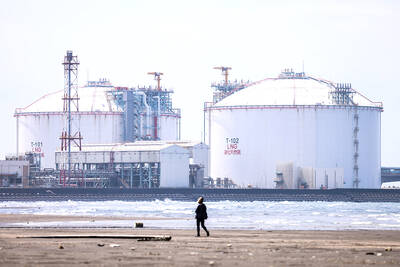
Taiwan is open to joining a global liquefied natural gas (LNG) program if one is created, but on the condition that countries provide delivery even in a scenario where there is a conflict with China, an energy department official said yesterday. While Taiwan’s priority is to have enough LNG at home, the nation is open to exploring potential strategic reserves in other countries such as Japan or South Korea, Energy Administration Deputy Director-General Chen Chung-hsien (陳崇憲) said. While the LNG market does not have a global reserve for emergencies like that of oil, the concept has been raised a few times —

Taiwan Semiconductor Manufacturing Co (TSMC, 台積電) yesterday received government approval to deploy its advanced 3-nanometer (3nm) process at its second fab currently under construction in Japan, the Ministry of Economic Affairs said in a news release. The ministry green-lit the plan for the facility in Kumamoto, which is scheduled to start installing equipment and come online in 2028 with a monthly production capacity of 15,000 12-inch wafers, the ministry said. The Department of Investment Review in June 2024 authorized a US$5.26 billion investment for the facility, slated to manufacture 6- to 12nm chips, significantly less advanced than 3nm process. At a meeting with
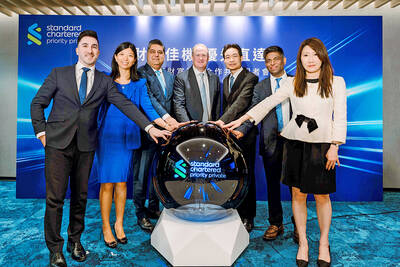
Standard Chartered Taiwan on March 26 announced that it has partnered with international fintech firm FinIQ to build an “Automated Structured Products Pricing Platform.” The bank is also introducing products from global issuers including Goldman Sachs Group Inc, Barclays PLC and BNP Paribas SA. The new platform enables an end-to-end process whereby it finds the most competitive pricing across multiple issuers in a matter of minutes, followed by automated documentation and transaction execution, which significantly shortens time-to-market and delivers a superior wealth management experience. Standard Chartered Bank Taiwan CEO Anthony Yu (游天立) said: “Standard Chartered is increasingly leveraging its wealth management


 RSS
RSS