


TRS programs takes effect
Beginning tomorrow, foreign tourists who make one-stop purchases totalling NT$3,000 (US$88.75) or more during their visit can apply for a 5-percent tax rebate upon their departure from Taiwan under a new government program to boost tourism.
Tourists who spend NT$3,000 or more in the same shop with a tax-return-shopping (TRS) logo and take the goods out of the country within 30 days will be eligible for the tax rebate at the airport upon departure.
The Ministry of Finance calculated that the program will reduce the government's business tax revenue by about NT$700 million per year.
More than 20 department stores nationwide have been approved as TRS shops so far.
The tax rebate scheme for foreign tourists is in tune with the government's efforts to double the number of tourist arrivals by 2008.
Fubon Financial ups bond sale
Fubon Financial Holding Co (富邦金控), the nation's second-largest financial services company, said it increased its sale of convertible bonds to US$245 million.
The company, which sold US$225 million of bonds last week, sold an additional US$20 million of zero-coupon bonds convertible into stock, Fubon said in a statement. The bonds have a conversion price of NT$42.33 a share.
Fubon shares fell NT$0.50, or 1.5 percent, to close at NT$33 today. Citigroup Inc and UBS AG arranged the sale.
Proceeds will be used to refinance debt, including US$430 million of convertible bonds that mature next July, Fubon said earlier.
Chinatrust takes over rival
Chinatrust Financial Holding Co (中信金控), owner of the country's largest credit-card issuer, yesterday officially took over smaller rival Grand Commercial Bank (萬通銀行), a lender controlled by Uni-President Group (統一集團).
Grand Commercial yesterday reshuffled its 18-member board and appointed Chinatrust president Luo Lian-fu (羅聯福) to double as its new chairman according to the written statement released by Chinatrust yesterday.
The merger plan will be completed by Dec. 31, the statement added.
LG Electronics names new CEO
LG Electronics Inc yesterday named vice chairman Kim Ssang-soo to replace John Koo as its new chief executive officer, the South Korean electronics manufacturer said in a statement.
Kim joined LG Electronics in 1969 and has been working at the digital appliance area for 35 years, it said.
LG Philips LCD, the joint venture between LG Electronics and Royal Philips Electronics NV, had 21.1 percent of the liquid crystal displays market in the world, leading Samsung Electronics Co with 18.9 percent and Taiwan's AU Optronics Corp (友達光電) with 11.7 percent, according to Austin, Texas-based DisplaySearch.
Siew leaves for US
Vincent Siew (蕭萬長), the head of President Chen Shui-bian's (陳水扁) economic advisory panel, left yesterday for the US to promote the signing of a free-trade agreement (FTA) between the US and Taiwan.
Both Taiwan and the US have previously expressed interest in conducting free trade talks, but the US still has misgivings about Taiwan's tax on rice wine, quotas on imported rice and the protection of intellectual property rights.
To help rekindle another around of free-trade talks with the US, Siew is scheduled to meet major US officials this time.
NT dollar gains ground
The New Taiwan dollar yesterday traded higher against its US counterpart, rising NT$0.010 to close at NT$33.780 on the Taipei foreign exchange market.
Turnover was US$977 million.

The domestic unit of the Chinese-owned, Dutch-headquartered chipmaker Nexperia BV will soon be able to produce semiconductors locally within China, according to two company sources. Nexperia is at the center of a global tug-of-war over critical semiconductor technology, with a Dutch court in February ordering a probe into alleged mismanagement at the company. The geopolitical tussle has disrupted supply chains, with some carmakers reportedly forced to cut production due to chip shortages. Local production would allow Nexperia’s domestic arm, Nexperia Semiconductors (China) Ltd (安世半導體中國), to bypass restrictions in place since October on the supply of silicon wafers — etched with tiny components to

Singapore-based ride-hailing and delivery giant Grab Holdings Ltd has applied for regulatory approval to acquire the Taiwan operations of Germany-based Delivery Hero SE's Foodpanda in a deal valued at about US$600 million. Grab submitted the filing to the Fair Trade Commission on Friday last week, with the transaction subject to regulatory review and approval, the company said in a statement yesterday. Its independent governance structure would help foster a healthy and competitive market in Taiwan if the deal is approved, Grab said. Grab, which is listed on the NASDAQ, said in the filing that US-based Uber Technologies Inc holds about 13 percent of

Taiwan Semiconductor Manufacturing Co (TSMC, 台積電) yesterday received government approval to deploy its advanced 3-nanometer (3nm) process at its second fab currently under construction in Japan, the Ministry of Economic Affairs said in a news release. The ministry green-lit the plan for the facility in Kumamoto, which is scheduled to start installing equipment and come online in 2028 with a monthly production capacity of 15,000 12-inch wafers, the ministry said. The Department of Investment Review in June 2024 authorized a US$5.26 billion investment for the facility, slated to manufacture 6- to 12nm chips, significantly less advanced than 3nm process. At a meeting with
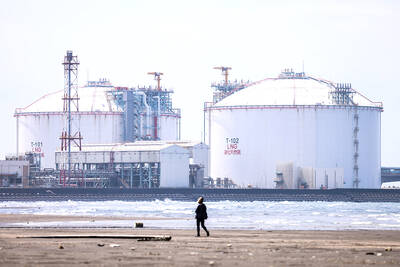
Taiwan is open to joining a global liquefied natural gas (LNG) program if one is created, but on the condition that countries provide delivery even in a scenario where there is a conflict with China, an energy department official said yesterday. While Taiwan’s priority is to have enough LNG at home, the nation is open to exploring potential strategic reserves in other countries such as Japan or South Korea, Energy Administration Deputy Director-General Chen Chung-hsien (陳崇憲) said. While the LNG market does not have a global reserve for emergencies like that of oil, the concept has been raised a few times —


 RSS
RSS