


A record number of visitors and healthy interest among buyers at Computex Taipei 2003 is not only a good indication for Taiwan's high-tech industry, but is also a promising sign for next year's event, the exhibition's organizer said yesterday.
"We are proud of the show, as most exhibitors and buyers gave an excellent evaluation of it," Lee Tsai-jen (李再仁), head of the exhibition department of China External Trade Development Council (CETRA), said yesterday.
"The show was so successful that many foreign exhibitors said they want to make their bookings for next year now," Lee said. "Besides Exhibition Halls I, II and III, where the trade show took place this year, we plan to use Taipei International Convention Center for Computex next year, making next year's show even larger than this year's."
According to CETRA statistics, visitors for the five-day event, including buyers, visitors and media, totaled 92,136 people, an increase of 28.62 percent from a year ago and a record since the show began in 1980.
The annual computer trade event was rescheduled from June due to the SARS outbreak. CETRA said the number of foreign buyers dropped slightly from 24,378 last year to 22,250 this year, but exhibitors said they saw no subsiding in purchases from buyers.
"I think the delay over the SARS outbreak has had no effect on the trade show," said Dennis Hsu (
BenQ also makes notebook PCs, digital cameras and a wide selection of consumer electronics.
"In addition to an obvious increase in visitors in the exhibition halls, buyers are also showing real interest in various products by visiting each booth instead of just wandering the hallways," Hsu said.
Another exhibitor said the bustling crowds in the exhibition venues meant that the economic pendulum was swinging upwards again.
"This is better than we had expected before the show began ? I think Taiwan, as well as the global economy, is gradually picking up," said Celia Lin (
Both BenQ and Ritek said they have received more orders during the show than they did last year, and are expecting more post-show orders to be finalized in the near future. They declined to elaborate.
Flat-screen TVs received the attention of most buyers this year, one exhibitor said.
"There is still a huge market out there for flat-panel TVs, especially those that can connect to computer devices and other consumer electronics," said Yang Yin-chih (
Sampo is one of the nation's largest home-appliance makers.
Sales of LCD-TVs are expected to rise an average annual rate of 87 percent, to 31 million units, in 2007, according to Texas-based DisplaySearch. Taiwan is the world's second-largest producer of LCD screens after South Korea.
Aside from price and quality, Yang said design is becoming a more important factor.
"Consumers are no longer satisfied with gray, square-shaped home appliances," Yang said. "Products with innovative designs increase appeal."
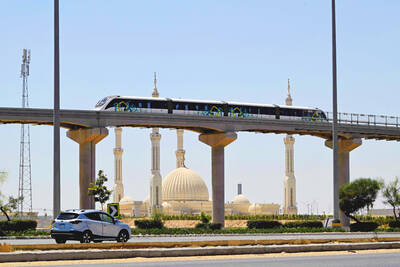
Cairo’s new monorail slices across the city skyline, running above the familiar chaos of blaring horns and aging buses’ exhaust fumes that mark rush hour below. The US$4.5 billion monorail, opened this month, is among Egypt’s most prominent new transport projects, part of a debt-funded infrastructure drive criticized for sapping state finances while bringing limited benefits to most of the country’s 109 million people. “It feels like you’re in a different country,” said Ramy Sayed, a restaurant manager, aboard a driverless Innovia 300 train. “No noise, no traffic, we’re not used to this.” The eastern line runs 56km from the bustling middle-class

Taiwanese firms have increased investment in the Philippines in recent years as Manila’s ties with Washington deepen and global supply chains continue to shift away from China, an expert at the Chung-Hua Institution for Economic Research (CIER, 中華經濟研究院) said yesterday. The Philippines had not been among Taiwanese investors’ top choices in Southeast Asia, CIER Taiwan ASEAN Studies Center director Kristy Hsu (徐遵慈) said at a seminar in Taipei. However, Taiwan’s investment in the country has grown significantly since the COVID-19 pandemic, reaching US $257 million last year, a high in recent years, she said. Although Taiwan’s total investment in the Philippines still lags

Intel Corp regards Taiwan Semiconductor Manufacturing Co (TSMC, 台積電) as a longstanding partner, as the US chipmaker would continue outsourcing production of advanced chips to TSMC, Intel chief executive officer Lip-Bu Tan (陳立武) said yesterday. “I don’t look at people as competitors. I look at the collaboration... Nvidia is also, you know, a good friend,” Tan told a news conference following his keynote speech at the Computex trade show in Taipei. “It’s a very trusted partnership for us... We are a big, top customer for them, and we’re going to continue doing that,” he said, referring to TSMC, the world’s largest foundry

Artificial intelligence (AI) agents would supplant smartphones as the center of people’s digital lives, fundamentally reshaping personal devices and driving a major computing upgrade cycle, Qualcomm Inc CEO Cristiano Amon said yesterday. In his keynote speech for this year’s Computex trade show in Taipei, Amon said that the rise of "agentic AI" — AI systems capable of reasoning, planning and carrying out tasks autonomously — would transform how people interact with technology across phones, PCs, vehicles and wearable devices. Describing the technology as the next major evolution in computing, Amon said that "2026 is the year of agents.” For decades, smartphones have sat


 RSS
RSS