


Evergreen to expand fleet
Evergreen Group (長榮集團), the world's fourth-largest shipping company by container capacity, plans to spend almost US$3 billion in the next 10 years to expand and upgrade its fleet to take advantage of a recovering global economy.
The company will add 49 new ships, costing an average US$55 million each, said Daphne Tsai, a spokeswoman for Evergreen Marine Corp (長榮海運), the group's main shipping unit.
Demand for Asian-made toys, clothing and electronic products from companies is rising as the US economy rebounds. Anticipation of increased exports from Asia is prompting shipping companies such as Evergreen and Kawasaki Kisen Kaisha Ltd, Japan's third-largest shipping line, to expand their fleets.
"A lot of shipping routes can be developed and the ships are also part of our replacement program," Tsai said, declining to be more specific.
Tax revenue on the rise
Minister of Finance Lin Chuan (林全) yesterday cited statistics showing that tax revenue in August totaled NT$60 billion (US$1.759 billion), a sharp increase from the same month last year.
This represented the first rebound since the outbreaks of SARS between March and June, indicating that the tax shortage this year will be less serious as earlier predicted, Lin said.
Lin said that August tax revenues were about NT$10 billion more than the same month last year, or an increase of 20 percent. If in the next four months tax revenues increase by NT$10 billion per month from the original prediction, then the tax shortage will be limited. The ministry originally estimated that the tax shortage would be NT$100 billion.
New telecom products eyed
The government will seek to expand cellphone and Internet applications by domestic users with a view to creating a new wave of trade opportunities for the telecommunications sector and other related industries, Council for Economic Planning and Development Deputy Chairwoman Ho Mei-yueh (何美玥) said yesterday.
Ho said that building a wireless roving environment favorable for expanding applications of the two systems will lead to the further development of local hardware manufacturing and software service industries.
The government will formulate a set of concrete measures to build an environment favorable for integrating Internet and cell phone applications, Ho said. The goal will be achieved by 2006 or 2007 if everything goes smoothly, she added.
Ownership rules evaluated
The government may lift its limit on foreign ownership in Chunghwa Telecom Co (中華電信) to 35 percent to prepare for more overseas sales of shares in the company, a Chinese-language newspaper said, citing unidentified officials.
The Ministry of Transportation and Communications, which sold a stake in the company in the US in July, will raise the current limit from 20 percent to help a new overseas share sale that could take place by October, the report said. On July 17, a 12 percent stake in Chunghwa Telecom was sold to overseas and domestic investors, raising US$1.65 billion to help plug a budget deficit and finance spending to create jobs.
Chunghwa Telecom reported yesterday that its August sales fell 1 percent to NT$15.6 billion (US$457.5 million) from the same month a year ago.
NT dollar up on greenback
The New Taiwan dollar yesterday turned strong against its US counterpart, rising NT$0.032 to close at NT$34.097 on the Taipei foreign exchange market.
Turnover was US$858 million.

The domestic unit of the Chinese-owned, Dutch-headquartered chipmaker Nexperia BV will soon be able to produce semiconductors locally within China, according to two company sources. Nexperia is at the center of a global tug-of-war over critical semiconductor technology, with a Dutch court in February ordering a probe into alleged mismanagement at the company. The geopolitical tussle has disrupted supply chains, with some carmakers reportedly forced to cut production due to chip shortages. Local production would allow Nexperia’s domestic arm, Nexperia Semiconductors (China) Ltd (安世半導體中國), to bypass restrictions in place since October on the supply of silicon wafers — etched with tiny components to

Singapore-based ride-hailing and delivery giant Grab Holdings Ltd has applied for regulatory approval to acquire the Taiwan operations of Germany-based Delivery Hero SE's Foodpanda in a deal valued at about US$600 million. Grab submitted the filing to the Fair Trade Commission on Friday last week, with the transaction subject to regulatory review and approval, the company said in a statement yesterday. Its independent governance structure would help foster a healthy and competitive market in Taiwan if the deal is approved, Grab said. Grab, which is listed on the NASDAQ, said in the filing that US-based Uber Technologies Inc holds about 13 percent of

Taiwan Semiconductor Manufacturing Co (TSMC, 台積電) yesterday received government approval to deploy its advanced 3-nanometer (3nm) process at its second fab currently under construction in Japan, the Ministry of Economic Affairs said in a news release. The ministry green-lit the plan for the facility in Kumamoto, which is scheduled to start installing equipment and come online in 2028 with a monthly production capacity of 15,000 12-inch wafers, the ministry said. The Department of Investment Review in June 2024 authorized a US$5.26 billion investment for the facility, slated to manufacture 6- to 12nm chips, significantly less advanced than 3nm process. At a meeting with
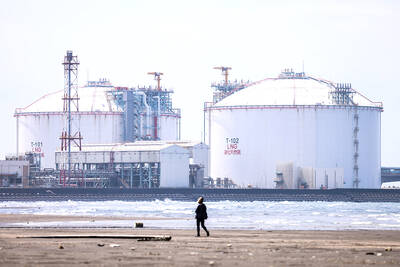
Taiwan is open to joining a global liquefied natural gas (LNG) program if one is created, but on the condition that countries provide delivery even in a scenario where there is a conflict with China, an energy department official said yesterday. While Taiwan’s priority is to have enough LNG at home, the nation is open to exploring potential strategic reserves in other countries such as Japan or South Korea, Energy Administration Deputy Director-General Chen Chung-hsien (陳崇憲) said. While the LNG market does not have a global reserve for emergencies like that of oil, the concept has been raised a few times —


 RSS
RSS