


The following heated exhange took place in the legislature's finance committee one year ago:
PFP Legislator Chen Chih-bin (
Lee Yung-san (
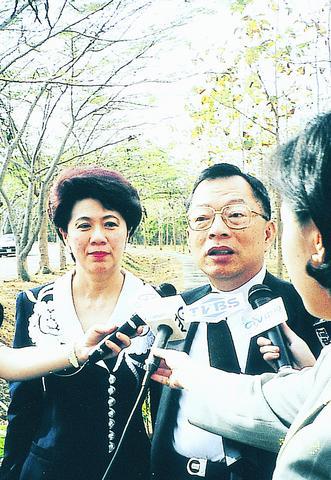
PHOTO: CHAN HSUN-HONG, TAIPEI TIMES
Chen: But everyone knows that [Tuntex's] Chen invested in the company.
Lee: He merely built the factory for China and transferred technology. According to an investigation by the Mainland Affairs Council (陸委會), he has no property registered under his name in China ... He's still doing business in Taiwan.
This exchange was brought on by the question of whether Chen had left his debts behind in Taiwan. After crossing swords with law-makers, Lee said something that no one found acceptable: "Chen's assets are still in Taiwan."
All of a sudden, ordinary people have finally realized why these "magnates" running into debt have all tried to avoid clearing their bank loans.
It is because the financial institutions haven't got a clue about the ability of these debt-evading tycoons to move their capital. What is even more deplorable is that government officials even speak on behalf of these shirkers.
When Lee said, "Chen's still running a business in Taiwan," it grated on those who know Chen in person or who used to work for him.
Apart from Chen, Hone Shee Group (
Wang owns a five-star hotel in Hangzhou. He left behind NT$88.5 billion in bad debts at Chung Shing Bank. Chen, Chang and Tsay and their affiliated businesses borrowed a total of more than NT$300 billion from local banks.
Despite the massive debts they left behind in Taiwan, these tycoons have shown their prowess across the Taiwan Strait. Chen set up his Xianglu Group in Xiamen. Chang and often invites influential Chinese officials to play golf at his Hone Shee golf course in Beijing. Tsay, hailed as "the King of Dalian," has seen the value of his shopping mall in Dalian City, northeast China, quadruple.
Core Pacific Group chairman Shen Ching-ching (
Let's have a closer look at the bad debts these entrepreneurs have left behind at Taiwan's financial institutions. Chen and Chang each owe nearly NT$100 billion. Tsay owes more than NT$10 billion yet he is still influential in both Taiwan and China. Faced with massive bad debts at local banks, even the finance ministry can do nothing about it.
Insufficient collateral is the banks' problem. This is an idea shared by all the tycoons who have left their debts in Taiwan. The debts left behind by Chang, Chen, Tsay, their affiliated businesses, friends and relatives are seriously short on collateral.
The banks have tried to auction off the deadbeats' collateral but have failed. In contrast, their businesses on the other side of the Strait are growing by the day. Each of them is investing large sums of money in those businesses, and none of them have borrowed money from Chinese financial institutions.
The Executive Yuan's financial reform task force is constantly reviewing how the financial institutions are disposing of their bad loans.
It has proposed an NT$600 billion financial reconstruction fund to stop the gap at the banks. One can't help but wonder: What is the reasoning behind having the entire public clean up the mess left behind by these deadbeat tycoons?
According to an investigation by Win-Win Weekly, Chen and his companies left behind debts totaling as much as NT$100 billion in Taiwan.
These include debts owed by:
-- Grand Union Construction Co Ltd (
-- Tung Hua Development Corp (
-- Tuntex Distinct Corp (
-- Tuntex Petrochemicals Inc (
In contrast, his businesses in China are growing by the day. For example, construction of the Donglian Mansion (
On June 13, Chen quietly arrived in Beijing from Xiamen to handle some private affairs. The Taipei District Court had issued an arrest warrant for Chen on a charge of embezzling more than NT$800 million from Tung Hua Development Corp.
As a partner of Beijing's Taiwan affairs office, Chen naturally was given a courteous reception in Beijing. Taiwan's arrest warrant did not seem to have any effect on him.
In Taiwan, even Chen himself has said the Tuntex group now exists in name only.
Over the past few years, he has successfully divided the conglomerate into independent entities so that the good companies can avoid being encumbered by the financially unsound ones.
Chen still plans to take back a leading role any time, including at Tuntex Petrochemicals Inc, which is a major manufacturer of purified terephthalic acid that has started to turn profitable.
Chen is an influential magnate in the US, Thailand and China. In particular the Xiamen Xianglu Group, which paid more than 600 million yuan in taxes last year, has set a stable foundation for Chen to cultivate his influence in China.
Hone Shee group chairman Chang, who was bogged down by another land development project in Hsintien City, allegedly bounced almost a thousand cheques in Taiwan more than a year ago. The group's affiliated businesses and individuals have all been blacklisted by Taiwan banks.
Meanwhile, a golf course he built in the Beijing Economic and Technology Development Zone has now become an important gathering place for Beijing's political and business luminaries.
Here in Taiwan, a financial crisis have prompted banks to try several times, unsuccessfully, to auction off the Hone Shee Villa and golf course. Chang's business in Beijing, meanwhile, has blossomed and borne fruit.
"These people are the biggest tragedy of the Taiwanese people. Some unknowledgeable officials even bailed them out, lowered interest rates and let them move money to China, creating job opportunities for the Chinese, while causing some Taiwanese to lose their jobs," said a Taiwanese businessman who used to work for Chen Yu-hao.
Currently the two sides of the Taiwan Strait are still stuck on the three direct links issue. There's no way to ask the Chinese government, through official procedures, to help arrest these economic criminals.
However, there are still ways to collect the massive debts they owe the banks. The local banks only have to ask third-country banks to help coordinate the overseas collection.
The debtors will eventually have to come forward and solve the problems; otherwise, their international credit will be affected.
Deplorably, our government officials are still out of the loop even when they are answering questions at the Legislative Yuan. In the end, the entire Taiwanese public will have to shoulder all the debts left behind by these tycoons.
This article first appeared in Win-Win Weekly (
Translated by Francis Huang and Jackie Lin


The domestic unit of the Chinese-owned, Dutch-headquartered chipmaker Nexperia BV will soon be able to produce semiconductors locally within China, according to two company sources. Nexperia is at the center of a global tug-of-war over critical semiconductor technology, with a Dutch court in February ordering a probe into alleged mismanagement at the company. The geopolitical tussle has disrupted supply chains, with some carmakers reportedly forced to cut production due to chip shortages. Local production would allow Nexperia’s domestic arm, Nexperia Semiconductors (China) Ltd (安世半導體中國), to bypass restrictions in place since October on the supply of silicon wafers — etched with tiny components to
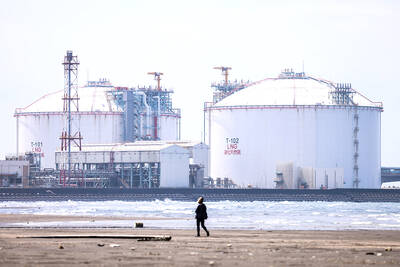
Taiwan is open to joining a global liquefied natural gas (LNG) program if one is created, but on the condition that countries provide delivery even in a scenario where there is a conflict with China, an energy department official said yesterday. While Taiwan’s priority is to have enough LNG at home, the nation is open to exploring potential strategic reserves in other countries such as Japan or South Korea, Energy Administration Deputy Director-General Chen Chung-hsien (陳崇憲) said. While the LNG market does not have a global reserve for emergencies like that of oil, the concept has been raised a few times —

Taiwan Semiconductor Manufacturing Co (TSMC, 台積電) yesterday received government approval to deploy its advanced 3-nanometer (3nm) process at its second fab currently under construction in Japan, the Ministry of Economic Affairs said in a news release. The ministry green-lit the plan for the facility in Kumamoto, which is scheduled to start installing equipment and come online in 2028 with a monthly production capacity of 15,000 12-inch wafers, the ministry said. The Department of Investment Review in June 2024 authorized a US$5.26 billion investment for the facility, slated to manufacture 6- to 12nm chips, significantly less advanced than 3nm process. At a meeting with
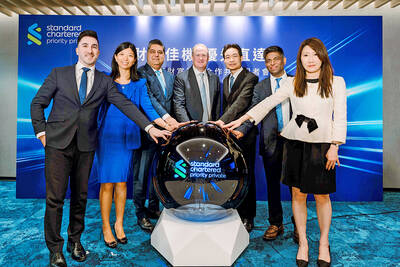
Standard Chartered Taiwan on March 26 announced that it has partnered with international fintech firm FinIQ to build an “Automated Structured Products Pricing Platform.” The bank is also introducing products from global issuers including Goldman Sachs Group Inc, Barclays PLC and BNP Paribas SA. The new platform enables an end-to-end process whereby it finds the most competitive pricing across multiple issuers in a matter of minutes, followed by automated documentation and transaction execution, which significantly shortens time-to-market and delivers a superior wealth management experience. Standard Chartered Bank Taiwan CEO Anthony Yu (游天立) said: “Standard Chartered is increasingly leveraging its wealth management


 RSS
RSS