


European stocks are poised for a second week of declines on concern companies will struggle to lift profit as economic growth stagnates. Nokia Oyj, the world's largest mobile-phone maker, and Bayer AG paced the slide.
Royal Vendex KBB NV, the biggest Dutch department-store owner, slumped 14 percent today after predicting a loss at one of its businesses. MMO2 Plc dropped after Goldman, Sachs & Co lowered its recommendation for the mobile phone company, citing concern about increasing competition in Britain.
The Dow Jones Stoxx 50 Index dropped 9.03, or 0.4 percent, to 2392.25 at 5:58pm in London. It has lost 1.4 percent this week.
The Stoxx 600 fell 0.3 percent to 203.22. It is down 0.8 percent since last Friday, with the telecom group leading declines.
"We are going to have a sticky, difficult summer," said Gary Clarke, who manages US$1.34 billion at Gartmore Investment Management in London. "We will get some poor corporate news over the summer and mixed economic news from the US and Europe."
Orders to German factories, whose production accounts for about a fifth of Europe's largest economy, fell 2.2 percent from April, the Economy and Labor Ministry said today. Economists had forecast orders to be unchanged. The drop was the third in the past four months. An unexpected interest-rate cut in Sweden added to concern about the region's economy.
Eight of the 17 Western European benchmark indexes fell today. Germany's DAX declined 0.4 percent. The UK's FTSE 100 Index lost 0.1 percent. France's CAC 40 Index dropped 0.6 percent.
September futures on the Dow Jones Euro Stoxx 50 Index of companies based in the 12 countries sharing the euro were unchanged at 2413. The index slid 0.6 percent to 2406.95.
Sweden's OMX Index climbed 0.2 percent to 539.05. Sweden's Riksbank cut its benchmark interest rate a quarter point to 2.75 percent. Twelve of 17 economists surveyed by Bloomberg News expected the bank to leave rates unchanged at 3 percent, while five had forecast a quarter-point reduction. The index fell as much as 0.5 percent after the announcement.
Swedish growth will slow to 1.2 percent this year from 1.9 percent in 2002, the Riksbank said last month. In the euro zone, which excludes Sweden, the economy may grow zero to 0.4 percent in the second and third quarters, the European Commission has forecast. It didn't grow at all from January through March.
Reports Tuesday showed that European manufacturing shrank in June, the ninth contraction in 10 months, and retail sales in Germany slid for the third month in four in May.
Nokia fell 2.5 percent to 14.10 euros today, losing 5 percent this week.
Commerzbank Securities cut its recommendation on Nokia to "reduce" from "hold" on Wednesday, citing concern mobile-phone service providers such as Orange SA will introduce more of their own branded phones.
Bayer, Germany's second-biggest drugmaker, lost 1.2 percent to 19.42 euros today, for a 4.6 percent decline since last Friday.
Vendex tumbled 13 percent this week to 8.50 euros. The company expects a loss of as much as 50 million euros (US$57 million) at its Vroom & Dreesmann unit this fiscal year after revenue from cosmetics and music fell in the second quarter. Sales at the subsidiary slipped about 5 percent in the three months ended in June.
MMO2, the fourth-biggest UK mobile phone company, fell 3.2 percent to £0.5325 after Goldman Sachs lowered its recommendation to "underperform" from "in-line." The company and rivals in the UK may have to reduce tariffs as competition mounts, according to the brokerage. MMO2 shares lost 8.2 percent in the week.
Vodafone Group Plc, the world's largest wireless service provider, slipped 1.5 percent to £1.1925, a 2.1 percent drop for the week. Orange, France Telecom SA's wireless unit, lost 3 percent to 7.40 euros.
Serco Group Plc, one of the UK Ministry of Defence's biggest service contractors, fell 2.2 percent to £1.545 after saying yesterday following the close of trading that it was taking a £4.5 million (US$7.5 million) one-time cost related to reorganizing its business.
Yesterday the shares slid 6.2 percent, the biggest drop in almost four months, after Merrill Lynch & Co analyst Paul Steegers downgraded the company to "neutral" from "buy," citing concern about reorganization costs.
William Hill Plc, the UK's second-largest betting chain, rose 2.5 percent to .£2.90. The company said first-half earnings increased at least 25 percent after it installed more gaming machines.
"Trading has continued to be excellent," Ivor Jones, an analyst at Citigroup Inc.'s Smith Barney unit, wrote in a research note. "The greater range of games in the shops is capturing" increasing spending from customers. Citigroup has an "outperform" recommendation on William Hill shares and a £3.30-a-share price target.
Corus Group Plc, Europe's third-biggest steelmaker, rose 28 percent this week to £0.185, the second-biggest gain on the Stoxx 600 after the Irish drugmaker Elan Corp. The company on Thursday said the Dutch Central Works Council gave positive advice that will help it secure a new three-year banking facility. Corus was also raised to "buy" from "add" by analysts at HSBC Holdings Plc.

The domestic unit of the Chinese-owned, Dutch-headquartered chipmaker Nexperia BV will soon be able to produce semiconductors locally within China, according to two company sources. Nexperia is at the center of a global tug-of-war over critical semiconductor technology, with a Dutch court in February ordering a probe into alleged mismanagement at the company. The geopolitical tussle has disrupted supply chains, with some carmakers reportedly forced to cut production due to chip shortages. Local production would allow Nexperia’s domestic arm, Nexperia Semiconductors (China) Ltd (安世半導體中國), to bypass restrictions in place since October on the supply of silicon wafers — etched with tiny components to

Singapore-based ride-hailing and delivery giant Grab Holdings Ltd has applied for regulatory approval to acquire the Taiwan operations of Germany-based Delivery Hero SE's Foodpanda in a deal valued at about US$600 million. Grab submitted the filing to the Fair Trade Commission on Friday last week, with the transaction subject to regulatory review and approval, the company said in a statement yesterday. Its independent governance structure would help foster a healthy and competitive market in Taiwan if the deal is approved, Grab said. Grab, which is listed on the NASDAQ, said in the filing that US-based Uber Technologies Inc holds about 13 percent of
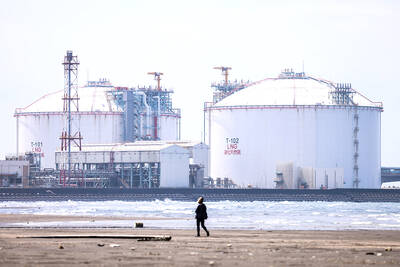
Taiwan is open to joining a global liquefied natural gas (LNG) program if one is created, but on the condition that countries provide delivery even in a scenario where there is a conflict with China, an energy department official said yesterday. While Taiwan’s priority is to have enough LNG at home, the nation is open to exploring potential strategic reserves in other countries such as Japan or South Korea, Energy Administration Deputy Director-General Chen Chung-hsien (陳崇憲) said. While the LNG market does not have a global reserve for emergencies like that of oil, the concept has been raised a few times —

Taiwan Semiconductor Manufacturing Co (TSMC, 台積電) yesterday received government approval to deploy its advanced 3-nanometer (3nm) process at its second fab currently under construction in Japan, the Ministry of Economic Affairs said in a news release. The ministry green-lit the plan for the facility in Kumamoto, which is scheduled to start installing equipment and come online in 2028 with a monthly production capacity of 15,000 12-inch wafers, the ministry said. The Department of Investment Review in June 2024 authorized a US$5.26 billion investment for the facility, slated to manufacture 6- to 12nm chips, significantly less advanced than 3nm process. At a meeting with


 RSS
RSS