


San Francisco businessman Jude Shao has been withering in a Shanghai prison since 1998, with only occasional visits from relatives and US consular agents trying to get him released.
But a grass-roots movement to free the 41-year-old naturalized American, convicted on tax evasion charges he denies, got a big boost Saturday from the 1993 class of Stanford University Graduate School of Business.
More than 100 alumni who attended a 10-year class reunion launched the "Free Jude Shao Campaign."
"Jude would not pay a bribe, and that's why he's in prison," said Chuck Hoover, a 39-year-old Los Angeles executive and Shao's best friend.
The alumni, mostly business executives in their late 30s and early 40s, planned to build a Web site dedicated to Shao and translate campaign paperwork into Chinese to explain the case to government delegations that visit Stanford.
"Until now we've been very below the radar," said Lang Anh Pham, a Silicon Valley marketing consultant and Shao's friend since graduate school.
Although the campaign focuses on Shao, the case highlights the plight of roughly 60 Americans serving contested sentences in Chinese prisons. More than half of the jailed Americans are business executives, said human rights crusader John Kamm, who leads the San Francisco-based Dui Hua Foundation (中美對話基金會).
Kamm, a former business executive and head of Hong Kong's American Chamber of Commerce, has facilitated the release of more than 250 political prisoners. He is increasingly also taking on cases involving businessmen, including Shao and David Chow, a retired airline pilot from Los Angeles.
Jailed on a conviction of ``attempted fraud'' after trying to arrange a municipal loan in Harbin province, Chow was released in October -- only eight days before US President George W. Bush was scheduled to meet with Chinese US President Jiang Zemin and discuss China's human rights record.
"People often ask me why American business should care about China's prisoners," Kamm said to the audience, full of men in golf attire and women in starched khakis and crisp linen shirts. "I tell them: David Chow. The same arbitrary abuses of power used to silence political dissent can be used for other purposes."
The overwhelming majority of roughly 30 imprisoned American businessmen are ethnic Chinese operating companies with ties to mainland China, Kamm said. Most are serving long sentences and say they didn't commit the crimes -- often tax evasion, importation of hazardous materials, or exportation of military products.
Like Shao, many prisoners say they refused to pay a bribe, or they sparred with a local politician. Few get convictions overturned, but many get sentences reduced or terminated when high-ranking American politicians, journalists or human rights leaders become interested in their case.
Shao, who continues to petition the government to overturn the conviction, founded a medical equipment vending company after graduation from Stanford. By 1996, China Business Ventures had 15 employees in a satellite office in Shanghai, where Shao's three siblings and parents lived.
Local tax auditors visited CBV in 1997 to conduct a "special tax audit." According to the Free Jude Shao Campaign, auditors removed all of Shao's accounting records when they inspected the office.
The next day, the head auditor offered to return the books if CBV posted a "tax audit bond" of US$60,000. Shao refused.
In April 1998, police arrested Shao, who was held incommunicado for 26 months. In March 2000, he was declared guilty of tax evasion, ordered to pay US$86,000 and serve a 16-year sentence in Shanghai Qing Pu prison, where he remains. His business has been defunct since his incarceration.

Cairo’s new monorail slices across the city skyline, running above the familiar chaos of blaring horns and aging buses’ exhaust fumes that mark rush hour below. The US$4.5 billion monorail, opened this month, is among Egypt’s most prominent new transport projects, part of a debt-funded infrastructure drive criticized for sapping state finances while bringing limited benefits to most of the country’s 109 million people. “It feels like you’re in a different country,” said Ramy Sayed, a restaurant manager, aboard a driverless Innovia 300 train. “No noise, no traffic, we’re not used to this.” The eastern line runs 56km from the bustling middle-class

Taiwanese firms have increased investment in the Philippines in recent years as Manila’s ties with Washington deepen and global supply chains continue to shift away from China, an expert at the Chung-Hua Institution for Economic Research (CIER, 中華經濟研究院) said yesterday. The Philippines had not been among Taiwanese investors’ top choices in Southeast Asia, CIER Taiwan ASEAN Studies Center director Kristy Hsu (徐遵慈) said at a seminar in Taipei. However, Taiwan’s investment in the country has grown significantly since the COVID-19 pandemic, reaching US $257 million last year, a high in recent years, she said. Although Taiwan’s total investment in the Philippines still lags

Intel Corp regards Taiwan Semiconductor Manufacturing Co (TSMC, 台積電) as a longstanding partner, as the US chipmaker would continue outsourcing production of advanced chips to TSMC, Intel chief executive officer Lip-Bu Tan (陳立武) said yesterday. “I don’t look at people as competitors. I look at the collaboration... Nvidia is also, you know, a good friend,” Tan told a news conference following his keynote speech at the Computex trade show in Taipei. “It’s a very trusted partnership for us... We are a big, top customer for them, and we’re going to continue doing that,” he said, referring to TSMC, the world’s largest foundry
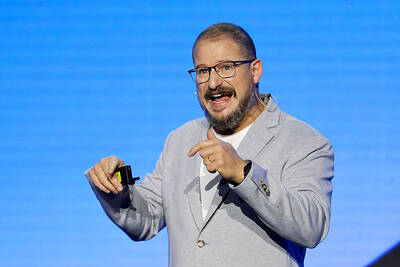
Artificial intelligence (AI) agents would supplant smartphones as the center of people’s digital lives, fundamentally reshaping personal devices and driving a major computing upgrade cycle, Qualcomm Inc CEO Cristiano Amon said yesterday. In his keynote speech for this year’s Computex trade show in Taipei, Amon said that the rise of "agentic AI" — AI systems capable of reasoning, planning and carrying out tasks autonomously — would transform how people interact with technology across phones, PCs, vehicles and wearable devices. Describing the technology as the next major evolution in computing, Amon said that "2026 is the year of agents.” For decades, smartphones have sat


 RSS
RSS