


Foreign businesspeople are expected to put off or cancel visits to Taiwan as severe acute respiratory syndrome (SARS) fears escalate.
Unless they have no choice, "traveling businessmen will not dare to board planes to Taiwan" if more cases of the disease are confirmed, National Taiwan University professor of economics Hsu Chen-ming (
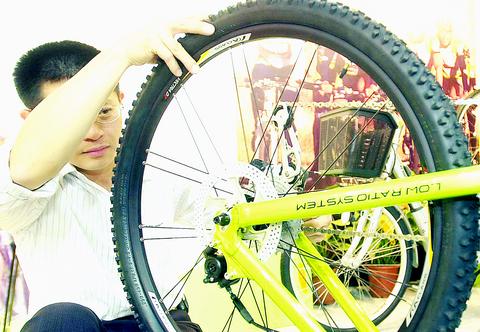
PHOTO: SEAN CHAO, TAIPEI TIMES
Hsu organizes international conferences in Taiwan and has noticed a flurry of cancellations, postponements and non-confirmations for upcoming events.
As of yesterday, the Department of Health said that there were 10 suspected SARS cases in Taiwan, six of which have been confirmed.
The World Health Organization (WHO) placed Taiwan on its list of "affected areas" for SARS on Thursday. Government officials are now scrambling to stop cancellations from overseas visitors.
But foreign businesspeople may already be aborting trips, Chinese-language media suggested yesterday.
Eight overseas companies canceled their booths at the 2003 Taipei International Cycle Show, which starts today.
The non-profit organizer of the show, the China External Trade Development Council (CETRA), tried to downplay SARS fears yesterday.
"I think these cancellations are a result of the war in Iraq and not SARS," CETRA secretary-general Chao Yung-chuan (
The Taipei International Machine Tools Show that ended last Sunday saw a 20-percent drop in overseas visitors, but as the event took place before the SARS cases were confirmed in Taiwan, the drop can not be attributed to the disease, Chao said.
"US visitors were down 20 percent and European visitors 40 percent, but mainland Chinese visitors increased fivefold, so our analysis of the drop in attendance is that it was a direct result of the US-Iraq war," Chao said.
Earlier this week CETRA sent an e-mail to overseas participants in five upcoming international events -- bicycle, sports, giftware, electronics and opto-electronics shows -- stressing the safety of Taiwan.
A copy of the e-mail obtained by the Taipei Times states that Taipei is "one of the world's safest and healthiest cities" and adds that "Taiwan has a glowing health record, which means that recent outbreaks of influenza in Hong Kong, Singapore, and China have been largely kept off the island."
June Chang (
Meanwhile, the disease is not expected to deter people from doing business across the Taiwan Strait.
"Taiwanese will continue to do business on the mainland and will not allow this disease to hinder their normal operations," Cheng Chen-mount (鄭貞茂), an economist at Citibank NA (花旗銀行), said yesterday.
Many Taiwanese companies have factories in China's Guangdong Province, where the highest number of confirmed SARS cases have been reported globally. As of the end of February, 792 SARS cases had been documented as well as 31 deaths, the WHO reported on Thursday.
Some businesspeople are choosing to opt out of China trips for now. A planned 40-strong fact-finding delegation to China next month by the Chinese National Association of Industry & Commerce (工商協進會) was canceled yesterday, deputy secretary-general George Lin (林添貴) said.
"We canceled the trip as a lot of the members said they were concerned about SARS," he said.
And Taiwan's largest tech company, Acer Inc, has banned trips across the Taiwan Strait.
"Acer Inc is advising employees to communicate via various means, such as video conferencing, the best we can, and forbidding travel to Hong Kong, Macau, Shenzhen and Guangzhou," Henry Wang (汪島雄), Acer's senior director of public relations, said in an e-mail. "We are also asking those employees needing to travel to other cities in mainland China to transfer flights via Tokyo instead of Hong Kong and Macau for the time being. Employees are asked to remain cautious."

The domestic unit of the Chinese-owned, Dutch-headquartered chipmaker Nexperia BV will soon be able to produce semiconductors locally within China, according to two company sources. Nexperia is at the center of a global tug-of-war over critical semiconductor technology, with a Dutch court in February ordering a probe into alleged mismanagement at the company. The geopolitical tussle has disrupted supply chains, with some carmakers reportedly forced to cut production due to chip shortages. Local production would allow Nexperia’s domestic arm, Nexperia Semiconductors (China) Ltd (安世半導體中國), to bypass restrictions in place since October on the supply of silicon wafers — etched with tiny components to

Singapore-based ride-hailing and delivery giant Grab Holdings Ltd has applied for regulatory approval to acquire the Taiwan operations of Germany-based Delivery Hero SE's Foodpanda in a deal valued at about US$600 million. Grab submitted the filing to the Fair Trade Commission on Friday last week, with the transaction subject to regulatory review and approval, the company said in a statement yesterday. Its independent governance structure would help foster a healthy and competitive market in Taiwan if the deal is approved, Grab said. Grab, which is listed on the NASDAQ, said in the filing that US-based Uber Technologies Inc holds about 13 percent of

Taiwan Semiconductor Manufacturing Co (TSMC, 台積電) yesterday received government approval to deploy its advanced 3-nanometer (3nm) process at its second fab currently under construction in Japan, the Ministry of Economic Affairs said in a news release. The ministry green-lit the plan for the facility in Kumamoto, which is scheduled to start installing equipment and come online in 2028 with a monthly production capacity of 15,000 12-inch wafers, the ministry said. The Department of Investment Review in June 2024 authorized a US$5.26 billion investment for the facility, slated to manufacture 6- to 12nm chips, significantly less advanced than 3nm process. At a meeting with
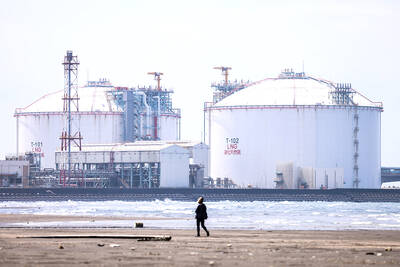
Taiwan is open to joining a global liquefied natural gas (LNG) program if one is created, but on the condition that countries provide delivery even in a scenario where there is a conflict with China, an energy department official said yesterday. While Taiwan’s priority is to have enough LNG at home, the nation is open to exploring potential strategic reserves in other countries such as Japan or South Korea, Energy Administration Deputy Director-General Chen Chung-hsien (陳崇憲) said. While the LNG market does not have a global reserve for emergencies like that of oil, the concept has been raised a few times —


 RSS
RSS