


Cramped space at the Taipei World Trade Center may force the government to push forward with a plan to construct an international exhibition hall in the city's Nankang district, officials suggested yesterday.
Land adjacent to the Nankang Software Park had been earmarked for the multi-billion dollar business complex consisting of a hotel, shopping complex and exhibition center.
"The plan is still under review, and no decision has been made yet," Council for Economic Planning and Development chairwoman Ho Mei-yueh (何美玥) said yesterday.
Nankang is expected to be connected to the blue line of the city's MRT system by 2007 or 2008. Land for the six-hectare site was purchased by the central government in 1996.
Vice Premier Lin Hsin-Yi (
The Ministry of Economic Affairs' Board of Foreign Trade initially raised the idea of a new exhibition hall back in 2000. The council then drafted a plan that recommended a shopping mall and hotel be added to the site. The council has now decided that a stand-alone "exhibition hall could be considered," Ho said.
Trade show officials say Taiwan is in dire need of larger facilities.
"We need a unique exhibition site," said Chang Wen-miao (張文淼), deputy executive director of the China External Trade Development Council.
The council holds around 20 international shows in the Taipei World Trade complex each year.
"Computex Taipei is very important as it is the world's third-largest computer show," Chang said. "International buyers are not very happy about moving between venues, so the best solution is a dedicated space."
Because of a lack of exhibition space, dozens of companies are turned away from Computex each year. Over 100 firms will be forced to find alternative space this year, with some using the Grand Hyatt Hotel next to the World Trade Center, and many others being completely excluded.
The annual Taipei International Machine Tool Show and the biannual Plastics and Rubber Machinery exhibition face similar constraints.
The Taipei World Trade Center's main hall has space for 1,313 booths, with another 331 spaces in Hall 2 beside the Warner Village complex. Overflow from those two venues is housed in the Taipei International Convention Center, next to the main hall.
The Taipei City government has made space available for 300 booths on the second floor of the main exhibition hall, and by September, more than 350 spaces are expected to be added in the Taipei 101 complex, across the road from the convention center.
The Taipei Computer Association, one of the organizers of Computex, said the additional space on the second floor of the World Trade Center and at Taipei 101 will be sufficient.
"The new arrangements should increase the space to around 3,000 booths," said Taipei Computer Association Vice-chairman Huang Yun-pei (
"This space is sufficient for our members."
The Information Service Industry Association, which represents 650 corporations, is also satisfied with the status quo.
"The World Trade Center is adequate for our needs," said David Chang (
"Exhibitions are just not as crowded as during the 2000 boom," Chang said.
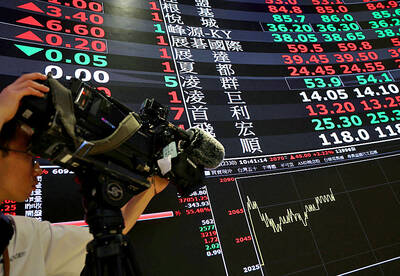
After several years flying high as Asia’s best Nvidia Corp proxy, Taiwan Semiconductor Manufacturing Co (TSMC, 台積電) is increasingly vying with other artificial intelligence (AI) stocks for investor attention. Stock traders are chasing a wider array of beneficiaries as mainstream usage of AI creates demand for hardware beyond the most-advanced chips TSMC makes for Nvidia. Subthemes from the deepening memory crunch to advances in robotics are also luring bids. At the same time, investment caps on single stocks are pushing funds to diversify, while retail investors long familiar with TSMC through its US depositary receipts are being offered a broader set of
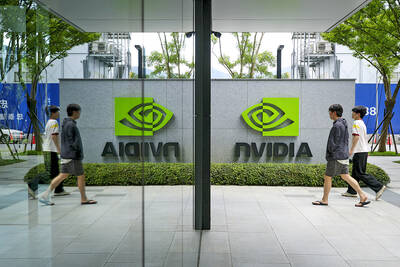
UNDER MICROSCOPE: Taiwan detained three people who allegedly conspired to buy servers in Taiwan and export them using fraudulent documentation, prosecutors said Nvidia Corp chief executive officer Jensen Huang (黃仁勳) on Saturday urged Super Micro Computer Inc to tighten up on compliance after Taiwan detained three people this week for allegedly making fraudulent declarations about artificial intelligence (AI) servers made by its US partner. The development marked the nation’s first crackdown on semiconductor smuggling, which grew after the US slapped restrictions on exports of high-end chips such as Nvidia AI accelerators to China. Nvidia is “rigorous” in explaining regulations to all of its partners, Huang told reporters after arriving in Taipei. “Ultimately Super Micro has to run their own company,” he said in response to
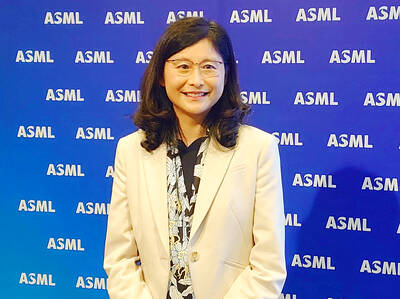
Netherlands-based semiconductor equipment supplier ASML Holding NV yesterday said that it is planning to hire an additional 1,000 people in Taiwan this year in response to growing demand from clients. ASML had previously planned to recruit 600 people this year, but that the plan has been adjusted upward, ASML vice president and ASML Taiwan general manager Grace Wang (汪佳慧) told reporters. ASML has a workforce of more than 4,500 in Taiwan, accounting for about 10 percent of its global total, Wang said. This year’s recruitment campaign would focus on adding people in the customer support, manufacturing and supply chain domains to assist ASML
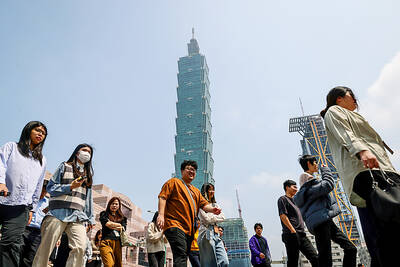
TECH RELIANCE: Growth is increasingly reflecting an unequal K-shaped distribution, where technology sectors outperform and other industries struggle, an expert said Standard Chartered Bank has significantly raised its forecast for Taiwan’s economic growth to 9.5 percent this year, up from 7.6 percent previously, citing surging artificial intelligence (AI) demand driving exports, semiconductor production and investment. The upgrade reflects a sustained AI supercycle that continues to fuel demand for advanced chips and technology infrastructure, which form the backbone of Taiwan’s exports, the bank said in a report this week. “We raise our 2026 growth forecast to reflect a much stronger-than-expected first-quarter GDP figure,” Standard Chartered senior economist for greater China and Asia Tommy Wu (胡東安) said in the report. Driven largely by a 35.3 percent


 RSS
RSS