


Floppy-disk drives may have moved one step closer to extinction after Dell Computer Corp announced Wednesday that it will stop installing them in its high-end computers beginning next month.
"It is a definite trend that the floppy disk is disappearing," Kevin Huang (
Cheaper, portable hard-disk drives and other storage methods are replacing floppy-disk drives, and so is the Internet, he said.
"People are using the Internet to transfer software, which used to be the main use for floppy disks," Huang said.
"The capacity of floppy disks is just too small," said Eve Jung (
Floppies can store up to 1.44MB of data, or over 700 pages of plain text. However newer computer files, such as pictures and music, need larger capacities. "One MP3 music file needs around 3MB, and this exceeds the limit of a floppy disk," Jung said.
Floppies are disks of magnetic tape that can store data which can be read and retrieved by a computer's floppy-disk drive. The disks are encased in plastic for protection and are pliable, hence the name "floppy."
Local computer makers are likely to welcome the move.
"Manufacturers will be happy to get rid of the floppy disk as the technology is too old," Huang said. "For developed countries such as Taiwan, South Korea and Japan, it's almost useless."
There may be resistance to the trend in an industry, however, where profit margins are very thin.
"The price of floppy drives is very low, so vendors might be reluctant to get rid of them, but if Dell sets the pace, other vendors will follow," Huang said.
Computer users are now turning to portable hard disks to move files from one computer to another. One example is the flash disk. The size of a cigarette lighter, these devices can store up to 512MB of data. And they don't need a special drive -- when plugged into a USB port they work like a built-in drive.
"More and more companies in Taiwan are making flash drives, so prices are falling quickly," Jung said. Each megabyte currently costs around NT$15 in Taiwan, so a 64MB flash disk costs around NT$900.
An alternative method for transporting files is portable hard disks which also plug into the computer's USB port. A few thousand New Taiwan dollars can buy a hard disk of the same capacity as that in a standard desktop or laptop computer. Files can also be saved onto rewritable CDs, which cost a few New Taiwan dollars each. Rewritable computer drives retail for as little as NT$3,000.
Computer retailers have already adjusted to the trend.
"We only carry a small selection of floppy disks as customers are mostly buying the new flash drives," said Lin Yung-chao (
This is not the first time pundits have predicted the end of the floppy.
Apple Computer Inc abandoned the floppy disk five years ago, and many expected the mainstream industry to follow. Apple continues to lead the industry by dumping obsolescent technology. CEO Steve Jobs announced last summer that Apple would only offer flat-screen displays with its iMac computers, even though sales of flat screens are not expected to overtake traditional cathode-ray computer displays until next year, US-based research firm DisplaySearch reported.
Dell's announcement may not be the final death knell for the floppy disk.
"In emerging countries, where file sizes may be smaller, they will continue to use the floppy," Jung said.
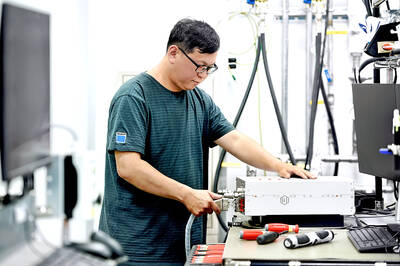
SEMICONDUCTORS: The German laser and plasma generator company will expand its local services as its specialized offerings support Taiwan’s semiconductor industries Trumpf SE + Co KG, a global leader in supplying laser technology and plasma generators used in chip production, is expanding its investments in Taiwan in an effort to deeply integrate into the global semiconductor supply chain in the pursuit of growth. The company, headquartered in Ditzingen, Germany, has invested significantly in a newly inaugurated regional technical center for plasma generators in Taoyuan, its latest expansion in Taiwan after being engaged in various industries for more than 25 years. The center, the first of its kind Trumpf built outside Germany, aims to serve customers from Taiwan, Japan, Southeast Asia and South Korea,

POWERING UP: PSUs for AI servers made up about 50% of Delta’s total server PSU revenue during the first three quarters of last year, the company said Power supply and electronic components maker Delta Electronics Inc (台達電) reported record-high revenue of NT$161.61 billion (US$5.11 billion) for last quarter and said it remains positive about this quarter. Last quarter’s figure was up 7.6 percent from the previous quarter and 41.51 percent higher than a year earlier, and largely in line with Yuanta Securities Investment Consulting Co’s (元大投顧) forecast of NT$160 billion. Delta’s annual revenue last year rose 31.76 percent year-on-year to NT$554.89 billion, also a record high for the company. Its strong performance reflected continued demand for high-performance power solutions and advanced liquid-cooling products used in artificial intelligence (AI) data centers,

Gasoline and diesel prices at domestic fuel stations are to fall NT$0.2 per liter this week, down for a second consecutive week, CPC Corp, Taiwan (台灣中油) and Formosa Petrochemical Corp (台塑石化) announced yesterday. Effective today, gasoline prices at CPC and Formosa stations are to drop to NT$26.4, NT$27.9 and NT$29.9 per liter for 92, 95 and 98-octane unleaded gasoline respectively, the companies said in separate statements. The price of premium diesel is to fall to NT$24.8 per liter at CPC stations and NT$24.6 at Formosa pumps, they said. The price adjustments came even as international crude oil prices rose last week, as traders

SIZE MATTERS: TSMC started phasing out 8-inch wafer production last year, while Samsung is more aggressively retiring 8-inch capacity, TrendForce said Chipmakers are expected to raise prices of 8-inch wafers by up to 20 percent this year on concern over supply constraints as major contract chipmakers Taiwan Semiconductor Manufacturing Co (TSMC, 台積電) and Samsung Electronics Co gradually retire less advanced wafer capacity, TrendForce Corp (集邦科技) said yesterday. It is the first significant across-the-board price hike since a global semiconductor correction in 2023, the Taipei-based market researcher said in a report. Global 8-inch wafer capacity slid 0.3 percent year-on-year last year, although 8-inch wafer prices still hovered at relatively stable levels throughout the year, TrendForce said. The downward trend is expected to continue this year,


 RSS
RSS