


Taiwan has the greatest representation of any foreign nation at this week's Comdex Fall 2002, the largest computer exhibition in the US, for the fifth year running. Taiwan boasts 120 firms at the Las Vegas show, followed by South Korea with around 50 exhibitors.
"There are around 120 Tai-wanese companies exhibiting at Comdex Fall this year compared with around 100 last year," said Maggie Yu (
ACE handles all arrangements for Taiwanese high-tech firms that want to exhibit at the annual Comdex Fall show.
"Taiwan is still the largest country exhibiting," Yu said.
Visitor numbers to Comdex and the number of companies exhibiting have been on the decline since 1999 when the organizing company changed from ZDNet to Key3Media.
In its heyday in 1998 the show drew a quarter of a million visitors and 2,500 exhibitors. Last year the show drew barely 124,000 visitors, down drastically from the previous year's 200,000.
The drop in exhibitors to around 2,000 led to the closure of one of the exhibition's three venues. Now there are only two exhibition venues, the north and south halls of the Las Vegas Convention Center.
Last year's exhibition was particularly turbulent with the event coming just one month after the Sept.11 terrorist attacks on the US.
Of the 125 Taiwanese companies originally booked to go to Comdex Fall 2001, only 100 went, Yu said.
What Comdex Fall gives domestic companies is a chance to firm up ties in the North American market, Shiny Lu (
"There are three exhibitions each year that are important for Taiwanese tech companies: CeBIT in Germany, where they meet their European customers, Comdex Fall in Las Vegas, where they meet their US customers, and Computex Taipei, when their customers come to Taiwan to see them," Lu said.
More than 50 of the Taiwanese companies attending are members of Lu's association.
US customers account for most sales for Taiwanese tech firms, she said, meaning there was great pressure from those customers for Taiwanese companies to attend.
"If Taiwanese companies don't attend Comdex, visitors make think they have gone bankrupt. By exhibiting there, they are showing that their company is doing well," she said.
Comdex Fall 2002 is open to the public and runs through tomorrow.
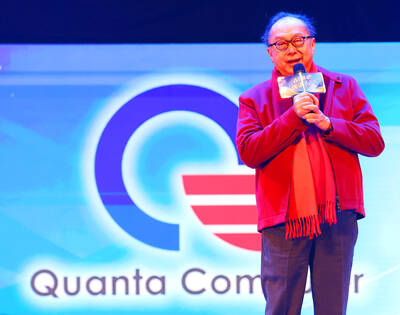
Quanta Computer Inc (廣達) chairman Barry Lam (林百里) is expected to share his views about the artificial intelligence (AI) industry’s prospects during his speech at the company’s 37th anniversary ceremony, as AI servers have become a new growth engine for the equipment manufacturing service provider. Lam’s speech is much anticipated, as Quanta has risen as one of the world’s major AI server suppliers. The company reported a 30 percent year-on-year growth in consolidated revenue to NT$1.41 trillion (US$43.35 billion) last year, thanks to fast-growing demand for servers, especially those with AI capabilities. The company told investors in November last year that

Intel Corp has named Tasha Chuang (莊蓓瑜) to lead Intel Taiwan in a bid to reinforce relations between the company and its Taiwanese partners. The appointment of Chuang as general manager for Intel Taiwan takes effect on Thursday, the firm said in a statement yesterday. Chuang is to lead her team in Taiwan to pursue product development and sales growth in an effort to reinforce the company’s ties with its partners and clients, Intel said. Chuang was previously in charge of managing Intel’s ties with leading Taiwanese PC brand Asustek Computer Inc (華碩), which included helping Asustek strengthen its global businesses, the company
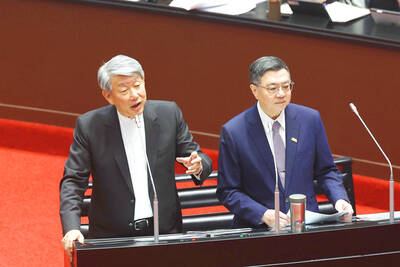
Taiwanese suppliers to Taiwan Semiconductor Manufacturing Co. (TSMC, 台積電) are expected to follow the contract chipmaker’s step to invest in the US, but their relocation may be seven to eight years away, Minister of Economic Affairs J.W. Kuo (郭智輝) said yesterday. When asked by opposition Chinese Nationalist Party (KMT) Legislator Niu Hsu-ting (牛煦庭) in the legislature about growing concerns that TSMC’s huge investments in the US will prompt its suppliers to follow suit, Kuo said based on the chipmaker’s current limited production volume, it is unlikely to lead its supply chain to go there for now. “Unless TSMC completes its planned six

Power supply and electronic components maker Delta Electronics Inc (台達電) yesterday said it plans to ship its new 1 megawatt charging systems for electric trucks and buses in the first half of next year at the earliest. The new charging piles, which deliver up to 1 megawatt of charging power, are designed for heavy-duty electric vehicles, and support a maximum current of 1,500 amperes and output of 1,250 volts, Delta said in a news release. “If everything goes smoothly, we could begin shipping those new charging systems as early as in the first half of next year,” a company official said. The new


 RSS
RSS