


James Murdoch, chairman of the Hong Kong-based Star Group Ltd, yesterday renewed his company's commitment to roll out a digital cable network, amidst concerns over delays.
"The soft launch began this month ? of Asia's first truly interactive digital cable service, using high-end set-top boxes with many more capabilities than deployed in other markets around Asia," he said.
The new service is managed by Star's local partner, China Network Systems (中嘉網路), of which Taiwan's Koos Group (和信集團) holds a 80 percent stake, while Star Group owns the remaining 20 percent. The US$240 million venture is part of Star Group's plan to take a share from Taiwan's digital TV market.
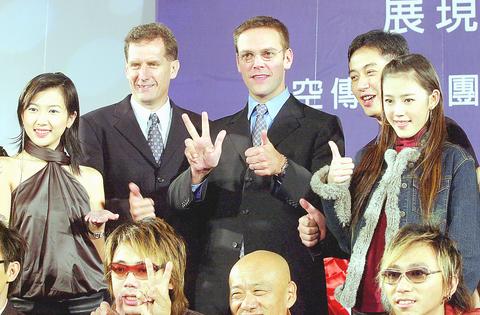
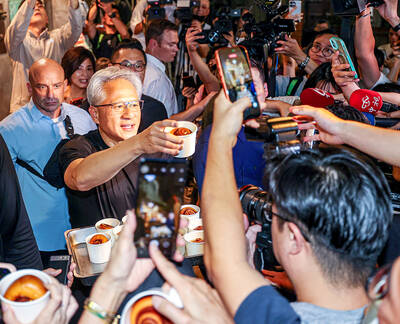
PHOTO: CHEN CHENG-CHANG, TAIPEI TIMES
"We are here to make great entertainment and to create a strong bond with local viewers. We have made long-term investments in cable systems to help transform the existing infrastructure into a digital world-class distribution network," he stressed yesterday.
Murdoch made the comments during a ceremony to announce the formal Chinese name-change of the company from Star Group (衛星電視) to Star Group (星空傳媒集團). Yesterday marked the group's 10-year anniversary in Taiwan.
Star Group, with a 7-percent share of the viewing market in Taiwan, currently owns eight channels that broadcast both Mandarin and English movies, sports, music, entertainment and documentary programs.
The soft launch of Taiwan's first digital cable service is being tested in Taipei's Chungho and Yungho districts, said China Network's Public Relations Manager Judy Chiang (蔣惠亭).
Starting from Nov. 6, 80,000 subscribers to New Visual Wave (新視波), a cable-service provider in Chungho and Yungho, can subscribe a digital set-top box with a deposit of NT$1,500 to view around 100 digital channels, including five new channels provided by China Network.
Digital cable networks can carry phone calls, data and video and they far outstrip the capacity available via analog cable networks.
The upgraded cable system and set-top boxes will allow viewers to view programming on Star's pay television stations and will offer a range of functions such as parental control, a Chinese-language electronic program guide, access to interactive premium channels and e-commerce services. Star, a wholly owned subsidiary of global media giant News Corp, operates 30 distributed services in seven languages to 53 Asian countries.
"Our next step is to offer [paid] premium-movie and erotica channels," she said. However, the plan can't move forward due to government regulations that forbid firms from charging for TV programs, she added.
Originally scheduled to launch in early 2002, Star Group's digital cable service has been delayed twice due to various problems and was only fired up officially last Wednesday.
Chiang explained that the delays were caused by central and local government licensing red tape. "The change from analogue to digital requires the refiling of proposals and approval from both the GIO and local governments," Chiang said.
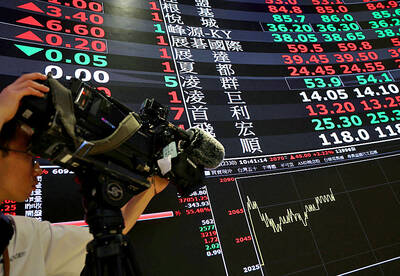
After several years flying high as Asia’s best Nvidia Corp proxy, Taiwan Semiconductor Manufacturing Co (TSMC, 台積電) is increasingly vying with other artificial intelligence (AI) stocks for investor attention. Stock traders are chasing a wider array of beneficiaries as mainstream usage of AI creates demand for hardware beyond the most-advanced chips TSMC makes for Nvidia. Subthemes from the deepening memory crunch to advances in robotics are also luring bids. At the same time, investment caps on single stocks are pushing funds to diversify, while retail investors long familiar with TSMC through its US depositary receipts are being offered a broader set of
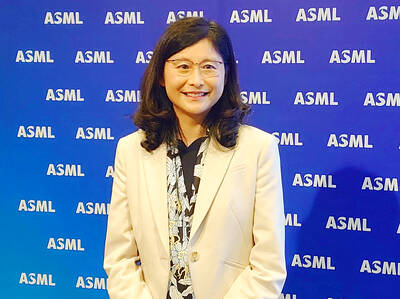
Netherlands-based semiconductor equipment supplier ASML Holding NV yesterday said that it is planning to hire an additional 1,000 people in Taiwan this year in response to growing demand from clients. ASML had previously planned to recruit 600 people this year, but that the plan has been adjusted upward, ASML vice president and ASML Taiwan general manager Grace Wang (汪佳慧) told reporters. ASML has a workforce of more than 4,500 in Taiwan, accounting for about 10 percent of its global total, Wang said. This year’s recruitment campaign would focus on adding people in the customer support, manufacturing and supply chain domains to assist ASML
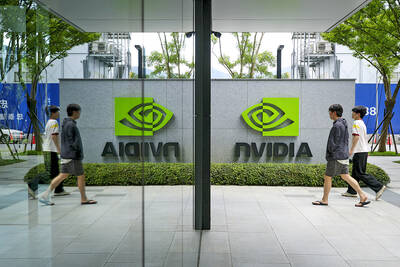
UNDER MICROSCOPE: Taiwan detained three people who allegedly conspired to buy servers in Taiwan and export them using fraudulent documentation, prosecutors said Nvidia Corp chief executive officer Jensen Huang (黃仁勳) on Saturday urged Super Micro Computer Inc to tighten up on compliance after Taiwan detained three people this week for allegedly making fraudulent declarations about artificial intelligence (AI) servers made by its US partner. The development marked the nation’s first crackdown on semiconductor smuggling, which grew after the US slapped restrictions on exports of high-end chips such as Nvidia AI accelerators to China. Nvidia is “rigorous” in explaining regulations to all of its partners, Huang told reporters after arriving in Taipei. “Ultimately Super Micro has to run their own company,” he said in response to
Nvidia Corp yesterday announced that CEO Jensen Huang (黃仁勳) would attend an employee meeting in Taipei tomorrow to celebrate the launch of the company’s Taiwan headquarters project. Huang would attend a gathering at the site of Nvidia’s planned headquarters in Beitou Shilin Technology Park (北投士林科技園區), the company said in a statement. After arriving in Taiwan on Saturday last week, Huang told reporters that he plans to meet with Quanta Computer Inc (廣達) chairman Barry Lam (林百里) and Taiwan Semiconductor Manufacturing Co (TSMC, 台積電) chairman C.C. Wei (魏哲家), and would attend the groundbreaking ceremony for Nvidia’s Taiwan headquarters tomorrow. Nvidia has not yet applied


 RSS
RSS