


The US' Federal Communications Commission blocked the merger of the nation's two largest satellite television broadcasters on Thursday, the first time in 36 years that the agency has challenged a large corporate deal for being anti-competitive and against the public interest.
Executives at the satellite companies, EchoStar Communications and the DirecTV unit of General Motors' Hughes Electronics, said that they remained committed to a deal and would soon propose substantial revisions to satisfy the regulators. But in a sign of the regulatory skepticism about even a revised deal, the FCC issued its 4-0 ruling after refusing the last-ditch entreaties of the companies to delay the vote until the new proposal was formally made.
Government officials said the companies now had high hurdles to overcome to engineer a deal that would be financially attractive to them and in the best interests of consumers. Moreover, either company can walk away from the transaction if it is not approved and completed by Jan. 21, a date that is almost certain to arrive before the FCC completes consideration of any revised deal.
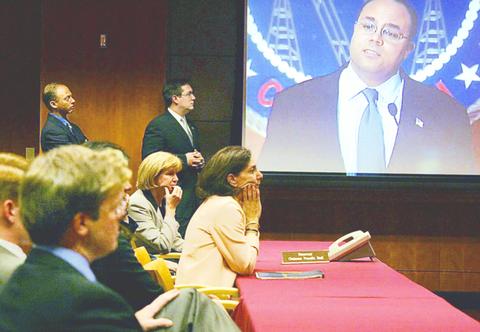
PHOTO: NY TIMES
Rupert Murdoch's News Corp, which lost to EchoStar last year in a bidding war for Hughes Electronics and DirecTV, is expected to make another run at DirecTV, if the EchoStar deal eventually dies. When EchoStar agreed to acquire Hughes last October, the deal was valued at about US$26 billion, but as the companies' share prices have declined, the value has fallen to about US$18 billion.
Thursday's decision represents a rare instance in which officials appointed by the Bush administration have tried to stop a corporate deal, and an even rarer instance in which a deal was blocked by the FCC. Officials said the agency had not voted to stop a major merger since it intervened in the proposed deal between the ABC broadcasting company and ITT, the former telecommunications giant, in 1966.
While the Clinton administration approved more than 90 percent of the deals it reviewed, it challenged or forced the restructuring of some big ones. Among the proposed mergers or joint ventures that were abandoned in the face of challenges by Clinton officials were Lockheed Martin-Northrop Grumman, WorldCom-Sprint, and Northwest-Continental. Bush administration officials have not reviewed the same number of major deals in their nearly two years in office, but have generally been more predisposed to approving them.
Staff officials at the Justice Department are said to oppose the original terms of the EchoStar deal as anti-competitive. But Charles A. James, the head of the antitrust division at the Justice Department, who has announced he will be leaving government soon, has not declared whether the deal can be rescued by a restructuring.
Comcast acquisition
James, however, was described Thursday as being close to approving another huge telecommunications deal, the proposed acquisition by Comcast of AT&T, lawyers involved in that review said. That merger would create a cable television behemoth with more than 22 million subscribers.
Officials at the FCC are expected to also approve the cable television transaction soon, having already concluded that it does not pose the same anti-competitive concerns as a DirecTV-EchoStar merger -- in large part because AT&T and Comcast serve different geographic markets. EchoStar and DirecTV compete for customers nationwide.
FCC officials said the proposed satellite deal, which would create a company with more than 18 million subscribers, offered no concrete benefits to consumers but threatened to reduce competition sharply.
The companies, meanwhile, had argued that the merger was the only way to compete with their cable television rivals and also amass enough satellite channels to be able to retransmit local broadcast stations.
They had proposed such steps as a new national pricing plan, to make sure that subscribers in rural areas and other places not served by cable would pay no more than customers in areas where cable competition kept prices moderate. But that proposal was rejected as a flawed effort to get the government back into the regulation of pay television, a market that officials have tried to deregulate.
"The combination of EchoStar and DirecTV would have us replace a vibrant competitive market with a regulated monopoly," said Michael K. Powell, chairman of the FCC. "This flies in the face of three decades of communications policy that has sought ways to eliminate the need for regulation by fostering greater competition."
"At best, this merger would create a duopoly in areas served by cable; at worst it would create a merger to monopoly in unserved areas," Powell said. "Either result would decrease incentives to reduce prices, increase the risk of collusion, and inevitably result in less innovation and fewer benefits to consumers. That is the antithesis of what the public interest demands."
Never say die
Executives at EchoStar, known to consumers through its Dish Network, and Hughes Electronics said Thursday they remained committed to a deal.
"We will continue to work aggressively within the context of this FCC process to achieve approval of the merger," the companies said in a brief statement.
But that process is certain to last many months. By law, Echostar and Hughes Electronics now have the burden of proving to an administrative law judge that a merger is in the public interest. If they lost that round, the companies could appeal to the FCC commissioners. The next recourse would then be to take their case to the federal appeals court here.
Thursday's decision was a big win for the News Corp and Murdoch. After losing out to EchoStar last year, he assembled a formidable lobbying force against the deal, lobbying federal and state officials and helping to organize opposition among grassroots organizations.
It was a stunning setback for the architects of the proposed deal, most notably Charles W. Ergen, EchoStar's chairman. Under the terms of the deal, EchoStar will have to pay Hughes a US$600 million termination fee if the deal is not approved by Jan. 21 and the deadline is not extended.
The decision was also a blow to two prominent law firms, Weil, Gotshal & Manges and Boies, Schiller & Flexner. Partners at those firms had advised the companies that the deal stood a likely chance of being approved by telecommunications and antitrust regulators.
The lawyers had argued that the deal should be approved because it was the only way to compete effectively against increasingly large cable television companies, which control about 80 percent of the subscription-TV market. They also said that the merger would enable the combined satellite company to be better able to carry local television stations, the way cable companies do.
But every one of their claims was rejected Thursday by the officials at the FCC.
"In short, the very premises upon which this proposed merger rest are themselves without foundation," Powell said.
Kenneth Ferree, a top staff official who reviewed the transaction, said that consumer losses from the proposed combination "would have been staggering."
He declined to disclose a precise figure, saying the government analysis was based on confidential information provided by the companies.

The domestic unit of the Chinese-owned, Dutch-headquartered chipmaker Nexperia BV will soon be able to produce semiconductors locally within China, according to two company sources. Nexperia is at the center of a global tug-of-war over critical semiconductor technology, with a Dutch court in February ordering a probe into alleged mismanagement at the company. The geopolitical tussle has disrupted supply chains, with some carmakers reportedly forced to cut production due to chip shortages. Local production would allow Nexperia’s domestic arm, Nexperia Semiconductors (China) Ltd (安世半導體中國), to bypass restrictions in place since October on the supply of silicon wafers — etched with tiny components to

Singapore-based ride-hailing and delivery giant Grab Holdings Ltd has applied for regulatory approval to acquire the Taiwan operations of Germany-based Delivery Hero SE's Foodpanda in a deal valued at about US$600 million. Grab submitted the filing to the Fair Trade Commission on Friday last week, with the transaction subject to regulatory review and approval, the company said in a statement yesterday. Its independent governance structure would help foster a healthy and competitive market in Taiwan if the deal is approved, Grab said. Grab, which is listed on the NASDAQ, said in the filing that US-based Uber Technologies Inc holds about 13 percent of

Taiwan is open to joining a global liquefied natural gas (LNG) program if one is created, but on the condition that countries provide delivery even in a scenario where there is a conflict with China, an energy department official said yesterday. While Taiwan’s priority is to have enough LNG at home, the nation is open to exploring potential strategic reserves in other countries such as Japan or South Korea, Energy Administration Deputy Director-General Chen Chung-hsien (陳崇憲) said. While the LNG market does not have a global reserve for emergencies like that of oil, the concept has been raised a few times —

Taiwan Semiconductor Manufacturing Co (TSMC, 台積電) yesterday received government approval to deploy its advanced 3-nanometer (3nm) process at its second fab currently under construction in Japan, the Ministry of Economic Affairs said in a news release. The ministry green-lit the plan for the facility in Kumamoto, which is scheduled to start installing equipment and come online in 2028 with a monthly production capacity of 15,000 12-inch wafers, the ministry said. The Department of Investment Review in June 2024 authorized a US$5.26 billion investment for the facility, slated to manufacture 6- to 12nm chips, significantly less advanced than 3nm process. At a meeting with


 RSS
RSS