


Here's the proposition: The record industry wants you to buy music on a new kind of disc. Unlike a CD, the format will greatly restrict your ability to make digital copies. It will cost more than a prerecorded CD. And it will require you to invest a few hundred dollars in a new player.
If the appeal isn't immediately apparent, you have some idea of the salesmanship task ahead.
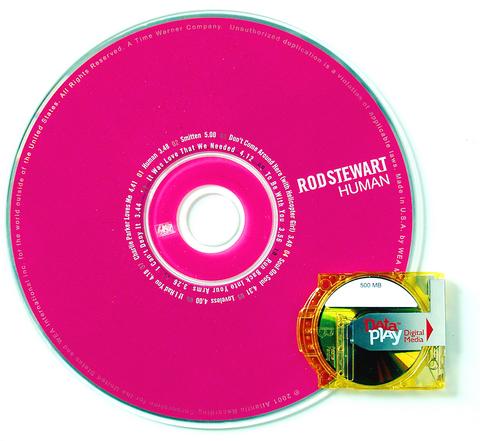
PHOTO: NY TIMES
The newly released portable music format, called DataPlay digital media, is the latest technology joining a cornucopia of choices for consumers to play their favorite tunes through headphones connected to palm-size devices. The discs, contained in a clear plastic shell, are about the size of the ring in the center of a CD, or about one-fourth the size of a minidisc. They will be available in blank, recordable form as well as prerecorded, copy-protected albums.
Because of that last feature, DataPlay is being embraced by major record labels. So far BMG, Universal Music and EMI Group have signed on, say officials for DataPlay of Boulder, Colorado, which developed the technology.
The first DataPlay music player-recorders went on sale recently, and waves of prerecorded DataPlay discs will soon wash into record stores, starting with re-releases of top-selling albums by the likes of Britney Spears, 'N Sync, Pink, Usher, OutKast, Sarah McLachlan and Brooks & Dunn, BMG record executives say. Some musicians, including Carlos Santana, are scheduled to have new albums released simultaneously on CD and DataPlay.
Ads for DataPlay blank discs started showing up this month with a tag line reading, "This thing is huge." But for the millions of music enthusiasts who have mounted the MP3 revolution, downloading music or copying it from CDs onto hard drives and then to portable players, what's the motivation to switch?
The selling points borrow a page from the DVD playbook, the success story of the video marketplace. The prerecorded versions will also incorporate features like digital photo galleries and music videos that can be viewed when the player is connected to a PC, and even interviews, extended liner notes and music-related games. Future players may well include color LCD screens to play music videos.
In addition, the DataPlay disc is far more compact than a compact disc while offering comparable sound quality. And the players can record music or data -- yes, even MP3 files -- from a hard drive onto blank discs that are easy to carry or swap.
"We're excited," said Aahmek Richards, who is in charge of new media for Arista Records, which is part of BMG. "Technology should allow the business to change and grow in so many ways it never had an opportunity to do."
Indeed. But DataPlay technology raises as many questions as it does expectations among its makers and early supporters. Chief among them, consumer electronics analysts say, is whether the arrival of DataPlay comes too late and offers too little to significantly attract music consumers, especially those of college age.
Todd Oseth, vice president for marketing and business development at DataPlay, said that while the format promised greater content security than CD's, it also offered more flexibility and convenience to reflect listeners' emerging habits, accommodating prerecorded, downloaded or copied music. Ultimately, he suggested, record company support and the marketplace will decide its success.
"Money is what ends up driving everything," he said.
DataPlay, a privately held company, was founded in 1998 by Steve Volk, the company's chairman, president and chief executive.
Initially, Volk's interest in developing smaller optical discs and micro drivers was to use them as storage media in digital cameras. But in time, a DataPlay spokeswoman said, Volk realized that the tiny, digitally secure discs and drivers were a natural fit for the music industry, which was searching for new ways to protect and distribute recorded music.
Attempts to retrofit CDs to discourage copying and pirating have proved problematic. For example, Arista has copy-protected some of its music CDs only to discover that they will not play in many car- and computer-based CD players.
So enters DataPlay, its content encrypted like Pentagon secrets, casting the long shadows of some of the biggest record companies in the world.
Kevin Clement, senior director of new media operations for BMG, said of DataPlay, said, "Our goal is to continue to release top titles," noting that he has been impressed with DataPlay's "versatility and incredibly small size."
Fringe benefits
BMG will not only be able to add photos and music videos to the discs, he said, but also encrypt extra songs, even entire previously released albums, to which consumers could get access after they paid online for a special content key.
"I don't think the CD is going away anytime soon," he said. "There's too much hardware in the marketplace, but clearly we love to see people enjoy the extra content we can put on a DataPlay disc."
Richards, who is also director of online marketing for Arista Records, said DataPlay is part of a much larger strategy to recapture consumers who are comfortable getting their music and music information online.
Under Richards' direction, Arista is starting a number of subscription-based fan Web sites at US$25 a year. The first features Boyz II Men and offers exclusive material, which could include live concert footage, interviews and pictures, all ideally suited for downloading and playback on DataPlay.
"The real fans will appreciate a site that is dedicated just to them, and they don't mind paying for it," Richards said, adding that DataPlay can open new vistas for the recording industry.
"All of this kind of plays in together. It's going to work. I believe in it."
But overall costs of DataPlay players and media may present an early stumbling block to widespread acceptance, some consumer electronics retailers warn. Prerecorded DataPlay discs will basically be priced more like a DVD than a CD, from US$18 to US$22, Richards said. (Some new releases, however, will be priced comparably to CDs: the new Carlos Santana album, Shaman, will list for US$18 on CD and US$19 on DataPlay, he said.)
For consumers who want to make their own, the price of the raw material for CD burning -- CD-R discs -- has dropped to only pennies a disc when the discs are bought in bulk. DataPlay discs, which have 500 megabytes of storage capacity, or 150 megabytes less than 74-minute CD-R discs, cost US$5 apiece if bought in packages of 10.
And the first DataPlay music player and burner, the iDP-100 by iRiver America, is relatively expensive at US$350; MP3 players with 20GB of memory, or 40 times the capacity of a DataPlay disc, are available for as little as US$300.

Cairo’s new monorail slices across the city skyline, running above the familiar chaos of blaring horns and aging buses’ exhaust fumes that mark rush hour below. The US$4.5 billion monorail, opened this month, is among Egypt’s most prominent new transport projects, part of a debt-funded infrastructure drive criticized for sapping state finances while bringing limited benefits to most of the country’s 109 million people. “It feels like you’re in a different country,” said Ramy Sayed, a restaurant manager, aboard a driverless Innovia 300 train. “No noise, no traffic, we’re not used to this.” The eastern line runs 56km from the bustling middle-class

Taiwanese firms have increased investment in the Philippines in recent years as Manila’s ties with Washington deepen and global supply chains continue to shift away from China, an expert at the Chung-Hua Institution for Economic Research (CIER, 中華經濟研究院) said yesterday. The Philippines had not been among Taiwanese investors’ top choices in Southeast Asia, CIER Taiwan ASEAN Studies Center director Kristy Hsu (徐遵慈) said at a seminar in Taipei. However, Taiwan’s investment in the country has grown significantly since the COVID-19 pandemic, reaching US $257 million last year, a high in recent years, she said. Although Taiwan’s total investment in the Philippines still lags

Intel Corp regards Taiwan Semiconductor Manufacturing Co (TSMC, 台積電) as a longstanding partner, as the US chipmaker would continue outsourcing production of advanced chips to TSMC, Intel chief executive officer Lip-Bu Tan (陳立武) said yesterday. “I don’t look at people as competitors. I look at the collaboration... Nvidia is also, you know, a good friend,” Tan told a news conference following his keynote speech at the Computex trade show in Taipei. “It’s a very trusted partnership for us... We are a big, top customer for them, and we’re going to continue doing that,” he said, referring to TSMC, the world’s largest foundry

Artificial intelligence (AI) agents would supplant smartphones as the center of people’s digital lives, fundamentally reshaping personal devices and driving a major computing upgrade cycle, Qualcomm Inc CEO Cristiano Amon said yesterday. In his keynote speech for this year’s Computex trade show in Taipei, Amon said that the rise of "agentic AI" — AI systems capable of reasoning, planning and carrying out tasks autonomously — would transform how people interact with technology across phones, PCs, vehicles and wearable devices. Describing the technology as the next major evolution in computing, Amon said that "2026 is the year of agents.” For decades, smartphones have sat


 RSS
RSS