


Maybe fans of the Chevrolet Camaro and Pontiac Firebird would feel better if General Motors were ending production to free up their factory for a hot-selling car, or even a sport utility vehicle.
Not so. Instead, the automaker will shut down its plant in Ste. Therese, Quebec, after the last of the two-door, rear-drive cars rolls off the assembly line on Aug. 28. There will be no 2003 models of the Camaro or Firebird, which have been the cornerstone of GM's performance heritage for 35 years.
The latest versions of the cars are widely acknowledged as the most refined and best-balanced models yet. Even so, GM says the cars are not selling well enough to justify their continued existence. After combined sales of the two cars peaked at nearly a half million in 1979, they have fallen steadily since the mid-1990s, to 66,466 last year, a sure sign that the end was near appeared at Chevrolet dealerships last year: Camaro outsold the far more costly Corvette by fewer than 2,000 units.
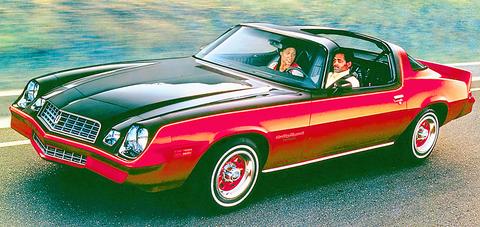
PHOTO: NY TIMES
The current generation is 10 years old -- past due for a costly redesign.
It is not that customers are no longer enticed by personal coupes with the long-hood, short-deck "pony car" look introduced by the Ford Mustang during the Johnson administration. Ford, after all, sold 170,000 Mustangs last year.
But if anything has doomed the F-bodies (the platform designation by which they are known), it is GM's dogged adherence to the cars' heritage. Their steeply raked windshields and low seats gave them a track-ready look but made them awkward to use (though they are comfortable enough once you're inside). The driver can't be sure where the nose ends until the paint has been nicked. With a deep dashboard and a wheelbase that has been shortened 18cm through the years even as the overall length grew by 23cm, there is a lot of overhang.
The Mustang, by contrast, has remained a more practical choice, with a larger back seat, easier entry and better visibility from the driver's seat -- though perhaps compromising its road prowess in the process.
Moreover, this sort of large, sporty two-plus-two configuration has become "increasingly irrelevant" said Jim Hall, an industry analyst at AutoPacific in Southfield, Michigan.
"Today's young buyers are focused on themselves and their pals," he said. "Cars that only carry two people in comfort aren't even on their radar screens."
The Camaro and Firebird have held true to their heritage to the end. The final models have all the curves, scoops and spoilers expected by shoppers in this class, making them voluptuous alternatives to the chiseled-and-creased Mustang. The top-of-the-line 35th Anniversary editions are handsomely turned out, even if their stripes, badges and blinding colors leave little to the imagination. There are still credible performance models: Both the Camaro and Firebird offer 5.7-liter V8 engines of up to 325HP, which rocket the cars to 97kph in just over 5 seconds.
In that respect, the last year of the Camaro and Firebird recalls their first, 1967. Driving a 2002 Camaro SS back to back with the 1967 SS 350 that has been in my family for more than 20 years, it is reassuring to find the V8 rumble intact and the urgent response to the throttle still very much present. The steering of this year's model is, naturally, far more exact and quicker to initiate change; likewise, the cornering of the outgoing Camaro is far flatter and displays higher limits than the earlier car does.
Still, over the years the car has become much better to drive with a meaty, weighted feel to the controls -- in contrast to the limp steering of my own 1967. As for the brakes, there's no comparison. I'd love to have the new car's superbly progressive 21st century discs on my vintage SS.
Other nameplates that went out of production -- like the Ford Thunderbird and Pontiac GTO -- have been resurrected in recent years. Camaro and Firebird enthusiasts with long memories can only hope the same thing can happen here.

The domestic unit of the Chinese-owned, Dutch-headquartered chipmaker Nexperia BV will soon be able to produce semiconductors locally within China, according to two company sources. Nexperia is at the center of a global tug-of-war over critical semiconductor technology, with a Dutch court in February ordering a probe into alleged mismanagement at the company. The geopolitical tussle has disrupted supply chains, with some carmakers reportedly forced to cut production due to chip shortages. Local production would allow Nexperia’s domestic arm, Nexperia Semiconductors (China) Ltd (安世半導體中國), to bypass restrictions in place since October on the supply of silicon wafers — etched with tiny components to

Singapore-based ride-hailing and delivery giant Grab Holdings Ltd has applied for regulatory approval to acquire the Taiwan operations of Germany-based Delivery Hero SE's Foodpanda in a deal valued at about US$600 million. Grab submitted the filing to the Fair Trade Commission on Friday last week, with the transaction subject to regulatory review and approval, the company said in a statement yesterday. Its independent governance structure would help foster a healthy and competitive market in Taiwan if the deal is approved, Grab said. Grab, which is listed on the NASDAQ, said in the filing that US-based Uber Technologies Inc holds about 13 percent of

Taiwan Semiconductor Manufacturing Co (TSMC, 台積電) yesterday received government approval to deploy its advanced 3-nanometer (3nm) process at its second fab currently under construction in Japan, the Ministry of Economic Affairs said in a news release. The ministry green-lit the plan for the facility in Kumamoto, which is scheduled to start installing equipment and come online in 2028 with a monthly production capacity of 15,000 12-inch wafers, the ministry said. The Department of Investment Review in June 2024 authorized a US$5.26 billion investment for the facility, slated to manufacture 6- to 12nm chips, significantly less advanced than 3nm process. At a meeting with

Taiwan’s food delivery market could undergo a major shift if Singapore-based Grab Holdings Ltd completes its planned acquisition of Delivery Hero SE’s Foodpanda business in Taiwan, industry experts said. Grab on Monday last week announced it would acquire Foodpanda’s Taiwan operations for US$600 million. The deal is expected to be finalized in the second half of this year, with Grab aiming to complete user migration to its platform by the first half of next year. A duopoly between Uber Eats and Foodpanda dominates Taiwan’s delivery market, a structure that has remained intact since the Fair Trade Commission (FTC) blocked Uber Technologies Inc’s


 RSS
RSS