


A Japanese laboratory has built the world's fastest computer, a machine so powerful that it matches the raw processing power of the 20 fastest American computers combined and far outstrips the previous leader, an IBM-built machine.
The achievement, which was reported Friday by an American scientist who tracks the performance of the world's most powerful computers, is evidence that a technology race US engineers have generally thought they were winning handily is far from over. American companies have built the fastest computers for most of the past decade.
The accomplishment is also a dramatic statement of contrasting scientific and technology priorities in the US and Japan. The Japanese machine was built to analyze climate change, including global warming, as well as weather and earthquake patterns. By contrast, the US has predominantly focused its efforts on building powerful computers for simulating weapons, while its efforts in scientific areas such as climate modeling have lagged.
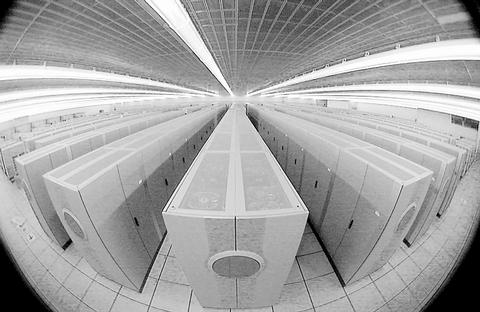
PHOTO: NY TIMES
For some American computer scientists, the arrival of this Japanese supercomputer is an event that evokes the type of alarm raised by the Russian Sputnik satellite in 1957.
"In some sense we have a Computenik on our hands," said Jack Dongarra, a University of Tennessee computer scientist who has for many years maintained an authoritative list of the world's 500 fastest computers.
Several US computer scientists said the Japanese machine is evidence of differences in style and commitment that suggest US research and spending efforts have grown complacent in recent years. For now, the new computer will be used only for climate research, and American scientists have already begun preparing to move some of their simulation research to run on the Japanese machine.
"The Japanese clearly have a level of will that we haven't achieved," said Thomas Sterling, a leading supercomputer designer at the California Institute of Technology. "These guys are blowing us out of the water, and we need to sit up and take notice."
The new Japanese supercomputer will have both scientific and practical applications. It will be used for advanced modeling of theories about global warming and climate change, but it will also be able to predict short-term weather patterns.
Dramatic advances in computer speed today routinely extend computer simulation into new areas of science and engineering as complex calculations take an increasingly shorter time. Because increases in computing power tend to have exponential results, a problem that could take years for even the fastest computers today might be finished in hours on the new computer.
The ability to track the path of a typhoon, for example, is of immediate relevance to the island nation of Japan. Improved prediction made possible by a more powerful computer could potentially saves lives and property.
Computer simulation has become a standard tool in both science and modern design of products ranging from drugs to bicycles. Computers that are more powerful make possible simulations that are more accurate and that can have an impact on cost and efficiency. At one time, for example, computers were capable of computing the flow of air over a single airplane wing, but not an entire airplane.
Five-year development period
The new Japanese supercomputer was financed by the Japanese government and has been installed at the Earth Simulator Research and Development Center in Yokohama, Japan. The Japanese government has spent between US$350 million and US$400 million developing the system during the past five years, according to Dr. Akira Sekino, president and chief executive of HNSX Supercomputers, an NEC Corp subsidiary based in Littleton, Colorado.
The new computer was formally dedicated last month, and the Japan Marine Science and Technology Center said Friday that the machine had reached more than 87 percent of its theoretical peak speed.
"This is a huge achievement for the Japanese," said Sekino.
NEC sells a scaled-down version of its earth simulator supercomputer commercially. Although several US universities and government agencies have attempted to buy the machines during the past decade, sales have been thwarted by resistance from the Commerce Department and members of Congress, who complained that NEC was "dumping" the machines, or selling them below cost. Last year Cray Inc, a US maker of supercomputers, entered into a marketing agreement to sell the machines in the US, but no sales have been announced to date.
The NEC supercomputers are built based on a design known as "vector processing," a way of using specialized hardware to solve complex calculations that was pioneered by the late American supercomputer designer Seymour Cray, but which has generally fallen out of favor in the US in recent years.
Assembled from 640 specialized "nodes" which are in turn composed of 5,104 processors made by NEC, the computer occupies the space of four tennis courts and has achieved a computing speed of 35.6 trillion mathematical operations per second. The processors are linked together in a way that allows extremely efficient operation compared with the previously fastest "massively parallel" computers, which are based on off-the-shelf chips.
Virtual earth
The Earth Simulator Project is intended to create a "virtual earth" on an NEC supercomputer to show what the world will look like under various climate conditions in the future by means of advanced numerical simulation.
The system is intended to serve as a research platform for international teams of researchers, and US scientists are now planning to participate in new projects made possible by the more powerful computer.
By comparison, the fastest American supercomputer, which until now held the world computing speed record, is the ASCI White Pacific computer at Lawrence Livermore National Laboratory. Based on IBM processors, it has achieved a top speed of 7 trillion math operations per second.
Faster machines are now being designed at government financed labs in Los Alamos, New Mexico; Pittsburgh, Pennsylvania; and Livermore, California, but they are still far from being operational.
The Japanese supercomputer dramatically underscores an ongoing debate within the computer design community. One camp has argued for building "massively parallel" supercomputers by chaining together thousands of off-the-shelf microprocessors.
That philosophy has come to dominate designs in the US in recent years. A second camp has pushed for computers made from specialized processors dedicated to solving a particular class of problem.
The vector processors used in the Japanese machine are an example of the second approach, and they have long been used with great success for scientific problems ranging from weather prediction to bomb design.
Scientists from the National Center for Atmospheric Research in Boulder, Colorado, said they were now planning to work with the Japanese Earth Simulation Center to convert US weather modeling codes to work with the new computer.
"It's potentially quite significant for climate studies," said Dr. Tim Kalleen, a space scientist who is director of the American climate research center.
He said his researchers were now in discussion with their Japanese counterparts about the technical details needed to make sure the advanced American programs would run on the Japanese machine.

The domestic unit of the Chinese-owned, Dutch-headquartered chipmaker Nexperia BV will soon be able to produce semiconductors locally within China, according to two company sources. Nexperia is at the center of a global tug-of-war over critical semiconductor technology, with a Dutch court in February ordering a probe into alleged mismanagement at the company. The geopolitical tussle has disrupted supply chains, with some carmakers reportedly forced to cut production due to chip shortages. Local production would allow Nexperia’s domestic arm, Nexperia Semiconductors (China) Ltd (安世半導體中國), to bypass restrictions in place since October on the supply of silicon wafers — etched with tiny components to

Singapore-based ride-hailing and delivery giant Grab Holdings Ltd has applied for regulatory approval to acquire the Taiwan operations of Germany-based Delivery Hero SE's Foodpanda in a deal valued at about US$600 million. Grab submitted the filing to the Fair Trade Commission on Friday last week, with the transaction subject to regulatory review and approval, the company said in a statement yesterday. Its independent governance structure would help foster a healthy and competitive market in Taiwan if the deal is approved, Grab said. Grab, which is listed on the NASDAQ, said in the filing that US-based Uber Technologies Inc holds about 13 percent of

Taiwan Semiconductor Manufacturing Co (TSMC, 台積電) yesterday received government approval to deploy its advanced 3-nanometer (3nm) process at its second fab currently under construction in Japan, the Ministry of Economic Affairs said in a news release. The ministry green-lit the plan for the facility in Kumamoto, which is scheduled to start installing equipment and come online in 2028 with a monthly production capacity of 15,000 12-inch wafers, the ministry said. The Department of Investment Review in June 2024 authorized a US$5.26 billion investment for the facility, slated to manufacture 6- to 12nm chips, significantly less advanced than 3nm process. At a meeting with
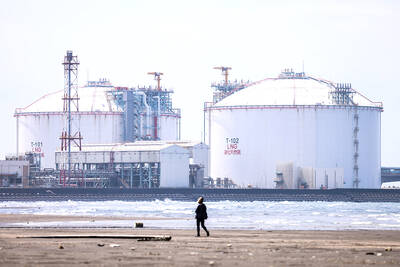
Taiwan is open to joining a global liquefied natural gas (LNG) program if one is created, but on the condition that countries provide delivery even in a scenario where there is a conflict with China, an energy department official said yesterday. While Taiwan’s priority is to have enough LNG at home, the nation is open to exploring potential strategic reserves in other countries such as Japan or South Korea, Energy Administration Deputy Director-General Chen Chung-hsien (陳崇憲) said. While the LNG market does not have a global reserve for emergencies like that of oil, the concept has been raised a few times —


 RSS
RSS