


Credit Suisse First Boston is planning another round of layoffs at its investment banking group, executives at the firm said Friday.
The new head of the investment banking group, Adebayo Ogunlesi, announced his intention to begin a new round of job cuts, focusing on senior executive positions, during a meeting earlier this week with the firm's staff, the executives said.
Ogunlesi, who was appointed to run the investment banking group last week, told an auditorium of 300 employees that Credit Suisse First Boston had 25 percent to 50 percent more senior managers than comparable firms on Wall Street and that cuts would be "swift and severe," the executives said.
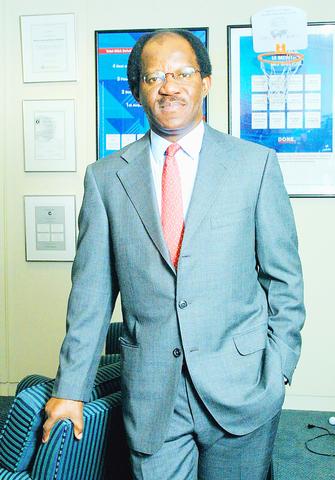
PHOTO: NY TIMES
"We're going to break a lot of glass," Ogunlesi said at the meeting, his first address to the firm's staff since taking the job.
While Ogunlesi has not made a final decision on how deep the cuts will be, the executives said, he has begun meeting with department heads to consider the scope of the cuts and to start assembling a list of candidates to be laid off.
While the senior management ranks are particularly large at Credit Suisse First Boston, the planned cuts come amid a major slowdown on Wall Street that has forced several leading firms, including Goldman Sachs, to consider scaling back their businesses. With scant merger and acquisition activity and a reluctant stock and bond market so far this year, investment banks are beginning to feel a pinch that may be much more painful than some of the cuts last fall.
John Mack, the chief executive of Credit Suisse First Boston, has made Ogunlesi's first priority reconfiguring the investment bank's cost structure so that it is more competitive with other Wall Street firms, the executives said.
In a memorandum to employees sent on Feb. 22, Hamilton James, the investment banking group's new chairman, wrote: "The ebullient 1990s are over, and the next five years could well be a period of modest growth and vigorous competition. To prosper in this new environment, we need to change the way we do business in some fundamental ways. Our focus must be on profitability, not market share."
Ogunlesi scolded bankers during the meeting for not paying enough attention to turning a profit and encouraged employees to take taxis instead of limousines, the executives said.
In November, Credit Suisse Group, the parent of Credit Suisse First Boston, posted its first unprofitable quarter since 1997, attributing some of the US$289 million loss to its investment banking unit.
A spokesman for Credit Suisse First Boston declined to comment on any specific plans for layoffs. "We will continue to evaluate staffing going forward based on market conditions and our clients' needs," the spokesman, Pen Pendleton, said.
Last fall, Credit Suisse First Boston laid off 20 percent, or 760, of its 3,800 employees worldwide.
He also persuaded about 100 investment bankers to tear up employment contracts that guaranteed them large pay packages regardless of the company's profitability. He did away with special, lucrative compensation deals for Frank Quattrone, the star banker who oversees the firm's technology group, and many other senior bankers.

The domestic unit of the Chinese-owned, Dutch-headquartered chipmaker Nexperia BV will soon be able to produce semiconductors locally within China, according to two company sources. Nexperia is at the center of a global tug-of-war over critical semiconductor technology, with a Dutch court in February ordering a probe into alleged mismanagement at the company. The geopolitical tussle has disrupted supply chains, with some carmakers reportedly forced to cut production due to chip shortages. Local production would allow Nexperia’s domestic arm, Nexperia Semiconductors (China) Ltd (安世半導體中國), to bypass restrictions in place since October on the supply of silicon wafers — etched with tiny components to

Singapore-based ride-hailing and delivery giant Grab Holdings Ltd has applied for regulatory approval to acquire the Taiwan operations of Germany-based Delivery Hero SE's Foodpanda in a deal valued at about US$600 million. Grab submitted the filing to the Fair Trade Commission on Friday last week, with the transaction subject to regulatory review and approval, the company said in a statement yesterday. Its independent governance structure would help foster a healthy and competitive market in Taiwan if the deal is approved, Grab said. Grab, which is listed on the NASDAQ, said in the filing that US-based Uber Technologies Inc holds about 13 percent of

Taiwan Semiconductor Manufacturing Co (TSMC, 台積電) yesterday received government approval to deploy its advanced 3-nanometer (3nm) process at its second fab currently under construction in Japan, the Ministry of Economic Affairs said in a news release. The ministry green-lit the plan for the facility in Kumamoto, which is scheduled to start installing equipment and come online in 2028 with a monthly production capacity of 15,000 12-inch wafers, the ministry said. The Department of Investment Review in June 2024 authorized a US$5.26 billion investment for the facility, slated to manufacture 6- to 12nm chips, significantly less advanced than 3nm process. At a meeting with

Taiwan is open to joining a global liquefied natural gas (LNG) program if one is created, but on the condition that countries provide delivery even in a scenario where there is a conflict with China, an energy department official said yesterday. While Taiwan’s priority is to have enough LNG at home, the nation is open to exploring potential strategic reserves in other countries such as Japan or South Korea, Energy Administration Deputy Director-General Chen Chung-hsien (陳崇憲) said. While the LNG market does not have a global reserve for emergencies like that of oil, the concept has been raised a few times —


 RSS
RSS