


Taipei's newest mega-mall opened yesterday with the complex's chairman vowing to woo customers with a combination of shopping, entertainment and around-the-clock services.
"The mall is designed to be a comfortable and convenient environment, and in addition to shopping, our customers can enjoy a variety of entertainment activities such as movie, disco and concerts," said Shen Ching-ching (沈慶京), chairman of the Core Pacific Group.
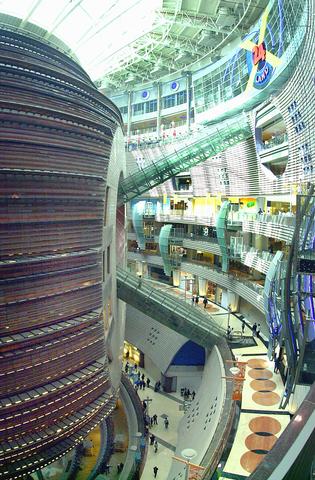
PHOTO: GEORGE TSORNG, TAIPEI TIMES
The futuristic mall launched its three day soft-opening yesterday, with the grand opening scheduled for Friday. The complex -- located near the intersection of the Civil Boulevard and Pateh Road -- has seen its share of bad luck prior to opening its doors.
Back in September, Typhoon Nari flooded six of the mall's lower levels. Though the losses were covered by insurance, the incident delayed the opening by about a month.
"The lower-level supermarket won't open until next month," said Goh Chai-khim (
The 24,420m2, 19-floor facility has signed on nearly a thousand retailers, some of whom will be open 24 hours a day.
"While most clothing, accessory and cosmetic retailers will close up shop at 10:30pm, our movie theater, supermarket, food court and drugstore never close," Goh said.
Covering a total of six floors, the 24-hour shops include a 13-screen Cinemark theater, an Eslite Bookstore (
"In addition, we will hold a variety of events, such as shows, exhibitions, concerts and parades to attract traffic," Goh said.
Located a few blocks from the recently opened Breeze Center (
Sheer size alone is expected to be an important factor.
"Core Pacific is triple the size of the Breeze Center and is three-times larger than Pacific Sogo Department Store (
According to Juan, for the first three days after the official opening, the company estimates sales will reach NT$450 million. The mall hopes to attract more than 300,000 visitors per day.
Those numbers may be wishful thinking.
Breeze Center took in NT$32 million per day over the first week and reported 200,000 customers on opening day.
But Core Pacific City has NT$24 billion on the line and some big promises to fulfill.
"Three years ago our investors were told the mall would earn NT$20 billion in its the first year, so we have to do our best to make that happen," Shen said.
He plans to entice customers with combination shopping alternatives and entertainment options.
"We estimate that 35 percent of total sales will come from entertainment," Shen said.
And in a city of 2.6 million, competition is fierce.
There are 26 shopping centers in Taipei, with annual sales totaling NT$60 billion, according to statistics compiled last year by the Department Store Association of Taiwan.
One economist said it remains to be seen whether public consumption can sustain the market.
"People still seem willing to buy, as long as prices are reasonable," said Kung Ming-hsing (
"Sales events are a good way to stimulate the current market."
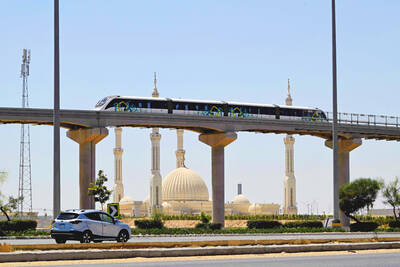
Cairo’s new monorail slices across the city skyline, running above the familiar chaos of blaring horns and aging buses’ exhaust fumes that mark rush hour below. The US$4.5 billion monorail, opened this month, is among Egypt’s most prominent new transport projects, part of a debt-funded infrastructure drive criticized for sapping state finances while bringing limited benefits to most of the country’s 109 million people. “It feels like you’re in a different country,” said Ramy Sayed, a restaurant manager, aboard a driverless Innovia 300 train. “No noise, no traffic, we’re not used to this.” The eastern line runs 56km from the bustling middle-class

Taiwanese firms have increased investment in the Philippines in recent years as Manila’s ties with Washington deepen and global supply chains continue to shift away from China, an expert at the Chung-Hua Institution for Economic Research (CIER, 中華經濟研究院) said yesterday. The Philippines had not been among Taiwanese investors’ top choices in Southeast Asia, CIER Taiwan ASEAN Studies Center director Kristy Hsu (徐遵慈) said at a seminar in Taipei. However, Taiwan’s investment in the country has grown significantly since the COVID-19 pandemic, reaching US $257 million last year, a high in recent years, she said. Although Taiwan’s total investment in the Philippines still lags

Intel Corp regards Taiwan Semiconductor Manufacturing Co (TSMC, 台積電) as a longstanding partner, as the US chipmaker would continue outsourcing production of advanced chips to TSMC, Intel chief executive officer Lip-Bu Tan (陳立武) said yesterday. “I don’t look at people as competitors. I look at the collaboration... Nvidia is also, you know, a good friend,” Tan told a news conference following his keynote speech at the Computex trade show in Taipei. “It’s a very trusted partnership for us... We are a big, top customer for them, and we’re going to continue doing that,” he said, referring to TSMC, the world’s largest foundry

Artificial intelligence (AI) agents would supplant smartphones as the center of people’s digital lives, fundamentally reshaping personal devices and driving a major computing upgrade cycle, Qualcomm Inc CEO Cristiano Amon said yesterday. In his keynote speech for this year’s Computex trade show in Taipei, Amon said that the rise of "agentic AI" — AI systems capable of reasoning, planning and carrying out tasks autonomously — would transform how people interact with technology across phones, PCs, vehicles and wearable devices. Describing the technology as the next major evolution in computing, Amon said that "2026 is the year of agents.” For decades, smartphones have sat


 RSS
RSS