


Contractor Chen Tien-mei was on the brink of bankruptcy when she did what many other Taiwanese businesses are doing during these sluggish economic times: She visited a feng shui (
Feng shui is the ancient Chinese art of arranging living and work space to ensure a smooth flow of "cheng chi" (
After inspecting Chen's office, feng shui master Chang Hsu-chu quickly saw the problem. The drainage ditch outside the building was sucking away her fortune. His advice: Put a fish tank on the balcony to help keep cash flowing in. He also urged her to rearrange the desks so that employees sit facing each other.
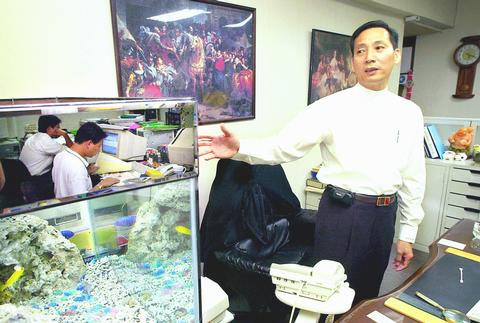
PHOTO: AP
"This way, your employees would not rebel against you but will fight side-by-side with you," Chang said.
In better financial times, many Taiwanese would spend a fortune to stimulate the flow of positive energy in their homes and offices. Walls and doors would be knocked down and rebuilt at chi-friendly angles.
Fountains would be added to gardens, and decorative water tanks filled with expensive "feng shui fish," such as the arowana or "red dragon," which experts say can help people escape disasters and get rich.
But as Taiwan drifts into a recession for the first time in decades, many businesses can't afford to make big feng shui changes. They're hoping that small, inexpensive changes will be just as effective. They're also indulging in other Taiwanese superstitions for an extra edge.
Contractor Chen was advised to simply put a curtain in the corridor to block the negative chi coming from a storage room. She's still waiting for results from the changes she has made.
Other small feng shui items are selling well.
Signs of life
Bamboo stalks or lush plants adorn many homes. If the plants thrive, it's a sign that chi is plentiful. If they begin to wilt, the plants are trashed to avoid bringing more bad luck.
Many people are wearing crystal bracelets, good conductors of qi that are supposed to stimulate a person's energy and potential. Others are adorning doorways with a chain of coins, engraved with the names of five ancient emperors. The powerful emperors are supposed to attract good luck.
Men can wear ties with lucky colors that befit their horoscopes. Women use makeup to help improve their luck.
"Many women have dark and yellowish faces. How can they expect good luck?" asked beauty consultant Chang Yu-chu. She advises clients to use cosmetics to brighten up the nose and forehead, parts said to determine one's career.
One problem with Taiwan's economy is that factories are downsizing or shutting down, causing the jobless rate to soar to a record high of 5.2 percent.
According to feng shui theory, the most auspicious sites are those located at the foot of a mountain facing a river. But they may be too remote for many businesses. So master Chen Teh-mao advises his clients to build factories in a solid square or in a square shape closing up on a courtyard.
Square deal
"Square buildings help to gather chi and hold it firmly," Chen said.
One electronics firm had a booming business until it added an annex jutting out of its square building to serve as the front gate, he said. The sharp-angled annex works like a "tiger's mouth," too fierce to maintain harmony at the workplace, he said.
Shop owner Huang Chia-sheng believes bad economic times require stronger dosages.
He sells miniature coffins made of wood or jade. Clients write down their birth dates on a slip of paper, put the slip in the coffin and burn incense sticks to pray for a rebirth.
"You use an unconventional method to dispel bad luck, and follow by doing many good things," he said.
Will these theories help? Some people have voiced doubts.
"It is not enough to have good feng shui in your home. We need good chi in the bigger environment," said Lin Chin-yuan, owner of a shop selling feng shui devices and books.
Taiwan can't expect prosperity if politicians continue feuding and weakening confidence in the economy, she said.
"People have become too greedy and no longer live peacefully with the environment," she lamented, amid the droning Buddhist music played in her shop.
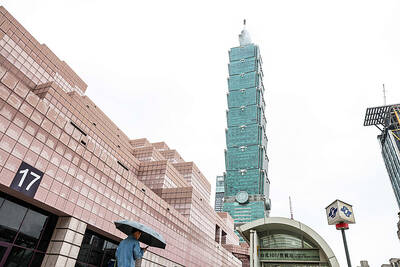
MANAGING RISKS: Taiwan has secured LNG sufficient to cover 95 percent of electricity demand for next month, UBS said, describing the government’s approach as proactive UBS Group AG has raised its forecast for Taiwan’s economic growth this year to 8 percent, up from 6.9 percent previously, and said expansion could reach as high as 8.6 percent if external energy shocks are avoided. The upgrade reflects a stronger-than-expected first-quarter performance and sustained momentum in artificial intelligence (AI)-driven exports, which UBS said are providing a firm foundation for growth despite geopolitical and energy risks. Taiwan’s GDP expanded 13.69 percent year-on-year in the first quarter, the fastest growth since the second quarter of 1987, the Directorate-General of Budget, Accounting and Statistics (DGBAS) reported on Thursday. On a seasonally
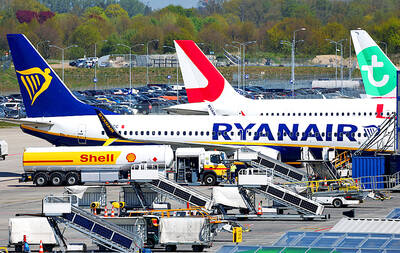
Ryanair, Transavia, Volotea and other low-cost airlines are feeling the financial pain from high jet fuel prices as a result of the Middle East war and are cutting flights. The closure of the Strait of Hormuz has taken a huge chunk of oil supplies off the market, sending the price of jet fuel soaring and triggering fears of shortages that could force airlines to cancel flights. Airlines are not waiting for a lack of supplies to react. “Travel alert: Airlines are cutting thousands of flights right now,” Travel Therapy host Karen Schaler said in an Instagram reel this past weekend.
Shares of Taiwan Semiconductor Manufacturing Co (TSMC, 台積電) have repeatedly hit new highs, but an equity analyst said the stock’s valuation remains within a reasonable range and any pullback would likely be technical. The contract chipmaker’s historical price-to-earnings (P/E) ratio has ranged between 20 and 30, Cathay Futures Consultant Co (國泰證期) analyst Tsai Ming-han (蔡明翰) told Central News Agency. With market consensus projecting that TSMC would post earnings per share of about NT$100 (US$3.17) this year, supported by strong global demand for artificial intelligence (AI) applications, and the stock currently trading at a P/E ratio of below 25, Tsai said the valuation

The list of Asian stocks that benefit from business partnership with Nvidia Corp is getting longer, as the region further integrates into the artificial intelligence (AI) chip giant’s business ecosystem. Just in the past week, South Korea’s LG Electronics Inc, Taiwan’s Nanya Technology Corp (南亞科技), as well as China’s Huizhou Desay SV Automotive Co (德賽西威) and Pateo Connect Technology Shanghai Corp (博泰車聯) have become the latest to rally on news of tie-ups, supply-chain participation or product collaboration with the US chip designer. Asian suppliers account for about 90 percent of Nvidia’s production costs, up from about 65 percent last year, data compiled


 RSS
RSS