


Aerospace Industrial Development Corp (AIDC,
Taichung-based AIDC's earnings fell sharply at the end of 1999, when it delivered the last of 130 Ching-kuo Indigenous Defense Fighters (IDFs) to the ROC Air Force, and since then the company has struggled to find revenue to offset the loss of IDF production. Nearly 80 percent of the company's income is currently derived from military contracts, including maintenance services for the IDFs.
The government has put an estimated US$13 billion into the company since 1969.
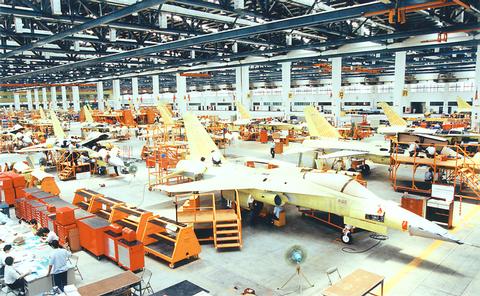
FILE PHOTO: TAIPEI TIMES
In recent years, AIDC has attempted to attract foreign investors. The company held unfruitful talks with Canada's Bombardier, France's Dassault, Boeing and GE of the US. Foreign aircraft manufacturers balked at purchasing a stake in AIDC for fear of becoming co-owners with their competitors.
As a result, AIDC's full privatization, originally scheduled for last year, has been delayed. The new deadline is Dec. 31, 2001, but that date is also unlikely to be met.
AIDC's revenue has shrunk from about US$750 million per year during IDF production, to about US$300 million. Vice Chairman Willy Peng (
Many of AIDC's risk-sharing ventures are still in the development stage. Projects include building cockpits for the Sikorsky S-92 helicopter, the back wings and tail for the Bombardier BD-100 business jet and Boeing 717, and wings for the Aero Vodochody AE-270 turboprop.
Because of a lack of capital, AIDC is unable to rebuild and retool its three factories, and it cannot take further risk-sharing stakes in international projects. A joint venture with Airbus to build parts for the giant A380 passenger plane has been abandoned, because AIDC doesn't have the US$120 million required to take a 1 percent share in the project.
AIDC has asked Chiao Tung Bank (
Other possible investors are the China Aviation Development Foundation (
"Our future depends on the attitude of the government," said an AIDC spokesman. "The banks [China Development and Chiao Tung] still have the money."
In a best-case scenario, AIDC would get US$120 million to US$200 from the banks, land some contracts from foreign companies, and then use the money to modernize and rebuild its three factories to produce the contracted items.
Meanwhile revenue would peak from programs like the S-92, AE-270, and BD-100, which have put in the development costs, but are not yet in full-scale production. "Many of our products are still in the investment stage, not in the production phase, so it will take many years to recover the revenue," Peng said.
One promising source of new business is target practice. In cooperation with Meggitt Defense Systems of the US, AIDC has bought an Astra SPX business jet, which can tow 545kg targets on each wing. AIDC tows the targets, and the Air Force and the Navy shoot at them, with the results recorded on a computer. AIDC has a three-year contract with the ROC Air Force and a one-year contract with the navy to provide target services.
AIDC has notable strengths. The company has trained personnel, including some 100 PhD and 500 MS degree holders. About 70 percent are university graduates, many from US schools, while the remainder have technical school training.
Peng acknowledged the difficulty of moving from slow production IDFs to the just-in-time delivery timetables demanded by foreign manufacturers, but Peng said AIDC has proven capabilities. "Our work on the [Boeing] 717 and Bombardier projects show that we can perform high-rate, low-cost production," he said. "Bombardier and Boeing are looking for high-rate, low-cost production and a one-shop concept from development to manufacturing."
AIDC has delivered more than 90 back wings and tail assemblies for the Boeing 717.
"We will focus on narrowbody, regional and business jets, and we will continue to focus on producing empennages," Peng said.

The domestic unit of the Chinese-owned, Dutch-headquartered chipmaker Nexperia BV will soon be able to produce semiconductors locally within China, according to two company sources. Nexperia is at the center of a global tug-of-war over critical semiconductor technology, with a Dutch court in February ordering a probe into alleged mismanagement at the company. The geopolitical tussle has disrupted supply chains, with some carmakers reportedly forced to cut production due to chip shortages. Local production would allow Nexperia’s domestic arm, Nexperia Semiconductors (China) Ltd (安世半導體中國), to bypass restrictions in place since October on the supply of silicon wafers — etched with tiny components to

Singapore-based ride-hailing and delivery giant Grab Holdings Ltd has applied for regulatory approval to acquire the Taiwan operations of Germany-based Delivery Hero SE's Foodpanda in a deal valued at about US$600 million. Grab submitted the filing to the Fair Trade Commission on Friday last week, with the transaction subject to regulatory review and approval, the company said in a statement yesterday. Its independent governance structure would help foster a healthy and competitive market in Taiwan if the deal is approved, Grab said. Grab, which is listed on the NASDAQ, said in the filing that US-based Uber Technologies Inc holds about 13 percent of

Taiwan Semiconductor Manufacturing Co (TSMC, 台積電) yesterday received government approval to deploy its advanced 3-nanometer (3nm) process at its second fab currently under construction in Japan, the Ministry of Economic Affairs said in a news release. The ministry green-lit the plan for the facility in Kumamoto, which is scheduled to start installing equipment and come online in 2028 with a monthly production capacity of 15,000 12-inch wafers, the ministry said. The Department of Investment Review in June 2024 authorized a US$5.26 billion investment for the facility, slated to manufacture 6- to 12nm chips, significantly less advanced than 3nm process. At a meeting with

Taiwan’s food delivery market could undergo a major shift if Singapore-based Grab Holdings Ltd completes its planned acquisition of Delivery Hero SE’s Foodpanda business in Taiwan, industry experts said. Grab on Monday last week announced it would acquire Foodpanda’s Taiwan operations for US$600 million. The deal is expected to be finalized in the second half of this year, with Grab aiming to complete user migration to its platform by the first half of next year. A duopoly between Uber Eats and Foodpanda dominates Taiwan’s delivery market, a structure that has remained intact since the Fair Trade Commission (FTC) blocked Uber Technologies Inc’s


 RSS
RSS