


The government is going out of its way to come up with a currency exchange mechanism between Taiwan and China as an accessory to its "mini three-links" plan, which will go into effect next year.
Chairman of the Mainland Affairs Council (MAC, 陸委會) Tsai Ing-wen (蔡英文) said yesterday she will come out within two weeks a detailed plan on how to allow the offshore banking units (OBU) of the local banks to offer services to companies doing business in China.
"There is definitely a need for a currency exchange mechanism with China," said Norman Yin (殷乃平), an economist who teaches banking at National Chengchi University(政治大學).
Financial experts believe the mini three-links policy will not become feasible without a currency arrangement scheme under which financial transactions can be conducted.
Lin Chung-ping (林中斌), vice chairman of the MAC, even said that renminbi may be circulated in Kinmen and Matsu on the condition that "China recognizes the NT dollar and the two sides establish a currency settlement mechanism."
Policy shift
His statement reflects a shift in MAC's previous stance of allowing residents of Kinmen and Matsu to only use in NT dollars and US dollars.
The ground-breaking proposal allows financial institutions in Kinmen and Matsu to offer financial services for cross-strait traders.
"It is a symbolic move for more positive developments in the future," said Chen Yuan-pao (
But any decision to allow the circulation of renminbi on Kinmen and Matsu may have to be approved by Beijing, which still uses draconian measures to regulate its currency.
Denise Yam, an economist at Morgan Stanley Dean Witter in Hong Kong, believes that allowing such circulation would affect China's grip on the currency, which is not fully convertible.
Capital flows
Taiwan's abrupt announcement of the banking decision, analysts believe, may be an attempt to calm rising fears in Taiwan over the massive outflow of capital into China.
Investors and legislators have repeatedly called for mechanisms to attract capital back into Taiwan from China. Bankers have also complained that the lack of direct banking across the Strait is robbing them of an opportunity to serve Taiwanese who are investing in China.
Even with such a currency mechanism, insiders question whether investors would send large amounts of capital back to Taiwan.

SECOND-RATE: Models distilled from US products do not perform the same as the original and undo measures that ensure the systems are neutral, the US’ cable said The US Department of State has ordered a global push to bring attention to what it said are widespread efforts by Chinese companies, including artificial intelligence (AI) start-up DeepSeek (深度求索), to steal intellectual property from US AI labs, according to a diplomatic cable. The cable, dated Friday and sent to diplomatic and consular posts around the world, instructs diplomatic staff to speak to their foreign counterparts about “concerns over adversaries’ extraction and distillation of US AI models.” Distillation is the process of training smaller AI models using output from larger, more expensive ones to lower the costs of training a powerful new

Micron Technology Inc is a driving force pushing the US Congress to pass legislation that would put new export restrictions on equipment its Chinese competitors use to make their chips, according to people familiar with the matter. A US House of Representatives panel yesterday was to vote on the “MATCH Act,” a bill designed to close gaps in restrictions on chipmaking equipment. It would also pressure foreign companies that sell equipment to Chinese chipmaking facilities to align with export curbs on US companies like Lam Research Corp and Applied Materials Inc. The bill targets facilities operated by China’s ChangXin Memory Technologies Inc

Singapore-based ride-hailing and delivery giant Grab Holdings’ planned acquisition of Foodpanda’s Taiwan operations has yet to enter the formal review stage, as regulators await supplementary documents, the Fair Trade Commission (FTC) said yesterday. Acting FTC Chairman Chen Chih-min (陳志民) told the legislature’s Economics Committee that although Grab submitted its application on March 27, the case has not been officially accepted because required materials remain incomplete. Once the filing is finalized, the FTC would launch a formal probe into the deal, focusing on issues such as cross-shareholding and potential restrictions on market competition, Chen told lawmakers. Grab last month announced that it would acquire
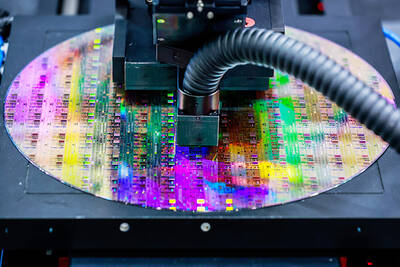
The artificial intelligence (AI) boom has triggered a seismic reshuffling of global equity markets, with Taiwan and South Korea muscling past European nations one by one. With its stock market now valued at nearly US$4.3 trillion, Taiwan surpassed the UK, Europe’s biggest market, earlier this month, data compiled by Bloomberg showed. South Korea is about US$140 billion away from doing the same. The tech-heavy Asian markets have shot past Germany and France in the past seven months. The shift is largely down to massive gains in shares of three companies that provide essential hardware for AI: Taiwan Semiconductor Manufacturing Co (TSMC, 台積電),


 RSS
RSS