


The Linux operating system has within a decade gone from underground "hackers only" networks to the institutional dollars of glass tower enterprises.
Perhaps no one ever expected the open-source operating system to make this shift, but that is not the only unpredictable move the software program has made. At present, Linux also offers cheaper solutions for small businesses, powers PDAs and provides China's government a chance to climb out from under the hegemony of Microsoft.
In Taiwan, figures as disparate as Chen Ing-hao, author of the world's second most destructive computer virus -- "I LOVEYOU" just beat him out for the number one spot -- and Peter Kurz, a top securities analyst, now work to develop and promote the once alternative operating system.
Mixed up in the middle of all these people, ideals, and financial ventures is XLinux Inc, a Taipei-based solutions provider and software developer.
Kurz says he recently joined XLinux's board of directors because "Taiwan software companies had no market until recently. Linux is a viable alternative to Microsoft, and they [the people at XLinux] are developing unique software that represents global potential."
Among the company's key self-developed products are a 126k Linux kernel -- as the world's smallest, it has significant potential for powering PDAs and other portable or limited memory Internet appliances -- and a Linux platform which supports software in a dozen different languages.
As a board member, Kurz is now helping XLinux prepare an initial public offering on the NASDAQ. Though the technology focused market has recently been rife with jitters, top officers at XLinux are unfazed.
That's because they have a couple things going for them, not the least of which is solid performance. Company sources say XLinux's earnings may jump from last year's US$0.097 per share to US$1 or more this year. Also important: California investors are still warm towards Linux and open-source.
Linux is free
When XLinux was founded in 1991 (the same year Linux was invented), but back then it was called Wahoo and provided other types of office network solutions, such as voicemail. In 1995, the company switched operating systems, going from DOS to Linux. By doing so, it also became part of the Linux world, which operates according to its own unique ideologies.
Linux started out, more or less, as a by-the-hacker and for-the-hacker operating system for amateur programmers. It attracted users who wanted the autonomy of open-source software (libertarians), many of whom also felt that all software, especially operating systems, should not be proprietary (Web communists).
Still, there is an effective copyright to Linux. It is owned by GNU, an organization that spun out of the Free Software Foundation during the mid-1980s. The document, a general public license, maintains that Linux and all of its descendents must exist as free software until the end of time. However, the license also states, "When we speak of free software, we are referring to freedom, not price."
It's a bit of a marketplace paradox. GNU's peculiar version of freedom entails the right to copy, distribute and sell "free software." But it also says that anyone can do this without anyone else's permission and that no one can patent or claim proprietary rights to any Linux operating system. In essence, you can sell Linux or you can copy it for free -- both ways are legal.
As it must, XLinux also works according to these rules. Anyone who wants to may copy the company's operating system (but not applications), and XLinux even promotes it. To date, more than 50,000 free downloads of XLinux version 1.0 have been recorded from company's Web site, www.xlinux.com.
Linux is not user friendly
Giving away products may seem like one of those wacky, Internet-only business models, but Linux companies can do it for two reasons: Linux is complex and needs to be made friendly; and, they can sell software applications on top of it.
"Linux is not user friendly. Most people can't use it," said Chen Jhun-Liang, an analyst at the Institute for Information Industry's Market Intelligence Center (MIC).
Chen was talking about its difficult interface and lack of any attached programs. "It's just an operating system -- with nothing," he said.
So users need Linux experts to bring Linux to them, with applications and installation software. Chen says that this is happening in Taiwan. There are currently roughly 10 companies selling Linux products, some to businesses such as XLinux and others to consumers, such as LinuxOne.
"You should note that you can keep proprietary rights over your software, even if it is Linux software," Chen said. "That means you don't have to show the source code and you can sell it."
That is what LinuxOne does. It sells systems complete with bundled software -- a browser, office suite, graphic interface, for example -- for between NT$1,000 and NT$1,700. Other Linux versions with only installers can be bought for as little as NT$180. By comparison, MS Windows 2000 costs roughly NT$6,000.
Windows, however, excels Linux in other areas. "Linux software is still not very developed. That's why we need to build a lot more applications," said Henry Chen, XLinux's Asia Pacific Region Business Development Manager.
That explains why about eight out of 10 computers in his company's administrative offices still run Windows.
Servers
While Linux may not be ready for workstations, it has proven itself in servers. "In the most recent survey, it has 30 percent of the world server market," MIC's Chen said.
It is especially suited to the demanding use in servers, because unquestionably, it is both the world's most stable operating system, and it is also virus free.
In addition, it has a price that can't be beat. What XLinux charges for a server with software installed is roughly equal to what Microsoft would charge for the software alone. In the case of Microsoft, the software is Windows NT.
At present, XLinux derives most of its income from sales of hardware with bundled software and the systems solutions that often accompany those sales. The company believes in hardware, which it contracts out to OEM or ODM manufacturers, because as Henry Chen said, "bundling, there's not much money in it."
But servers and their software will not be XLinux's only vehicle of growth. In Kurz's view, "they pay the bills for now." What comes next will be up to the R&D team.
Among XLinux's claims to fame is the world's most international Linux platform. It is able to support software in a dozen Asian and European languages, in addition to Klingon. The irony here is that, according to the original Star Trek series, humans will not encounter Klingons (or their software) until the year 2218.
The Klingon was added on by the head of XLinux's Kaohsiung R&D office, a man called Foxman. (Because the company's PR branch either did not know or would not reveal Foxman's real name, only his Net-nerd moniker will be used in this article).
Foxman was able to add the alien tongue because there was plenty of room left over in XLinux's GCS (Giga-character set), the part of its operating system that was developed for linguistic support.
GCS allots 4 bytes to each character -- which is a lot when compared to reigning standards. The Big-5 Chinese character set uses just 2 bytes per character, and most Western alphabet systems require only 1 byte. The expansion allows the XLinux platform to support 75,000 Chinese characters (including the fairly standard Big-5 and Simplified formats), Japanese, Korean, Thai, Russian, Spanish, Portuguese, French, Vietnamese and English.
Now, GCS may be unique in the computing world, but as Kurz observed, "multi-lingual, it's not the end-all of software, but it's an edge."
In fact, he believes there is something better coming. "The real upside will be the move to embedded systems," he said.
One of the programmers who will make the move possible is none other than Chen Ing-hao, author of the virus known as CIH, or Chernobyl. Chen, who goes by the nickname "CIH" within the company, was recruited by XLinux last year after he was released from the military. Since then, he has turned his focus away from destroying other people's computers and is reportedly happy and busy programming Linux fourteen hours a day. Already, he has produced a Linux kernel of just 126 KB, which is the world's smallest.
A kernel is the core of an operating system. It carries out only basic tasks, such as retrieving memory and running programs. Other elements of the operating system are added on top of or around the kernel.
Embedded systems: where the money will be
A very small memory efficient operating system will be extremely well suited to embedded systems, where memory limitations are a real concern. Such systems are most commonly found in PDAs and other types of mobile Internet and Information appliances.
Linux is currently one of the operating systems vying for a share in this embedded market. (Incidentally, Linux inventor Linus Torvalds is also working to integrate Linux into embedded systems. He's doing it for the California chip producer Transmeta.) Kurz feels that XLinux's products will have competitive advantages for several reasons.
"A lot of PDAs will be made in Taiwan. XLinux can license its products to chip producers, which will give it maximum leverage into international markets with minimum cost," he said.
When embedded sales generate volume, however, may still be a year or two off. "PDAs haven't seen huge volumes yet. Even Acer pushed back the clock on its IAs," observed one local analyst.
"Broadband access is what's really going to make it happen. But that won't come until 2001 or 2002," he said.
The China-Linux connection
To distribute its products, XLinux has cultivated partners all throughout Asia. In Korea, it has teamed up with a company that controls 80 percent of all Linux distribution in that country. Other regional alliances cover Hong Kong and Malaysia, while others are being built in Singapore, Japan, Thailand and the Philippines. Top management is even thinking about how and when it can begin actively marketing in the US.
XLinux's most lucrative channel, however, is GNet, one of mainland China's largest hardware distributors with more than 200 outlets. In the first quarter, the company's China orders alone came to more than US$1.8 million.
As elsewhere in Asia, cost provides a big edge. But with China, there is also a favorable political climate. In mid-January, rumors that China would ban the Windows operating system were widely circulated among the media. Though a ban was never enacted, other reports have stated that Linux has become the official operating system of all of China's government agencies and that the government is actively supporting Linux.
Almost strangely, China seems to like Linux for the same reason that hackers do: autonomy. Since Linux is open-source, China is free to develop and implement it any way it likes. Probably more importantly, China doesn't have to buy it from the US.
SECOND-RATE: Models distilled from US products do not perform the same as the original and undo measures that ensure the systems are neutral, the US’ cable said The US Department of State has ordered a global push to bring attention to what it said are widespread efforts by Chinese companies, including artificial intelligence (AI) start-up DeepSeek (深度求索), to steal intellectual property from US AI labs, according to a diplomatic cable. The cable, dated Friday and sent to diplomatic and consular posts around the world, instructs diplomatic staff to speak to their foreign counterparts about “concerns over adversaries’ extraction and distillation of US AI models.” Distillation is the process of training smaller AI models using output from larger, more expensive ones to lower the costs of training a powerful new

Singapore-based ride-hailing and delivery giant Grab Holdings’ planned acquisition of Foodpanda’s Taiwan operations has yet to enter the formal review stage, as regulators await supplementary documents, the Fair Trade Commission (FTC) said yesterday. Acting FTC Chairman Chen Chih-min (陳志民) told the legislature’s Economics Committee that although Grab submitted its application on March 27, the case has not been officially accepted because required materials remain incomplete. Once the filing is finalized, the FTC would launch a formal probe into the deal, focusing on issues such as cross-shareholding and potential restrictions on market competition, Chen told lawmakers. Grab last month announced that it would acquire
Shares of Taiwan Semiconductor Manufacturing Co (TSMC, 台積電) have repeatedly hit new highs, but an equity analyst said the stock’s valuation remains within a reasonable range and any pullback would likely be technical. The contract chipmaker’s historical price-to-earnings (P/E) ratio has ranged between 20 and 30, Cathay Futures Consultant Co (國泰證期) analyst Tsai Ming-han (蔡明翰) told Central News Agency. With market consensus projecting that TSMC would post earnings per share of about NT$100 (US$3.17) this year, supported by strong global demand for artificial intelligence (AI) applications, and the stock currently trading at a P/E ratio of below 25, Tsai said the valuation
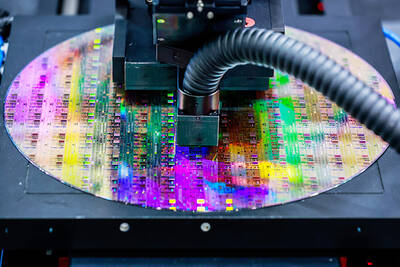
The artificial intelligence (AI) boom has triggered a seismic reshuffling of global equity markets, with Taiwan and South Korea muscling past European nations one by one. With its stock market now valued at nearly US$4.3 trillion, Taiwan surpassed the UK, Europe’s biggest market, earlier this month, data compiled by Bloomberg showed. South Korea is about US$140 billion away from doing the same. The tech-heavy Asian markets have shot past Germany and France in the past seven months. The shift is largely down to massive gains in shares of three companies that provide essential hardware for AI: Taiwan Semiconductor Manufacturing Co (TSMC, 台積電),


 RSS
RSS