


There is no truth to the rumor that the resignations of the three most influential people in Taiwan's stock market this past week were somehow connected. Peter Kurz did not follow the example of President Lee Teng-hui and Liu Tai-ying, head of the KMT's business management committee, in resigning as the Taiwan director of US securities house Merrill Lynch for political reasons.
He laughs at the suggestion, but it is obvious that Kurz has heard even crazier theories espoused about his impact on the Taiwan stock market over the years, all of which has contributed to local media awarding him the moniker, "Mr Taiwan."
"So that's what they're saying now, huh?" he says with a chuckle.
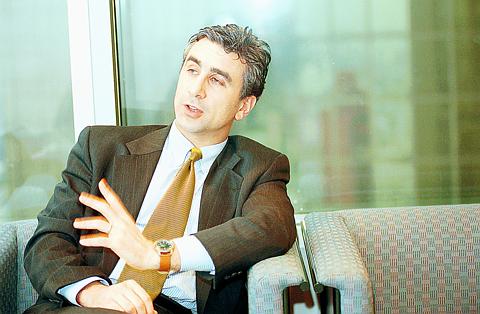
PHOTO: GEORGE TSORNG, TAIPEI TIMES
Seriously, though, the impact of Kurz's contribution to the development of Taiwan's capital markets over the past 12 years cannot be underestimated. Yet it is a compliment that he modestly declines to accept.
"I think I was fortunate, admittedly, that I came here with a broad background of experience internationally, having been in commercial banking, bond trading, futures and options dealing, in both New York and London," he says. "Retail investors here respect an international image, and that's probably why I got so much attention."
Still, it's clear as Kurz talks that he had a lot to learn about Taiwan after landing here in 1988, and it is this experience that stands him in the strongest stead today.
He uses a geological analogy to describe his understanding of Taiwan's capital markets. "It's like a desert storm, which can lead to floods. Hard to imagine, right? But it's because the sand dunes cake so quickly and the water is forced to run off the top. There's not much absorption.
"The same goes for the markets here. Because there are not many investment options or vehicles available to soak up the abundant supplies of cash that run through Taiwan's financial system, it's easy for a trickle of investment in the stock market to turn into a flood."
This, combined with the fact that 90 percent of Taiwan's daily turnover is in the hands of retail investors, is the reason why volatility is so high. It's also why, in his words, "it's so easy to get it wrong."
"I certainly did, when I first came here," he admits. "I would see a movement and project where it would lead. But it would always go for much longer than I thought possible. That was realization number one -- that rallies could be extended beyond logical bounds."
Realization number two, he says, was that the economy was very open, especially compared with the financial markets. Being so heavily export-oriented meant that a jolt in the external environment would have a magnified impact on the economy, and therefore the stock market.But it was obviously realization number three that was to prove the most instructive: that retail investors were emotional creatures, and that the top of the market was always going to be driven higher by people who did not have access to the kind of sophisticated analysis that institutional investors did.
The lack of a more mature stock market has not, however, had much of a retarding effect on the economy, Kurz notes, which is a sign of its amazing capability. It's this admiration that keeps him keenly interested in Taiwan's future, and provides a hint that he is not exactly getting out of the business, whatever he decides to do next.
"I think the future is extremely bright for what I like to call the `greater Taiwan' economy," Kurz says with a smile.
He explains: "Taiwan has taken an effective lead in the global PC manufacturing industry, which I see growing even stronger in the so-called post-PC era. This is because, first, the PC is hardly going to be made redundant by the slew of new products that are coming out centered on the Internet. Rather, they appear to be like satellites to the PC.
"Second, Taiwan has positioned itself very strongly as the middleman in the global manufacturing chain. Product design is done in the US, the manufacturing design and engineering is done in Taiwan, and the high-volume, low-cost stuff is done by their factories in China. I can't see why the importance of this role should be affected; in fact, it should only improve as far as Taiwan is concerned," he says.
"Everybody talks about how clever these new gadgets are, but what they don't talk about is where they will be made. The fact is that all these new appliance makers are worried about where to find manufacturing capacity; it's not the manufacturers who are worried about where the orders will come from."
Besides, as Kurz sees it, Taiwan is starting to look increasingly at a massive "home" market with real intent for the first time: China.
With the right know-how, Taiwanese companies face the exciting prospect of actually becoming brand-builders in the post-Microsoft software era that is being driven by the Linux operating system.
With software development increasingly moving into the hands of the "downstream" players (those who actually make the gadgets), by becoming embedded in those products, Taiwanese stand to profit nicely in a market they understand, he says.
Which puts foreigners who understand Taiwan in an equally exciting position, the unfinished sentence seems to be.
But for now, he's not giving anything away. "I plan to take some time off, go to the beach and I'll let you know what happens later," Mr Taiwan says.

The domestic unit of the Chinese-owned, Dutch-headquartered chipmaker Nexperia BV will soon be able to produce semiconductors locally within China, according to two company sources. Nexperia is at the center of a global tug-of-war over critical semiconductor technology, with a Dutch court in February ordering a probe into alleged mismanagement at the company. The geopolitical tussle has disrupted supply chains, with some carmakers reportedly forced to cut production due to chip shortages. Local production would allow Nexperia’s domestic arm, Nexperia Semiconductors (China) Ltd (安世半導體中國), to bypass restrictions in place since October on the supply of silicon wafers — etched with tiny components to

Singapore-based ride-hailing and delivery giant Grab Holdings Ltd has applied for regulatory approval to acquire the Taiwan operations of Germany-based Delivery Hero SE's Foodpanda in a deal valued at about US$600 million. Grab submitted the filing to the Fair Trade Commission on Friday last week, with the transaction subject to regulatory review and approval, the company said in a statement yesterday. Its independent governance structure would help foster a healthy and competitive market in Taiwan if the deal is approved, Grab said. Grab, which is listed on the NASDAQ, said in the filing that US-based Uber Technologies Inc holds about 13 percent of

Taiwan Semiconductor Manufacturing Co (TSMC, 台積電) yesterday received government approval to deploy its advanced 3-nanometer (3nm) process at its second fab currently under construction in Japan, the Ministry of Economic Affairs said in a news release. The ministry green-lit the plan for the facility in Kumamoto, which is scheduled to start installing equipment and come online in 2028 with a monthly production capacity of 15,000 12-inch wafers, the ministry said. The Department of Investment Review in June 2024 authorized a US$5.26 billion investment for the facility, slated to manufacture 6- to 12nm chips, significantly less advanced than 3nm process. At a meeting with
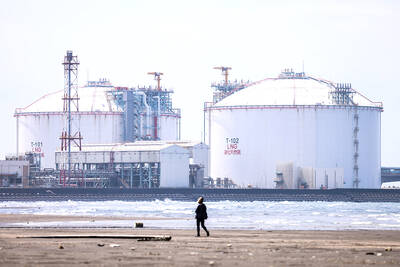
Taiwan is open to joining a global liquefied natural gas (LNG) program if one is created, but on the condition that countries provide delivery even in a scenario where there is a conflict with China, an energy department official said yesterday. While Taiwan’s priority is to have enough LNG at home, the nation is open to exploring potential strategic reserves in other countries such as Japan or South Korea, Energy Administration Deputy Director-General Chen Chung-hsien (陳崇憲) said. While the LNG market does not have a global reserve for emergencies like that of oil, the concept has been raised a few times —


 RSS
RSS