


Taliban leaders have sanctioned suicide squads to seek and destroy US and Northern Alliance targets in a significant escalation of their resistance to ground assaults, it was claimed Wednesday.
Teams of militants have allegedly been granted permission to strap explosives to their bodies and vehicles to launch potentially devastating attacks against enemy forces, despite unease over Islam's disapproval of suicide.
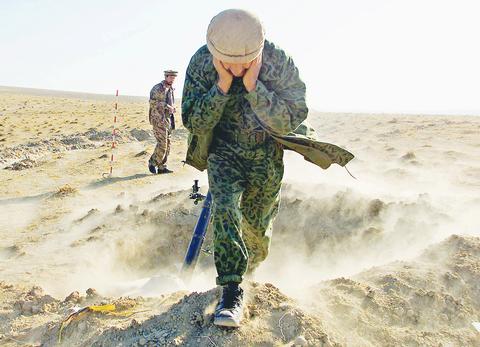
PHOTO: AFP
A determination to inflict maximum casualties against American troops and their Northern Alliance proxies has apparently convinced the Taliban to approve a tactic which has bloodied Indian security forces in Kashmir.
Muslim militants waging an insurgency in the disputed Himalayan territory have bombed Indian military bases, checkpoints and patrols in a series of spectacular raids which claimed dozens of lives.
Fighters willing to make the ultimate sacrifice are known as fidayeen.
The Islamist groups trained for suicide attacks in Afghanistan under the sponsorship of the Taliban and Osama bin Laden's al-Qaeda network, which see the fight against the US as a holy war.
According to refugees, Arab and Pakistani hardliners have in recent weeks taken an increasingly dominant role in organizing Taliban resistance, elbowing aside those Afghans deemed too moderate.
Jaish-e-Mohammad, a fundamentalist Pakistani group suspected of last month's car bomb which killed at least 38 people outside a state assembly building in Kashmir, said its militants had infiltrated Afghanistan and would use identical methods.
"They work against India and they will work against the Americans," said Mohammad Gul, who trains the volunteers.
"We have redirected our members from Kashmir to Afghanistan."
Sardar Ahmedia, a spokesman for the Northern Alliance in New Delhi, claimed the Taliban's supreme leader, Mullah Omar, mobilized fidayeen at a meeting in the southern city of Kandahar last week.
After being drilled in commando tactics the squads would be slipped across the border to target US bases and depots in neighboring countries such as Tajikistan, he said.
Trucks, tanks and other vehicles loaded with explosives could also be driven at opposition forces trying to retake the northern city of Mazar-i-Sharif, he told Defence Week magazine.

A signaling system malfunction disrupted high-speed rail (HSR) services beginning at 8am today, with trains temporarily reduced to three northbound and three southbound trains per hour as authorities conduct inspections. The malfunction occurred on a section of track in Miaoli County during pre-operation checks early this morning, forcing northbound and southbound trains to use a single track, the HSR operator said. The regular schedule has been replaced with three hourly trains offering only nonreserved seating in each direction, stopping at every station, it said, adding that business class cars would still have reserved seating. Departures from terminal stations are scheduled at the top

Taiwan is still in the process of assessing the possibility of recruiting workers from Eswatini, the Ministry of Foreign Affairs said yesterday, adding that its goal is to help Eswatini upgrade its vocational training centers. If there are plans to recruit workers from Eswatini, safeguarding national security, protecting public health and ensuring the employment rights of Taiwanese would be prerequisites, Department of West Asian and African Affairs Director-General Yen Chia-liang (顏嘉良) told a news conference. Key considerations would also include filling labor shortages in specific industries, and fostering bilateral professional and technical exchanges, he said. Yen was asked about the progress of labor

VERBOSE VESSELS: A CGA cutter and a China Coast Guard exchanged verbal barbs for more than a day in Taiwanese-controlled waters before the Chinese vessel left The Taiwanese and Chinese coast guards had a standoff near the strategically located Pratas Islands (Dongsha Islands, 東沙群島) in the north of the South China Sea, the Coast Guard Administration (CGA) said yesterday. The two sides engaged in intense radio exchanges over sovereignty claims during the 33-hour standoff. China Coast Guard vessel 3501 eventually left the restricted waters, 26.6 nautical miles (49.2km) west of the Pratas Islands, at 5pm yesterday, the CGA said. Lying approximately between southern Taiwan and Hong Kong, the Taiwan-controlled Pratas are seen by some security experts as vulnerable to Chinese attack due to their distance — more than
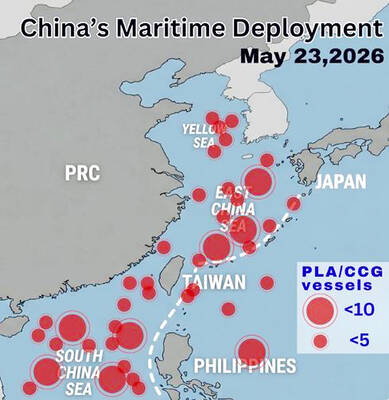
WARNING: China should stop engaging in actions that undermine regional peace and stability, as it would only build resentment among people across the Strait, the CGA said China has deployed more than 100 navy, coast guard and other vessels in waters from the Yellow Sea to the South China Sea and the western Pacific since US President Donald Trump and Chinese President Xi Jinping (習近平) met in Beijing, National Security Council Secretary-General Joseph Wu (吳釗燮) said yesterday. “In this part of the world, #China is the one & only PROBLEM wrecking the #StatusQuo & threatening regional peace & stability,” Wu wrote on X. In a separate post, he said Beijing was coercing Taiwan’s maritime domain, calling it illegal and provocative, after the Coast Guard Administration (CGA) expelled a


 RSS
RSS