


As US jets bomb Taliban frontlines one of their key targets will be Osama bin Laden's ruthless "055 brigade" of Arab mercenaries.
The brigade is a small unit of highly trained, well-paid guerrilla fighters set up by bin Laden shortly after he arrived in Afghanistan five years ago.
The highly motivated elite international group is a key target, much as Saddam Hussein's republican guard was in the 1991 Gulf war, military experts say.
The 055 brigade numbers at least 500 men. It has been based and trained at Rishikor, a former Afghan army base outside Kabul.
Although it has no heavy artillery or other heavy weapons, it is believed to be equipped with sophisticated western communications equipment and night vision goggles. Military sources say it is a collection of small mobile units which has been used to back up Taliban fighters on the frontlines of the civil war.
"It is that part of al-Qaeda that appears to be exclusively dedicated to the support of the Taliban," a US defense official said. It is also regarded as the most effective and disciplined foreign contingent fighting alongside the Taliban.
The units tend to be much better motivated than regular Taliban soldiers and are used to "give backbone" to the fight and prevent defections, the official said. They "can be thrown into the front, put in various places at times of need," he added.
Early in the bombing campaign a garrison of 055 fighters near the northern city of Mazar-i-Sharif was one of the first targets for US jets. Donald Rumsfeld, the US defense secretary, described the troops as "the al-Qaeda-dominated ground force."
The 055 fighters are the elite of the 3,000 Arabs who are believed to have sought sanctuary in Afghanistan. At least 1,000 more Arabs are thought to have arrived in the country since the World Trade Center attacks, crossing over the border at passes from Pakistan and Iran. Many are based at Jalalabad, Khost, Kandahar and Mazar-i Sharif.
"The Arabs are regarded as better fighters than the Afghans," said Kamal Matinuddin, a retired Pakistani army general. "They seem to be very loyal to bin Laden, who is paying them well, and they are willing to die. There is every possibility that at the moment they are the main fighting elements in Taliban-controlled areas."
During the 1980s war against the Soviet occupation more than 25,000 Arab volunteers, including bin Laden, went to Afghanistan to join the mujahidin resistance. The other "Arab-Afghans," as they were known, included men from Saudi Arabia, Egypt, Algeria, Sudan, Chad, Mauritania, Somalia and Yemen, and Uyghurs from western China.
Some came from Sudan, where bin Laden set up training camps before he returned to Afghanistan, while others are said to have come from Indonesia. All were regarded as more brutal than the Afghan mujahidin.
After the war they dispersed across the world to join other insurrections, some going to the Groupe Islamique Armee in Algeria, others to fight in Kashmir, Somalia, Yemen, Azerbaijan, Bosnia, Chechnya and the Philippines.
When bin Laden sought sanctuary in Afghanistan in 1996 other Arab-Afghans joined him. The small 055 force was set up as a foreign legion to drive ahead with the vision, shared by bin Laden and the hardline regime, of a global Islamist revolution.
The force had close contacts with militant groups fighting against Indian security forces in Kashmir, and with Islamist organizations trying to ferment a revolt in central Asia, particularly the Islamic Movement of Uzbekistan. There were rumors in the weeks before the Sept. 11 attacks that Juma Namangani, the movement's reclusive leader, had been appointed as one of the top commanders in the 055 brigade.
In the past three years the unit has also been used to back up Taliban attacks. One of their first reported forays inside Afghanistan was in 1998 when 055 fighters were used in the campaign to capture Mazar-i Sharif. The troops were back in July the following year in the battle for Bamiyan. They were also believed to be behind a string of civilian massacres of the Shia population nearby in Hazarajat, including one attack early this year in which more than 200 people died.
Since the bombing campaign began three weeks ago the 055 fighters have been moved to strategic positions around the country to prepare for a ground war with US troops.
"The ideological indoctrination is very high and this is a major factor. They can destroy a group like this, but it will be a long war." said Dr. Rohan Gunaratna, of the center for the study of terrorism and political violence at St. Andrews University.

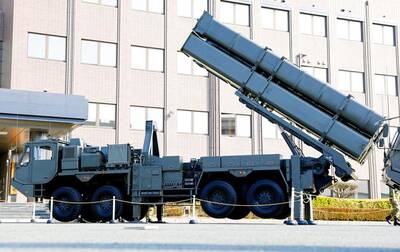
Japan has deployed long-range missiles in a southwestern region near China, the Japanese defense minister said yesterday, at a time when ties with Beijing are at their lowest in recent years. The missiles were installed in Kumamoto in the southern region of Kyushu, as Japan is attempting to shore up its military capacity as China steps up naval activity in the East China Sea. “Standoff defense capabilities enable us to counter the threat of enemy forces attempting to invade our country ... while ensuring the safety of our personnel,” Japanese Minister of Defense Shinjiro Koizumi said. “This is an extremely important initiative for

MORE POPULAR: Taiwan Pass sales increased by 59 percent during the first quarter compared with the same period last year, the Tourism Administration said The Tourism Administration yesterday said that it has streamlined the Taiwan Pass, with two versions available for purchase beginning today. The tourism agency has made the pass available to international tourists since 2024, allowing them to access the high-speed rail, Taiwan Railway Corp services, four MRT systems and four Taiwan Tourist Shuttles. Previously, five types of Taiwan Pass were available, but some tourists have said that the offerings were too complicated. The agency said only two types of Taiwan Pass would be available, starting from a three-day pass with the high-speed rail and a three-day pass with Taiwan Railway Corp. The former costs NT$2,800

NEW LOW: The council in 2024 based predictions on a pessimistic estimate for the nation’s total fertility rate of 0.84, but last year that rate was 0.69, 17 percent lower An expected National Development Council (NDC) report expects the nation’s population to drop below 12 million by 2065, with the old-age dependency ratio to top 100 percent sooner than 2070, sources said yesterday. The council is slated to release its latest population projections in August, using an ultra-low fertility model, the sources said. The previous report projected that Taiwan’s population would fall to 14.37 million by 2070, but based on a new estimate of the total fertility rate (TFR) — the average number of children born to a woman over her lifetime — the population is expected to reach 12 million by

COUNTERING HOSTILITY: The draft bill would require the US to increase diplomatic pressure on China and would impose sanctions on those who sabotage undersea cable networks US lawmakers on Thursday introduced a bipartisan bill to bolster the resilience of Taiwan’s submarine cables to counter China’s hostile activities. The proposal, titled the critical undersea infrastructure resilience initiative act, was cosponsored by Republican representatives Mike Lawler and Greg Stanton, and Democratic Representative Dave Min. US Senators John Curtis and Jacky Rosen also introduced a companion bill in the US Senate, which has passed markup at the chamber’s Committee on Foreign Relations. The House’s version of the bill would prioritize the deployment of sensors to detect disruptions or potential sabotage in real-time and enhance early warning capabilities through global intelligence sharing frameworks,


 RSS
RSS