


All inbound travelers to Taiwan would have their luggage X-rayed at airports to check for pork products, and local health bureaus have been instructed to increase market inspections beginning this week, Minister of Health and Welfare Shih Chung-liang (石崇良) said yesterday.
The announcements came after African swine fever (ASF) was detected in Taichung last week.
The Legislative Yuan yesterday invited ministries and agencies to discuss the detection and prevention of the smuggling of meat in packages from overseas, bolstering the nation’s borders to prevent epidemics and enhancing domestic prevention of outbreaks.
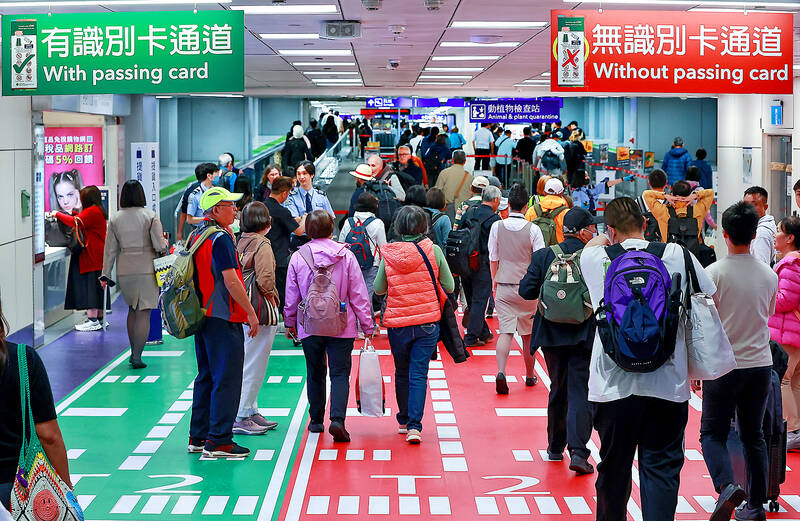
Photo: Chu Pei-hsiung, Taipei Times
The Ministry of Health and Welfare, in coordination with the Customs Administration, would soon require inbound travelers to undergo animal and plant quarantine inspection, Shih said.
Previously, travelers from countries with high risk of ASF were handed a “red card” before passing immigration and had to have their carry-on luggage X-rayed for pork products.
Travelers from countries that were not at risk of ASF were handed a “green card” and allowed to go straight through to immigration.
All incoming parcels are also subject to X-ray screening or manual inspections by the Customs Administration, Shih said, adding that X-ray screening is to be expanded.
The Food and Drug Administration is to continue inspecting vendors who sell meat products and supermarkets, including shops with Southeast Asian goods, he said.
As of this month, 35,000 inspections have been carried out and no ASF was detected in illegally imported meat products, he added.
The Animal and Plant Health Inspection Agency is also coordinating with the Customs Administration and the Coast Guard Administration to inspect inbound travelers, cargo containers, express parcels and coastal fishing vessels, the Ministry of Agriculture said.
The agencies have implemented strict procedures for the disposal of kitchen waste from international flights and cruise ships, it added.
In other news, the Executive Yuan yesterday announced subsidies for pig farmers and other pork-related businesses affected by controls put in place due to the ASF outbreak.
The program aims to counter the effects of a 15-day ban on transporting and slaughtering pigs, as well as pig feed controls.
Premier Cho Jung-tai (卓榮泰) said that the ban greatly impacted pig farmers and pork-related industries.
Subsidy applications are expected to open on Monday next week, the Cabinet said.
The subsidies for pig farmers available would be as follows: NT$810 per pig for additional costs resulting from the slaughter ban, NT$300 per pig to cover the difference in feed cost due to the ban on using kitchen waste and NT$2,500 per pig if sows die due to overcrowding due to the transport ban.
Fuel subsidies for 434 hog farms certified to use food waste as feed would also be available, starting at NT$8,000 for farms with 200 to 500 pigs and up to NT$18,000 for those with more than 2,000 pigs.
Pig wholesalers are entitled to a subsidy of NT$15,000 for operation suspension losses, slaughterhouses could get NT$280 per pig affected by the slaughter ban and meat sellers could receive NT$30,000 for income losses.
Those who voluntarily report cases of ASF would also receive NT$5,000 per report, the agriculture ministry said.
Financial support for the hog industry would also be available, with interest rates for six months capped at 1 percent for first-time borrowers, it said.
Repeat borrowers could apply for a six-month deferral for their payments, during which the government would subsidize up to 1 percent of the interest rate, the ministry said.
Each borrower could receive up to NT$6 million in loans, and would not have to pay guarantee fees during the subsidy period, it added.
Additional reporting by Lin Chi-y

Considering that most countries issue more than five denominations of banknotes, the central bank has decided to redesign all five denominations, the bank said as it prepares for the first major overhaul of the banknotes in more than 24 years. Central bank Governor Yang Chin-lung (楊金龍) is expected to report to the Legislative Yuan today on the bank’s operations and the redesign’s progress. The bank in a report sent to the legislature ahead of today’s meeting said it had commissioned a survey on the public’s preferences. Survey results showed that NT$100 and NT$1,000 banknotes are the most commonly used, while NT$200 and NT$2,000

The Centers for Disease Control (CDC) yesterday reported the first case of a new COVID-19 subvariant — BA.3.2 — in a 10-year-old Singaporean girl who had a fever upon arrival in Taiwan and tested positive for the disease. The girl left Taiwan on March 20 and the case did not have a direct impact on the local community, it said. The WHO added the BA.3.2 strain to its list of Variants Under Monitoring in December last year, but this was the first imported case of the COVID-19 variant in Taiwan, CDC Deputy Director-General Lin Ming-cheng (林明誠) said. The girl arrived in Taiwan on

ANNUAL EVENT: Two massive Pokemon balloons are to be set up in Daan Park, with an event zone operating from 10am to 6pm This year’s Taipei Floral Picnic is to be held at Daan Park today and tomorrow, featuring an exclusive Pokemon Go event, a themed food market, a coffee rave picnic area and stage performances, the Taipei Department of Information and Tourism said yesterday. Two massive Pokemon balloons are to be set up in the park as attractions, with an exclusive event zone operating from 10am to 6pm, it said. Participants who complete designated tasks on-site would have a chance to receive limited-edition souvenirs, it added. People could also try the newly launched game Pokemon Pokopia in the trial area, the department said. Three PokeStops are

South Korea is planning to revise its controversial electronic arrival card, a step Taiwanese officials said prompted them to hold off on planned retaliatory measures, a South Korean media report said yesterday. A Yonhap News Agency report said that the South Korean Ministry of Foreign Affairs is planning to remove the “previous departure place” and “next destination” fields from its e-arrival card system. The plan, reached after interagency consultations, is under review and aims to simplify entry procedures and align the electronic form with the paper version, a South Korean ministry official said. The fields — which appeared only on the electronic form


 RSS
RSS