


Britain’s conciliation service Acas said it would broker talks between British Airways (BA) and the Unite union today aimed at halting four planned five-day strikes.
The talks will take place on the same day the airline seeks an injunction at the High Court in London to prevent the strikes going ahead, the first of which is scheduled to begin tomorrow.
“There is now an opportunity for the parties to seriously reflect on the issues and the implications of not reaching an agreement,” chief conciliator Peter Harwood said on Saturday. “We will be using all of our expertise in any way we can to help the parties reach a resolution.”
Unite, Britain’s biggest union, is locked in an increasingly bitter standoff with BA over jobs, pay and staffing.
Its members are due to walk out from tomorrow to Saturday, then from May 24 to May 28, May 30 to June 3 and June 5 to June 9 — the last strike ending just two days before the soccer World Cup starts in South Africa.
The government has warned that British airspace could be closed again from Sunday as a result of the volcanic ash drifting from Iceland — a no-fly zone over parts of Northern Ireland was imposed in the early hours of yesterday.
Asked whether the threat to flights posed by the ash cloud would have any impact on the strike action, Tony Woodley, joint general secretary of Unite, said: “Like many people, we are assessing the situation, but at this moment there is absolutely no need to call off the strike.”
“Our main focus is on making sure we have meaningful talks at Acas in the coming days,” he said.

PROVOCATIVE: Chinese Deputy Ambassador to the UN Sun Lei accused Japan of sending military vessels to deliberately provoke tensions in the Taiwan Strait China denounced remarks by Japan and the EU about the South China Sea at a UN Security Council meeting on Monday, and accused Tokyo of provocative behavior in the Taiwan Strait and planning military expansion. Ayano Kunimitsu, a Japanese vice foreign minister, told the Council meeting on maritime security that Tokyo was seriously concerned about the situation in the East China and South China seas, and reiterated Japan’s opposition to any attempt to change the “status quo” by force, and obstruction of freedom of navigation and overflight. Stavros Lambrinidis, head of the EU delegation to the UN, also highlighted South China Sea

The final batch of 28 M1A2T Abrams tanks purchased from the US arrived at Taipei Port last night and were transported to the Armor Training Command in Hsinchu County’s Hukou Township (湖口), completing the military’s multi-year procurement of 108 of the tanks. Starting at 12:10am today, reporters observed more than a dozen civilian flatbed trailers departing from Taipei Port, each carrying an M1A2T tank covered with black waterproof tarps. Escorted by military vehicles, the convoy traveled via the West Coast Expressway to the Armor Training Command, with police implementing traffic control. The army operates about 1,000 tanks, including CM-11 Brave Tiger

Taiwan Semiconductor Manufacturing Co (TSMC, 台積電), the world’s largest contract chipmaker, said it expects its 2-nanometer (2nm) chip capacity to grow at a compound annual rate of 70 percent from this year to 2028. The projection comes as five fabs begin volume production of 2-nanometer chips this year — two in Hsinchu and three in Kaohsiung — TSMC senior vice president and deputy cochief operating officer Cliff Hou (侯永清) said at the company’s annual technology symposium in Silicon Valley, California, last week. Output in the first year of 2-nanometer production, which began in the fourth quarter of last year, is expected to
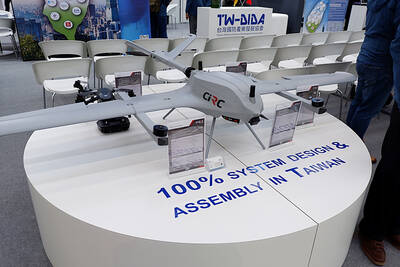
Taiwan’s drone exports surged past US$100 million in the first quarter, exceeding last year’s full-year total, with the Czech Republic emerging as the largest buyer, the Ministry of Economic Affairs said. Exports of complete drones reached US$115.85 million in the period, about 1.2 times the total recorded for all of last year, the ministry said in a report. Exports to the Czech Republic accounted for about US$100 million, far outpacing other markets. Poland, last year’s top destination, recorded about US$11.75 million in the first quarter. Taiwan’s drone exports have expanded rapidly in the past few years, with last year’s total


 RSS
RSS