


US aerospace giant Boeing lashed out on Monday at Germany’s plans for a multibillion-dollar loan to develop Airbus’s A350 airliner, ahead of a WTO ruling on EU aid to its European arch-rival.
With a final WTO ruling on US accusations of unfair EU subsidies expected as early as yesterday, Boeing criticized the German government’s move to provide 1.1 billion euros (US$1.49 billion) toward the development of the A350.
“On the eve of such an important decision, it is unfortunate and disappointing to see news reports quoting a senior German official saying that Germany is prepared to provide 1.1 billion euros for the development of the Airbus A350 — a move that flies in the face of both the expected WTO decision and the rules-based global trading system we’ve all endorsed,” Ted Austell, vice president of Boeing’s executive, legislative and regulatory affairs, said in a statement.
A senior German economic ministry official said on Sunday that the government was ready to grant a 1.1 billion euro loan to develop the A350 passenger aircraft.
“As far as we are concerned all pre-conditions have been met and the funds are available,” said Peter Hintze, parliamentary state secretary at the ministry of economics, in a statement implying that the conditions were in line with WTO rules.
Airbus, a division of the European Aeronautic Defence and Space Company (EADS), intends to launch the A350 as a rival to Boeing’s new 787 Dreamliner.
The 12 billion euro program is supported by four partner nations: Britain, France, Germany and Spain.
France has announced support of 1.4 billion euros and Britain is contributing 400 million euros.
The Spanish government remains in discussions with Airbus over its funding offer but reports say it could be around 300 million euros.
The WTO treats disputes at the government level, and the Boeing-Airbus case pits the US against the 27-nation EU.
“As US officials have repeatedly made clear, there’s a place for negotiations, but not on programs and actions declared inconsistent with WTO obligations,” Austell said.
“Illegal European subsidies have done great harm to the US aerospace industry. It’s time to level the playing field and let companies compete on product, price, innovation, and customer support without market-distorting government subsidies,” he said.
The US filed the WTO complaint in October 2004, alleging that an accord that allowed the EU to provide up to a third of development costs of new airliners was no longer valid since Airbus was now a major industry player and not the fledgling firm when the deal was struck.
The EU has also filed a complaint against the US on multibillion-dollar state aid to Boeing. A first interim ruling in that case is due to be delivered in June, the WTO said.
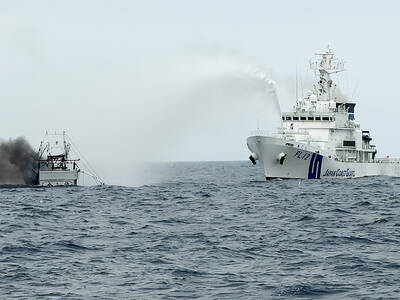
CREDIT-GRABBER: China said its coast guard rescued the crew of a fishing vessel that caught fire, who were actually rescued by a nearby Taiwanese boat and the CGA Maritime search and rescue operations do not have borders, and China should not use a shipwreck to infringe upon Taiwanese sovereignty, the Coast Guard Administration (CGA) said yesterday. The coast guard made the statement in response to the China Coast Guard (CCG) saying it saved a Taiwanese fishing boat. The Chuan Yu No. 6 (全漁6號), a fishing vessel registered in Keelung, on Thursday caught fire and sank in waters northeast of Diaoyutai Islands (釣魚台). The vessel left Keelung’s Badouzih Fishing Harbor (八斗子漁港) at 3:35pm on Sunday last week, with seven people on board — a 62-year-old Taiwanese captain surnamed Chang (張) and six
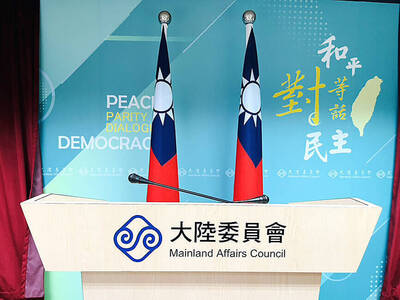
RISKY BUSINESS: The ‘incentives’ include initiatives that get suspended for no reason, creating uncertainty and resulting in considerable losses for Taiwanese, the MAC said China’s “incentives” failed to sway sentiment in Taiwan, as willingness to work in China hit a record low of 1.6 percent, a Ministry of Labor survey showed. The Directorate-General of Budget, Accounting and Statistics (DGBAS) also reported that the number of Taiwanese workers in China has nearly halved from a peak of 430,000 in 2012 to an estimated 231,000 in 2024. That marked a new low in the proportion of Taiwanese going abroad to work. The ministry’s annual survey on “Labor Life and Employment Status” includes questions respondents’ willingness to seek employment overseas. Willingness to work in China has steadily declined from

The Legislative Yuan’s Finance Committee yesterday approved proposed amendments to the Amusement Tax Act (娛樂稅法) that would abolish taxes on films, cultural activities and competitive sporting events, retaining the fee only for dance halls and golf courses. The proposed changes would set the maximum tax rate for dance halls and golf courses at 50 and 20 percent respectively, with local governments authorized to suspend the levies. Article 2 of the act says that “amusement tax shall be levied on tickets sold or fees charged by amusement places, facilities or activities” in six categories: “Cinema; professional singing, story-telling, dancing, circus, magic show, acrobatics
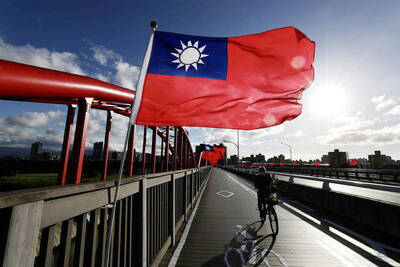
INFLATION UP? The IMF said CPI would increase to 1.5 percent this year, while the DGBAS projected it would rise to 1.68 percent, with GDP per capita of US$44,181 The IMF projected Taiwan’s real GDP would grow 5.2 percent this year, up from its 2.1 percent outlook in January, despite fears of global economic disruptions sparked by the US-Iran conflict. Taiwan’s consumer price index (CPI) is projected to increase to 1.5 percent, while unemployment would be 3.4 percent, roughly in line with estimates for Asia as a whole, the international body wrote in its Global Economic Outlook Report published in the US on Monday. The figures are comparatively better than the IMF outlook for the rest of the world, which pegged real GDP growth at 3.1 percent, down from 3.3 percent


 RSS
RSS