


ABC News has called into question its reporting on acceleration problems with Toyota vehicles.
The network’s handling of a Feb. 22 World News story about potential problems with computer systems in Toyota cars has created ethical questions and intensified bitter feelings the besieged automaker already had toward ABC.
ABC has admitted to a misjudgment and swapped out the brief dashboard video in its report, which continues to be available online. Its story illustrated a report by David Gilbert, a Southern Illinois University professor who suggested that a design flaw in Toyotas might leave a short-circuit that could cause sudden acceleration undetected by the car’s computer system.
Correspondent Brian Ross’ World News report showed him driving a Toyota with Gilbert that was rigged to quickly accelerate.
Briefly during the drive, ABC cut to a picture of a tachometer with the needle zooming forward. The impression was that the tachometer was documenting the ride Ross was taking. Instead, that picture was taken from a separate instance where a short-circuit was induced in a parked car.
ABC said that editing was done because it was impossible to get a good picture of the tachometer while the car was moving because the camera was shaking. The camera shot was steady when it was taken in a parked car.
“The tachometer showed the same thing every time,” ABC News spokeswoman Emily Lenzner said.
Toyota spokesman John Hanson disputes that, saying tachometers react much more dramatically when short-circuits happen in a parked car than in a car that is moving. Tachometers measure engine speed.
Toyota recognized the differences right away — the shot showed the car’s speedometer was at zero, the parking brake was on and no one was using the seat belts, while Ross wore one on the test drive, Hanson said.
ABC edited the online version of its story shortly after that story appeared and wrote a note on its Web site explaining why.
“This was a misjudgment made in the editing room,” Lenzner said.
“They should have left the shaky shot in, but I want to make clear that the two-second shot that was used did not change the outcome of the report in any way,” she said.
Hanson said it was next to impossible for the short-circuit detailed by Gilbert to happen in real life.
The automaker, which had to recall many of its cars because of problems associated with a depressed gas pedal, held a press conference on Monday to rebut Gilbert’s study. It depicted similar short-circuits in other cars, none of which were detected by the vehicles’ computer system.
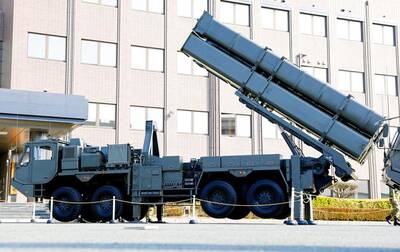
Japan has deployed long-range missiles in a southwestern region near China, the Japanese defense minister said yesterday, at a time when ties with Beijing are at their lowest in recent years. The missiles were installed in Kumamoto in the southern region of Kyushu, as Japan is attempting to shore up its military capacity as China steps up naval activity in the East China Sea. “Standoff defense capabilities enable us to counter the threat of enemy forces attempting to invade our country ... while ensuring the safety of our personnel,” Japanese Minister of Defense Shinjiro Koizumi said. “This is an extremely important initiative for

The nation’s fastest supercomputer, Nano 4 (晶創26), is scheduled to be launched in the third quarter, and would be used to train large language models in finance and national defense sectors, the National Center for High-Performance Computing (NCHC) said. The supercomputer, which would operate at about 86.05 petaflops, is being tested at a new cloud computing center in the Southern Taiwan Science Park in Tainan. The exterior of the server cabinet features chip circuitry patterns overlaid with a map of Taiwan, highlighting the nation’s central position in the semiconductor industry. The center also houses Taiwania 2, Taiwania 3, Forerunner 1 and
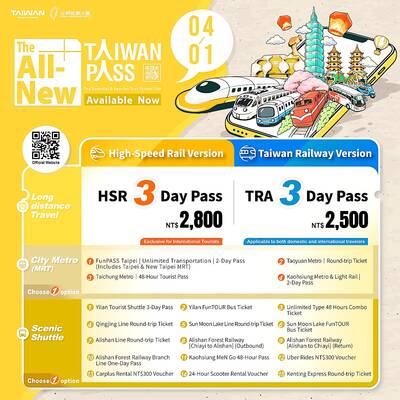
MORE POPULAR: Taiwan Pass sales increased by 59 percent during the first quarter compared with the same period last year, the Tourism Administration said The Tourism Administration yesterday said that it has streamlined the Taiwan Pass, with two versions available for purchase beginning today. The tourism agency has made the pass available to international tourists since 2024, allowing them to access the high-speed rail, Taiwan Railway Corp services, four MRT systems and four Taiwan Tourist Shuttles. Previously, five types of Taiwan Pass were available, but some tourists have said that the offerings were too complicated. The agency said only two types of Taiwan Pass would be available, starting from a three-day pass with the high-speed rail and a three-day pass with Taiwan Railway Corp. The former costs NT$2,800
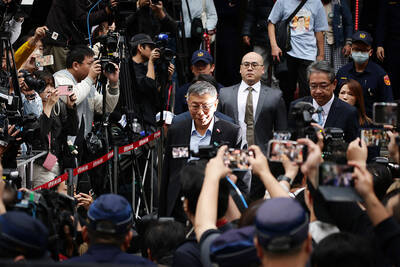
FIRST TRIAL: Ko’s lawyers sought reduced bail and other concessions, as did other defendants, but the bail judge denied their requests, citing the severity of the sentences Former Taipei mayor Ko Wen-je (柯文哲) was yesterday sentenced to 17 years in prison and had his civil rights suspended for six years over corruption, embezzlement and other charges. Taipei prosecutors in December last year asked the Taipei District Court for a combined 28-year, six-month sentence for the four cases against Ko, who founded the Taiwan People’s Party (TPP). The cases were linked to the Core Pacific City (京華城購物中心) redevelopment project and the mismanagement of political donations. Other defendants convicted on separate charges included Chinese Nationalist Party (KMT) Taipei City Councilor Angela Ying (應曉薇), who was handed a 15-year, six-month sentence; Core Pacific


 RSS
RSS