

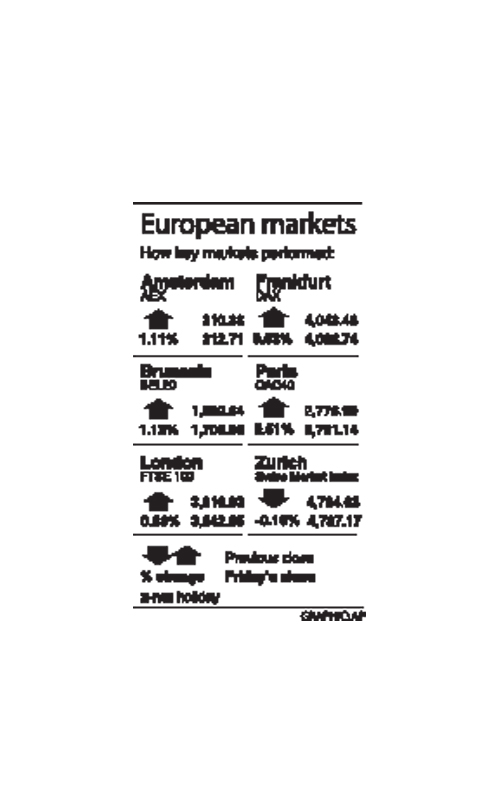
European stocks rose for a second week, led by financial firms, after Barclays PLC and HSBC Holdings PLC reported a “strong” start to this year and the US Federal Reserve pledged to buy US$300 billion in US government bonds.
Barclays, the UK’s third-biggest lender, surged 42 percent, while HSBC, Deutsche Bank AG and UBS AG also climbed. Companies relying on US sales, including Royal Ahold NV, limited gains in the Dow Jones STOXX 600 Index as the US dollar tumbled, while Group Danone SA paced losses among businesses less geared to economic growth.
The STOXX 600 advanced 2.4 percent to 172.58. The gauge measure has rebounded 9.3 percent since reaching a 12-year low on March 9 as Citigroup Inc, Bank of America Corp and JPMorgan Chase & Co said they made money during the first two months of this year, trimming this year’s drop to 13 percent.
“We had had a very aggressive sell-off, investors were very defensive, and there was a lot of cash on the side,” said Adrian Darley, who helps oversee about US$101 billion as head of equities at Ignis Asset Management Ltd. “There’s been a lot of value in the market for a while.”
National benchmark indexes climbed in all 18 of the western European markets except Luxembourg this week. The UK’s FTSE 100 rose 2.8 percent, led higher by Aviva PLC. Germany’s DAX added 2.9 percent, and France’s CAC 40 advanced 3.2 percent as Axa SA rallied.
Banks in the region have underpinned a 21-month market rout as they reported more than US$370 billion in credit losses.
“Markets have seen an increase in signs pointing to an end of the stressed phase,” said Gunnar Stangl, head of portfolio strategy at Dresdner Kleinwort in Frankfurt. “While the recession still has to run its course around the globe, valuations may start to set their sights beyond the downturn.”
Banks in the STOXX 600 added 10 percent as a group, while a measure for insurers soared 13 percent.
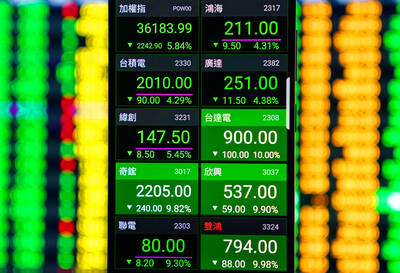
VOLATILITY: The decline in Taiwan’s stock market largely mirrored global markets, and there are no problems with the nation’s economy, the Ministry of Finance said The Financial Supervisory Commission (FSC) yesterday announced that it had further tightened short-selling restrictions after the country’s stock market suffered heavy losses in recent sessions amid global volatility in artificial intelligence (AI)-related stocks. In a statement, the FSC said it had prohibited short-selling of stocks whose prices fell in the previous trading session, marking the first time since 2015 that the commission had imposed such a blanket restriction. The latest measure tightens a restriction announced on Thursday that prohibited short-selling of stocks that had fallen 3.5 percent or more in the previous trading session. The new rule is aimed at

The Legislative Yuan yesterday passed a bill to give NT$20,000 (US$607.24) to members of the public, with the Chinese Nationalist Party (KMT) voting for it, while Taiwan People’s Party (TPP) lawmakers opposed it and Democratic Progressive Party (DPP) legislators running for local office did not vote. The bill, proposed by the KMT caucus, passed 50-46, with all eight TPP lawmakers voting against it. DPP lawmakers at the session also voted against the bill, but the rare show of agreement between the DPP and the TPP failed to block its passage, with 13 DPP lawmakers absent. Almost all of the absent DPP lawmakers were
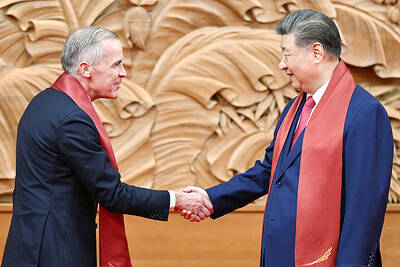
CALL FOR COLLABORATION: ‘We have a high respect of Prime Minister [Mark] Carney’s vision, and we want to be part of this vision,’ the deputy minister of foreign affairs said Canadian Prime Minister Mark Carney risks exposing Canada to the very economic coercion he has cautioned against by deepening trade ties with China, Deputy Minister of Foreign Affairs Chen Ming-chi (陳明祺) said on Saturday, adding that Taiwan has learned the hard way that dependence on Beijing comes with consequences. “We worry. We worry,” Chen said in an interview at the Halifax International Security Forum in Nova Scotia when asked about Carney’s efforts to improve relations with China. Carney has said that major powers are using economic integration as a weapon, citing US tariffs and China’s restrictions on critical minerals. He
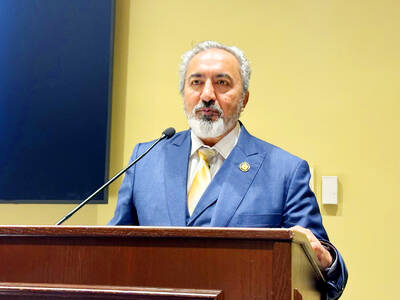
STRONG BIPARTISAN SUPPORT: It is the established policy of the US Congress that Taiwan’s future should be decided by its people, US Representative Ami Bera said Bipartisan congressional groups are expected to continue supporting Taiwan in the next US Congress, incoming US House of Representatives Foreign Affairs Subcommittee on East Asia and the Pacific chairman Ami Bera said, reaffirming the longstanding US congressional position that Taiwan’s future should be decided by its people. Bera made the remarks at a seminar hosted by the Washington-based Global Taiwan Institute titled: “If China Seizes Taiwan: Implications for the United States and the World.” The new US Congress is scheduled to take office on Jan. 3, and the Democratic representative from California is expected to chair the subcommittee. Bera said


 RSS