


An angry US public and Congress are pushing to snip the rip cord on golden parachutes used by fat cat CEOs to escape Wall Street’s mayhem.
Democrats in Congress — set to resume emergency talks yesterday with their Republican counterparts on a US$700 billion bailout for the financial industry — insisted that any agreed package include restrictions on executive pay.
They caught the mood of a nation sickened at watching the titans of finance walk away from Wall Street disasters not only unscathed, but enriched.
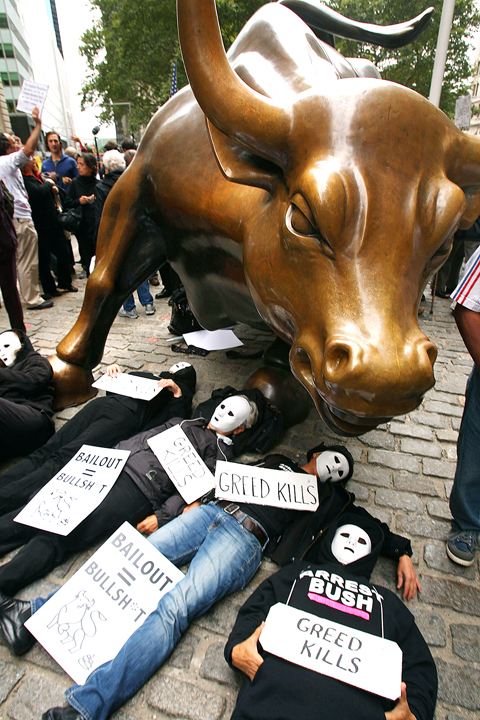
PHOTO: AFP
“The wealthiest people, those ... in the best position to pay, are being asked for no sacrifice at all,” read a petition to US Treasury Secretary Henry Paulson, which by Thursday, after three days, had 32,600 signatures.
The petition, organized by independent Senator Bernie Sanders from Vermont, attacked what it described as the Treasury’s attempt to let bungling executives “continue to make exorbitant salaries and bonuses.”
Those huge pay checks, bonuses and Midas-like farewells encapsulate what the public sees as Wall Street’s greed-is-good philosophy.
For example, the CEO of bankrupt Lehman Brothers, Richard Fuld, received total compensation of US$71.9 million last year, including stock, bonuses and other pay, a survey published by Forbes magazine showed.
Martin Sullivan, the chief executive of AIG, who left the insurance giant before it was rescued this month by the federal government, received US$14 million, a survey in USA Today said. He also quit with a US$47 million severance package.
Even punishment for those at the center of the chaos comes with a gold lining.
When the government took over collapsed mortgage giants Fannie Mae and Freddie Mac, ousted bosses Daniel Mudd and Richard Syron were not allowed US$12.59 million in severance payments.
Yet they still got out the door with US$9.43 million in retirement benefits.
Public anger at such figures underlies skepticism about the entire government rescue.
“We’ll never see that money again,” said Mathew May, a 24-year-old economics student attending a small demonstration near the New York Stock Exchange. “They deregulated the markets and ran wild. Now we’re bailing them out.”
Arun Gupta, an editor of alternative New York newspaper the Indypendent, said there was “socialism for the rich and dog-eat-dog capitalism for the rest of us.”
“Think about it,” Gupta wrote in an e-mail that quickly circulated to thousands of activists and inspired the New York street protest.
“They said providing healthcare for 9 million children, perhaps costing US$6 billion a year, was too expensive, but there’s evidently no sum of money large enough that will sate the Wall Street pigs,” Gupta said.
And left-wingers are not the only ones speaking out.
Newt Gingrich, the fiercely conservative former speaker in the House of Representatives, wrote in the National Review that the bailouts, likely to top a trillion dollars, smack of “crony capitalism.”
“Doesn’t that mean that we’re using the taxpayers’ money to hire people to save their friends with even more taxpayer money?” he asked.
Forbes, the magazine of the rich and the wealthy, also said enough was enough.
“The compensation schemes for Wall Street CEOs should be capped to a small fixed amount,” national editor Robert Lenzner wrote.
“The rest should be dependent on performance in a way that does not reward taking greater risk than is prudent. If CEOs don’t perform, they should get nothing,” he wrote.
One worker in the New York finance sector, who asked not to be named, said his colleagues were as angry as the general public.
“A lot of people are very upset that managers in their own companies and captains of industry in other areas made some really, really bad decisions,” he said.
“The most insulting thing is the golden parachutes where these jackals from Fannie and Freddie, having destroyed the company, walked away with millions .... It all comes down to greed,” he said.
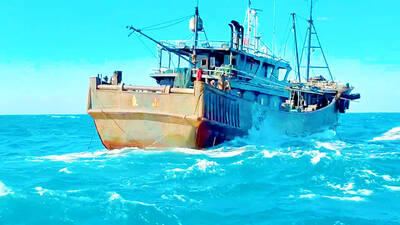
MAKING WAVES: China’s maritime militia could become a nontraditional threat in war, clogging up shipping lanes to prevent US or Japanese intervention, a report said About 1,900 Chinese ships flying flags of convenience and fishing vessels that participated in China’s military exercises around Taiwan last month and in January last year have been listed for monitoring, Coast Guard Administration (CGA) Deputy Director-General Hsieh Ching-chin (謝慶欽) said yesterday. Following amendments to the Commercial Port Act (商港法) and the Law of Ships (船舶法) last month, the CGA can designate possible berthing areas or deny ports of call for vessels suspected of loitering around areas where undersea cables can be accessed, Oceans Affairs Council Minister Kuan Bi-ling (管碧玲) said. The list of suspected ships, originally 300, had risen to about
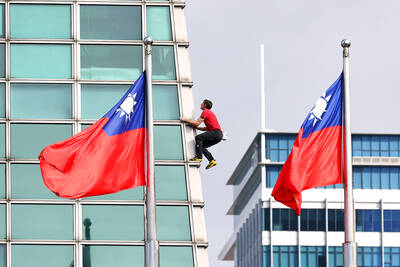
DAREDEVIL: Honnold said it had always been a dream of his to climb Taipei 101, while a Netflix producer said the skyscraper was ‘a real icon of this country’ US climber Alex Honnold yesterday took on Taiwan’s tallest building, becoming the first person to scale Taipei 101 without a rope, harness or safety net. Hundreds of spectators gathered at the base of the 101-story skyscraper to watch Honnold, 40, embark on his daredevil feat, which was also broadcast live on Netflix. Dressed in a red T-shirt and yellow custom-made climbing shoes, Honnold swiftly moved up the southeast face of the glass and steel building. At one point, he stepped onto a platform midway up to wave down at fans and onlookers who were taking photos. People watching from inside
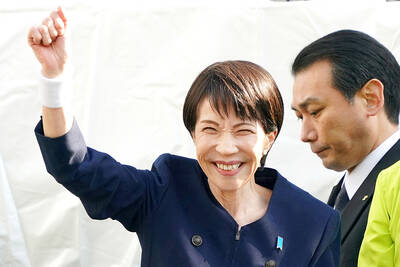
Japan’s strategic alliance with the US would collapse if Tokyo were to turn away from a conflict in Taiwan, Japanese Prime Minister Sanae Takaichi said yesterday, but distanced herself from previous comments that suggested a possible military response in such an event. Takaichi expressed her latest views on a nationally broadcast TV program late on Monday, where an opposition party leader criticized her for igniting tensions with China with the earlier remarks. Ties between Japan and China have sunk to the worst level in years after Takaichi said in November that a hypothetical Chinese attack on Taiwan could bring about a Japanese
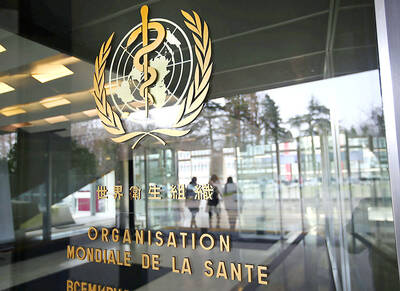
The WHO ignored early COVID-19 warnings from Taiwan, US Deputy Secretary of Health and Human Services Jim O’Neill said on Friday, as part of justification for Washington withdrawing from the global health body. US Secretary of State Marco Rubio on Thursday said that the US was pulling out of the UN agency, as it failed to fulfill its responsibilities during the COVID-19 pandemic. The WHO “ignored early COVID warnings from Taiwan in 2019 by pretending Taiwan did not exist, O’Neill wrote on X on Friday, Taiwan time. “It ignored rigorous science and promoted lockdowns.” The US will “continue international coordination on infectious


 RSS
RSS