


Life in India’s eastern state of West Bengal and southern Andhra Pradesh was disrupted yesterday after opposition parties called a day-long shutdown to protest a hike in fuel prices, officials said.
Demanding a rollback, the left-wing partners of the ruling United Progressive Alliance (UPA) launched weeklong protests on Thursday with a shutdown in the West Bengal, eastern Tripura and southern Kerala states, which they govern.
The strikes began a day after the UPA increased prices of petrol, diesel fuel and cooking gas by between 9.5 and 17 percent.
West Bengal was in the grip of the second day of the strike, which disrupted road and rail transport and was called by the opposition Trinamool Congress party.
Railway authorities said they canceled several trains and many long-distance trains were stranded at stations because of blockades put on the tracks by strike supporters.
Most shops and markets were closed and there were few vehicles on roads in the state’s cities, particularly in and around its capital, Kolkata. Schools, colleges and educational institutions also remained closed.
Meanwhile, the strike call by the opposition Telegu Desam Party evoked a successful response in Andhra Pradesh with businesses shutting down and thin attendance in offices.
Opposition parties including the Bharatiya Janata Party and communist parties also called for a statewide strike and opposition activists held protests and sit-ins around Andhra Pradesh.
A near-shutdown was seen in the state capital, Hyderabad, and the other main cities, including Vishakapatnam, Vijaywada, Guntur, Kakinada, Tirupati and Medak, the IANS news agency reported.
Other news outlets reported that strikers had laid siege at state-run bus depots and threw stones at buses to stop road transport in the state.
Local train service was also disrupted in India’s financial capital of Mumbai because of protests by the opposition Hindu nationalist Shiv Sena party.
The demonstrators, who carried out a rail blockade at one of the main rail lines in Mumbai, were dispersed by police later in the day.
In a related development, Indian Prime Minister Manmohan Singh directed his Cabinet to adopt “austerity measures” and cut all wasteful expenditures, particularly on foreign travel, the Hindu newspaper reported.
The Congress Party-led UPA came to power in 2004, promising to alleviate economic hardships for the poor and farmers, but it has lost several key state elections and economic problems are expected to have a negative impact on its future electoral prospects.
A spate of state elections are scheduled over the next few months and general elections are due next year.
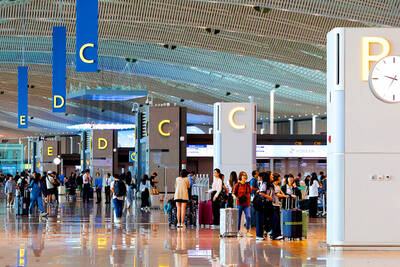
South Korea has adjusted its electronic arrival card system to no longer list Taiwan as a part of China, a move that the Ministry of Foreign Affairs said would help facilitate exchanges between the two sides. South Korea previously listed “Taiwan” as “Taiwan (China)” in the drop-down menus of its online arrival card system, where people had to fill out where they came from and their next destination. The ministry had requested South Korea make a revision and said it would change South Korea’s name on Taiwan’s online immigration system from “Republic of Korea” to “Korea (South),” should the issue not be

Tainan, Taipei and New Taipei City recorded the highest fines nationwide for illegal accommodations in the first quarter of this year, with fines issued in the three cities each exceeding NT$7 million (US$220,639), Tourism Administration data showed. Among them, Taipei had the highest number of illegal short-term rental units, with 410. There were 3,280 legally registered hotels nationwide in the first quarter, down by 14 properties, or 0.43 percent, from a year earlier, likely indicating operators exiting the market, the agency said. However, the number of unregistered properties rose to 1,174, including 314 illegal hotels and 860 illegal short-term rental
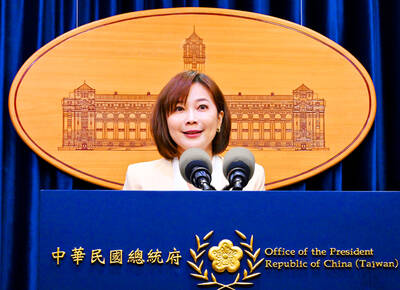
ECONOMIC COERCION: Such actions are often inconsistently applied, sometimes resumed, and sometimes just halted, the Presidential Office spokeswoman said The government backs healthy and orderly cross-strait exchanges, but such arrangements should not be made with political conditions attached and never be used as leverage for political maneuvering or partisan agendas, Presidential Office spokeswoman Karen Kuo (郭雅慧) said yesterday. Kuo made the remarks after China earlier in the day announced 10 new “incentive measures” for Taiwan, following a landmark meeting between Chinese President Xi Jinping (習近平) and Chinese Nationalist Party (KMT) Chairwoman Cheng Li-wun (鄭麗文) in Beijing on Friday. The measures, unveiled by China’s Xinhua news agency, include plans to resume individual travel by residents of Shanghai and China’s Fujian
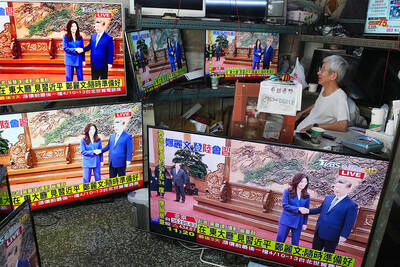
Chinese President Xi Jinping (習近平) and Chinese Nationalist Party (KMT) Chairwoman Cheng Li-wun (鄭麗文) met in Beijing yesterday, where they vowed to bring people on both sides of the Taiwan Strait closer to facilitate the “great rejuvenation of the Chinese nation.” The meeting was held in the East Hall of the Great Hall of the People, a venue typically reserved for meetings between Xi and foreign heads of state. In public remarks prior to a closed-door meeting, Xi, in his role as head of the Chinese Communist Party (CCP), said that Taiwan is historically part of China, and remains an “inalienable” and


 RSS
RSS