


The US and China, with increasingly dependent economies, have to work together to fight protectionist sentiment in both countries, officials from both nations said yesterday.
The comments came on the eve of high-level meetings this week between US Treasury Secretary Henry Paulson and Chinese officials at which China's massive trade surplus with the US and its product safety record are expected to be key issues.
"We have to continue opening global markets. America and China must work together to stem the tide of projectionist sentiment in out nations," said US Secretary of Commerce Carlos Gutierrez.
"It is ironic that we have found that protectionism does not protect. The only thing that does protect is innovation and engaging with the world, competing, being more productive," Gutierrez told a seminar on innovation in Beijing.
Gutierrez also pointed to China's reputation for lax enforcement of intellectual property rights, calling for "consistent, transparent and equitable" rules to guarantee that innovation will not be stifled.
Congress has been demanding the US administration act more forcefully to get China to halt what critics see as unfair trade practices. They contend China is manipulating its currency to keep the value low to boost Chinese imports into the US while making US goods more expensive in China, inflating the US trade deficit with China, which last year reached a record US$233 billion.
US Health Secretary Mike Leavitt said China and Western countries needed to cooperate because the global market had changed so much that governments had lagged behind in regulating their booming trade.
"Our systems our different and yet we need to achieve a common result ... it's a question of building bridges," Leavitt said in a separate speech to the American Chamber of Commerce in Beijing.
Leavitt, who will sign an agreement today on food and feed product safety, and a second on drugs and medical devices, quoted a Chinese proverb in saying the bridge-building would take time.
"The man who removes a mountain begins by carrying away small stones," he said. "This is not about the US and China, this is about the world," Leavitt said.
Their comments were echoed by published remarks from Chinese officials.
Chinese Finance Minister Xie Xuren (謝旭人) said in an interview with the official Xinhua news agency that the protectionist sentiment in the US Congress was alarming.
"At present, the tendency within Congress toward protectionism is in fact rather worrying," Xie said.
He added the passage of such legislation would "seriously harm China-US trade cooperation, and in the end, harm America's own interests."
Chinese Vice Commerce Minister Chen Deming (
He said a narrow focus on the value of the yuan and intellectual property rights risked "hindering the normal development" of trade links.
Paulson said last week in Washington that US worries about Chinese product safety will be a major topic at the Strategic Economic Dialogue meeting to be held just outside Beijing starting tomorrow.
China's ability to manage the safety of its goods will be an important part of Beijing's future growth and its trade relations with the US, he said.
Paulson and other senior Bush administration officials in China for the third round of the talks. Paulson launched the effort a year ago, but so far it has produced few results. Chinese Vice Premier Wu Yi (
Gutierrez later attended a ceremony where Wal-Mart China announced it had received approval to open its 100th store in China. It will open in Loudi, Hunan Province.
About 80 Wal-Mart employees wearing red shirts were on hand in a Beijing hotel. US products sold in Wal-Mart stores in China, such as Hunt's barbecue sauce and apples from Washington state, were on display.
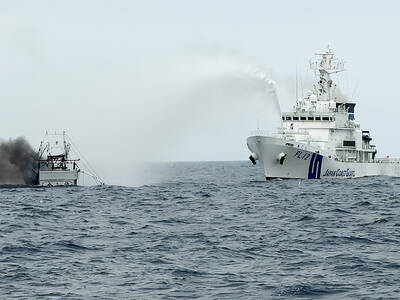
CREDIT-GRABBER: China said its coast guard rescued the crew of a fishing vessel that caught fire, who were actually rescued by a nearby Taiwanese boat and the CGA Maritime search and rescue operations do not have borders, and China should not use a shipwreck to infringe upon Taiwanese sovereignty, the Coast Guard Administration (CGA) said yesterday. The coast guard made the statement in response to the China Coast Guard (CCG) saying it saved a Taiwanese fishing boat. The Chuan Yu No. 6 (全漁6號), a fishing vessel registered in Keelung, on Thursday caught fire and sank in waters northeast of Diaoyutai Islands (釣魚台). The vessel left Keelung’s Badouzih Fishing Harbor (八斗子漁港) at 3:35pm on Sunday last week, with seven people on board — a 62-year-old Taiwanese captain surnamed Chang (張) and six
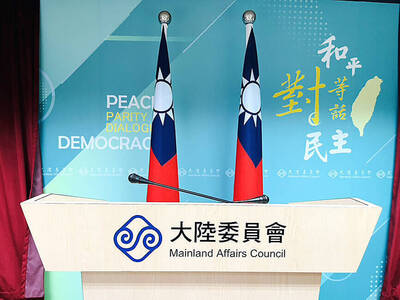
RISKY BUSINESS: The ‘incentives’ include initiatives that get suspended for no reason, creating uncertainty and resulting in considerable losses for Taiwanese, the MAC said China’s “incentives” failed to sway sentiment in Taiwan, as willingness to work in China hit a record low of 1.6 percent, a Ministry of Labor survey showed. The Directorate-General of Budget, Accounting and Statistics (DGBAS) also reported that the number of Taiwanese workers in China has nearly halved from a peak of 430,000 in 2012 to an estimated 231,000 in 2024. That marked a new low in the proportion of Taiwanese going abroad to work. The ministry’s annual survey on “Labor Life and Employment Status” includes questions respondents’ willingness to seek employment overseas. Willingness to work in China has steadily declined from
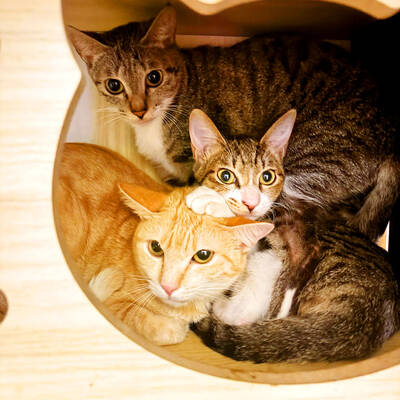
The number of pet cats in Taiwan surpassed that of pet dogs for the first time last year, reaching 1,742,033, a 32.8 percent increase from 2023, the Ministry of Agriculture said yesterday, citing a survey. By contrast, the number of pet dogs declined slightly by 1.2 percent over the same period to 1,462,528, the ministry said. Despite the shift, households with dogs still slightly outnumber those with cats by 1.2 percent. However, while the number of households with multiple dogs has remained relatively stable, households keeping more than two cats have increased, contributing to the overall rise in the feline population. The trend

LEVERAGE: China did not ‘need to fire a shot’ to deny Taiwan airspace over Africa when it owns ‘half the continent’s debt,’ a US official said, calling it economic warfare The EU has raised concerns about overflight rights following the delay of President William Lai’s (賴清德) planned state visit to the Kingdom of Eswatini after three African nations denied overflight clearance for his charter at the last minute. Taiwanese allies Paraguay and Saint Kitts and Nevis, as well as several US lawmakers and the Inter-Parliamentary Alliance on China (IPAC) condemned China for allegedly pressuring the countries. Lai was scheduled to fly directly to Taiwan’s only African ally from yesterday to Sunday to celebrate the 40th anniversary of King Mswati III’s accession and his 58th birthday, but Seychelles, Mauritius and Madagascar suddenly revoked


 RSS
RSS