


After 20 straight days of negotiations, the United Auto Workers (UAW) union said it would strike General Motors Corp yesterday morning if a new contract agreement is not reached, saying the automaker has failed to address job security and other concerns.
"We're shocked and disappointed that General Motors has failed to recognize and appreciate what our membership has contributed during the past four years," UAW president Ron Gettelfinger said in a statement early yesterday.
The union had been expected to ask General Motors for guarantees of future production at US plants as part of the negotiations.
The union had set the strike deadline for 11am yesterday. Cal Rapson, the union's chief General Motors negotiator, said the union would remain at the bargaining table until the deadline.
He said the company had failed to meet the needs and concerns of the union members.
"Instead, in 2007 company executives continued to award themselves bonuses while demanding that our members accept a reduced standard of living," Rapson said in a statement.
"The company's disregard for our members has forced our bargaining committee to take this course of action," he said.
General Motors spokesman Dan Flores said the automaker is working with the union to resolve issues.
"The contract talks involve complex, difficult issues that affect the job security of our US work force and the long term viability of the company," Flores said.
"We are fully committed to working with the UAW to develop solutions together to address the competitive challenges facing General Motors," he said.
The union may be trying to pressure General Motors to get a deal.
Gettelfinger said as recently as on Friday that the union was trying to speed up negotiations and did not want to strike.
UAW has not called a nationwide strike during contract negotiations since 1976, when Ford Motor Co plants were shut down. There were strikes at two General Motors plants during contract negotiations in 1996.
It represents 73,000 General Motors workers at 82 US facilities nationwide. If workers go on strike, they will be paid US$200 a week plus medical benefits from the union strike fund.
The union had more than US$800 million in the fund as of last November, its Web site said.
UAW's original deadline to reach an agreement with GM was Sept. 14, but the union decided to extend the contract on an hour-by-hour basis and keep talking.
It was widely believed that the negotiators were making progress and a strike would not be called.
A local UAW official said on Sunday that negotiators had wrapped up work on most issues and were determining how much money General Motors must put into a trust fund for retiree healthcare that will be managed by the union.
The official spoke on condition of anonymity because the talks are private.
The healthcare fund -- known as a Voluntary Employees Beneficiary Association (VEBA) -- would be a significant change for the auto industry and has been the major issue in this year's negotiations. General Motors has approximately US$51 billion in unfunded retiree health care costs but the company is not required to put the full amount into the VEBA.
The union and General Motors have been wrangling over how much GM should put in and how much can be paid in cash or in stock.
The union picked General Motors as the lead company and potential strike target in the negotiations, which began in July. Ford Motor Co and Chrysler LLC have indefinitely extended their contracts with the union.
They are expected to match many of the terms of GM's agreement once it is reached. The three automakers have a total of US$90 billion in unfunded retiree health care costs.
If a tentative agreement is reached, local union leaders will meet for a briefing and then present the contract to their members. Any agreement would have to be ratified by a majority of General Motors' UAW members.
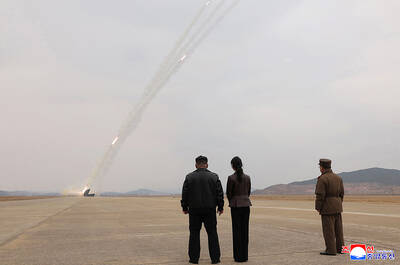
North Korea tested nuclear-capable rocket launchers, state media reported yesterday, a day after Seoul detected the launch of about 10 ballistic missiles. The test comes after South Korean and US forces launched their springtime military drills, due to run until Thursday. North Korean leader Kim Jong-un on Saturday oversaw the testing of the multiple rocket launcher system (MRLS), the Korean Central News Agency (KCNA) said. The test involved 12 600mm-caliber ultra-precision multiple rocket launchers and two artillery companies, it said. Kim said the drill gave Pyongyang’s enemies, within the 420km striking range, a sense of “uneasiness” and “a deep understanding
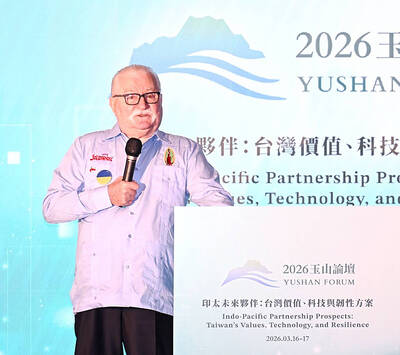
RECOGNITION: Former Fijian prime minister Mahendra Chaudhry said that Taiwan’s New Southbound Policy serves as a stabilizing force in the Indo-Pacific region Taiwan can lead the unification of the Chinese people, Nobel Peace Prize laureate and former Polish president Lech Walesa said in Taipei yesterday, adding that as the world order is changing, peaceful discussion would find good solutions, and that the use of force and coercion would always fail. Walesa made the remarks during his keynote address at a luncheon of the Yushan Forum in Taipei, titled “Indo-Pacific Partnership Prospects: Taiwan’s Values, Technology and Resilience,” organized by the Taiwan-Asia Exchange Foundation with the Ministry of Foreign Affairs. Walesa said that he had been at the forefront of a big peaceful revolution and “if
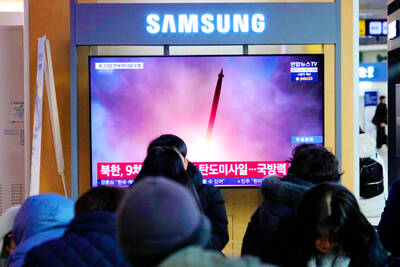
North Korea yesterday fired about 10 ballistic missiles to the sea toward Japan, the South Korean Joint Chiefs of Staff (JCS) said, days after Pyongyang warned of “terrible consequences” over ongoing South Korea-US military drills. Pyongyang recently dashed hopes of a diplomatic thaw with Seoul, Washington’s security ally, describing its latest peace efforts as a “clumsy, deceptive farce.” Seoul’s military detected “around 10 ballistic missiles launched from the Sunan area in North Korea toward the East Sea [Sea of Japan] at around 1:20pm,” JCS said in a statement, referring to South Korea’s name for the body of water. The missiles

‘UNWAVERING FRIENDSHIP’: A representative of a Japanese group that co-organized a memorial, said he hopes Japanese never forget Taiwan’s kindness President William Lai (賴清德) yesterday marked the 15th anniversary of the Tohoku earthquake and tsunami, urging continued cooperation between Taiwan and Japan on disaster prevention and humanitarian assistance. Lai wrote on social media that Taiwan and Japan have always helped each other in the aftermath of major disasters. The magnitude 9 earthquake struck northeastern Japan on March 11, 2011, triggering a massive tsunami that claimed more than 19,000 lives, according to data from Japanese authorities. Following the disaster, Taiwan donated more than US$240 million in aid, making it one of the largest contributors of financial assistance to Japan. In addition to cash donations and


 RSS
RSS