


The global demand for diesel vehicles is expected to nearly double over the next 10 years to 29 million vehicles from 15 million sold worldwide last year, J.D. Power Automotive Forecasting said on Thursday.
A sharp increase in demand in the US, which has been slow to adopt diesel, will help fuel the growth, the company said.
Diesel vehicles are expected to make up 10 percent of the vehicles sold in the US by 2015 from the current rate of just 3.2 percent. That will help push the global market share of diesel vehicles to 26 percent from the current rate of 18 percent, J.D. Power forecast.
"As a proven, cost-effective and `off-the-shelf' solution, diesel has a head start over other emerging fuel-efficient technologies," Alastair Bedwell, senior manager for J.D. Power Automotive Forecasting said in a statement.
"With energy prices at elevated levels and new regulatory pressure to improve light-truck fuel efficiency, a range of fuel-efficient alternatives to the conventional gasoline engine will be required," he said. "The United States and Canada are markets with enormous potential for diesel light-vehicle sales."
Prospects for diesel demand within Asian markets remains mixed, however.
"South Korea and India are key markets for diesel growth in Asia, and the market in China is continuously developing," Bedwell said.
"However, near- and mid-term prospects for diesel vehicle sales in Japan remain limited. There has been some rejection of diesel technology among consumers," he said.
New emission controls will limit the cost advantages of diesel fuel in Europe and J.D. Power forecasts that diesel is approaching a saturation point in Western Europe at below 60 percent of the market.
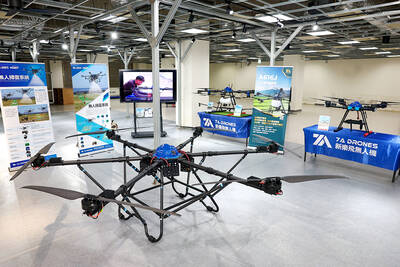
DRONE CENTRAL: Taiwan aims to become Asia’s democratic hub for drones, with most exports focused on high-quality military-grade models, an official said Taiwan’s drone industry is expected to expand significantly by 2030, producing 100,000 units per month and exporting half of them, the Ministry of Economic Affairs said yesterday. Current drone production capacity is about 15,000 units per month, but the industry can quickly scale up as demand increases, Industrial Development Administration Director-General Chiou Chyou-huey (邱求慧) told a news conference in Taipei. Taiwan’s drone output grew 2.5-fold last year to NT$12.9 billion (US$408.3 million) under a government program to develop the uncrewed vehicle sector, he said. The Executive Yuan in October last year approved plans to invest NT$44.2 billion into domestic production of uncrewed aerial
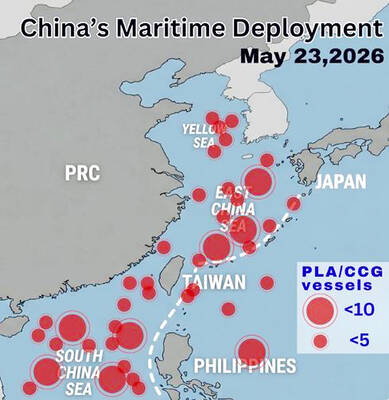
WARNING: China should stop engaging in actions that undermine regional peace and stability, as it would only build resentment among people across the Strait, the CGA said China has deployed more than 100 navy, coast guard and other vessels in waters from the Yellow Sea to the South China Sea and the western Pacific since US President Donald Trump and Chinese President Xi Jinping (習近平) met in Beijing, National Security Council Secretary-General Joseph Wu (吳釗燮) said yesterday. “In this part of the world, #China is the one & only PROBLEM wrecking the #StatusQuo & threatening regional peace & stability,” Wu wrote on X. In a separate post, he said Beijing was coercing Taiwan’s maritime domain, calling it illegal and provocative, after the Coast Guard Administration (CGA) expelled a

VERBOSE VESSELS: A CGA cutter and a China Coast Guard exchanged verbal barbs for more than a day in Taiwanese-controlled waters before the Chinese vessel left The Taiwanese and Chinese coast guards had a standoff near the strategically located Pratas Islands (Dongsha Islands, 東沙群島) in the north of the South China Sea, the Coast Guard Administration (CGA) said yesterday. The two sides engaged in intense radio exchanges over sovereignty claims during the 33-hour standoff. China Coast Guard vessel 3501 eventually left the restricted waters, 26.6 nautical miles (49.2km) west of the Pratas Islands, at 5pm yesterday, the CGA said. Lying approximately between southern Taiwan and Hong Kong, the Taiwan-controlled Pratas are seen by some security experts as vulnerable to Chinese attack due to their distance — more than

More than 8,000 people took part in a rally in Taipei yesterday to express support for more defense spending, after the opposition slashed the Cabinet’s proposed NT$1.25 trillion (US$39.6 billion) special defense budget and capped it at NT$780 billion. The demonstrators urged the Cabinet to propose another bill. Taiwan Economic Democracy Union convener Lai Chung-chiang (賴中強) said the main problem of the passed budget plan is the removal of funding for critical items, not just that the total amount is smaller. Critical budget items included purchasing or developing uncrewed vehicles, Strong Bow (強弓) missile systems, additional ammunition, artificial intelligence-powered combat systems and Taiwan-US


 RSS
RSS