


US-Chinese talks on a dispute over American efforts to restrain surging imports of Chinese underwear and other textiles broke down yesterday, the chief US negotiator said, leaving little chance of a settlement before Chinese President Hu Jintao (胡錦濤) visits Washington next week.
A brief written statement issued by US envoy David Spooner didn't say whether the two sides had made any progress.
"Despite our best efforts we were not able to reach a broader agreement," the statement said. "We will be consulting with the Chinese over the next few days on the date and location of the next round."
Washington has imposed controls on the growth of imports of some low-priced Chinese textiles, which have surged since a worldwide quota system expired on Jan. 1. US producers complain that the flood of goods threatens to wipe out thousands of jobs.
Talks aimed at negotiating controls on a broader range of products began on Tuesday and were to last two days. They were extended into yesterday, though US negotiators were doubtful they could reach an agreement.
The dispute is especially sensitive amid rising US frustration at the country's soaring trade deficit with China, which reached a record US$162 billion last year. Washington says the trade deficit this year is running 32 percent above that level.
Chinese officials argue that developed countries should focus on selling higher-tech goods such as airliners and not try to block China's exports of low-cost items like socks and underwear.
The Chinese government hasn't commented on the talks, but state media have suggested that Beijing's position might be strengthened by an uproar in the EU over a backlog of Chinese textiles at European ports under a quota system negotiated in June.
"This trade fiasco demonstrates that protective measures, at best, are zero-sum games for those who resort to them," the official China Daily newspaper said on Wednesday.
In Europe, some 75 million pieces of Chinese-made clothing are stuck in customs houses for exceeding import limits, prompting European retailers to complain that their store shelves may go bare.
In Brussels, the EU head office said on Wednesday there was growing consensus among member states to unblock the Chinese textile imports held up at Europe's borders.
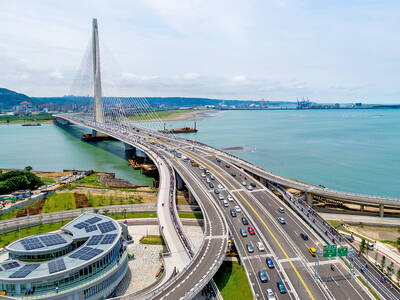
The Ministry of Transportation and Communications yesterday inaugurated the Danjiang Bridge across the Tamsui River in New Taipei City, saying that the structure would be an architectural icon and traffic artery for Taiwan. Feted as a major engineering achievement, the Danjiang Bridge is 920m long, 211m tall at the top of its pylon, and is the longest single-pylon asymmetric cable-stayed bridge in the world, the government’s Web site for the structure said. It was designed by late Iraqi-British architect Zaha Hadid. The structure, with a maximum deck of 70m, accommodates road and light rail traffic, and affords a 200m navigation channel for boats,
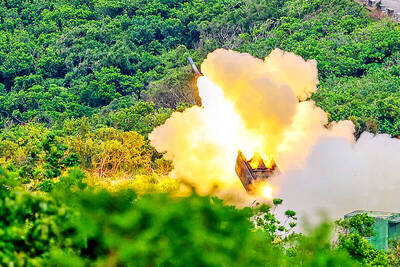
PRECISION STRIKES: The most significant reason to deploy HIMARS to outlying islands is to establish a ‘dead zone’ that the PLA would not dare enter, a source said A High Mobility Artillery Rocket System (HIMARS) would be deployed to Penghu County and Dongyin Island (東引) in Lienchiang County (Matsu) to force the Chinese military to retreat at least 100km from the coastline, a military source said yesterday. Taiwan has been procuring HIMARS and Army Tactical Missile Systems (ATACMS) from the US in batches. Once all batches have been delivered, Taiwan would possess 111 HIMARS units and 504 ATACMS, which have a range of 300km. Considering that “offense is the best defense,” the military plans to forward-deploy the systems to outlying islands such as Penghu and Dongyin so that
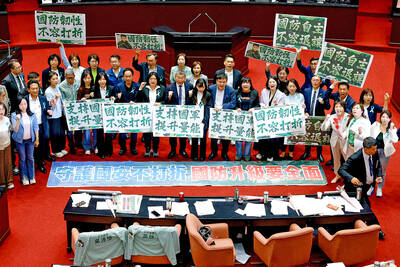
WHAT WAS ALL THAT FOR? Jaw Shaw-kong said that Cheng Li-wen had pushed for more drastic cuts and attacked him, just for the outcome to be nearly identical to his bill The legislature yesterday passed a supplementary budget bill to fund the purchase of separate packages of US military equipment, with the combined amount of spending capped at NT$780 billion (US$24.8 billion). The Chinese Nationalist Party (KMT) and Taiwan People’s Party (TPP) used their legislative majority to pass the bill, which runs until 2033 and has two main funding provisions. One was for NT$300 billion of arms sales already approved by the US for Taiwan on Dec. 17 last year, the other was for NT$480 billion for another arms package expected to be announced by Washington. The bill, which fell short of the NT$1.25
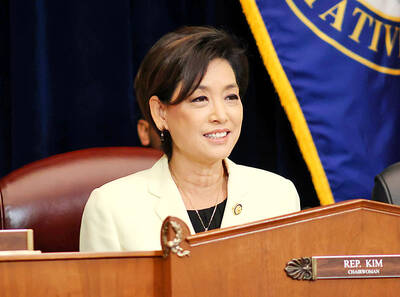
‘CLEAR MESSAGE’: The bill would set up an interagency ‘tiger team’ to review sanctions tools and other economic options to help deter any Chinese aggression toward Taiwan US Representative Young Kim has introduced a bill to deter Chinese aggression against Taiwan, calling for an interagency “tiger team” to preplan coordinated sanctions and economic measures in response to possible Chinese military or political action against Taiwan. “[Chinese President] Xi Jinping [習近平] has directed the People’s Liberation Army to be ready to invade Taiwan by 2027. China has a plan. America should have one too,” Kim said in a news release on Thursday last week. She introduced the “Deter PRC [People’s Republic of China] aggression against Taiwan act” to “ensure the US has a coordinated sanctions strategy ready should


 RSS
RSS