


South Korea's Asiana Airlines scrambled to find alternative ways to ship products for some of the country's biggest corporations after canceling all of its cargo flights yesterday because of a pilots' strike.
The airline, South Korea's second-largest, dropped 78 of its 163 scheduled domestic passenger flights yesterday as well as a flight to Sydney, Australia, its first international cancellation, Asiana spokesman Jason Kim said.
Asiana was forced to suspend all three scheduled cargo flights yesterday, the strike's third day, and was working with other carriers including Germany's Lufthansa Airlines to find substitutes, Kim said.
"Today the cancellation of all cargo flights is causing some problems for us," Kim said.
The airline's cargo customers include Samsung Electronics Co, LG Electronics Inc and Hyundai Motor Co, he said.
On Monday, the airline canceled 81 domestic flights and four of seven scheduled cargo flights.
The airline's unionized pilots walked off the job on Sunday for the second time in less than two weeks, demanding more rest days, a greater say in management decisions and a raising of the retirement age from 55 to 60.
Asiana's management is trying to juggle schedules to protect key domestic and lucrative international routes during peak summer travel. It is operating flights with nonunion pilots and any unionized pilots who haven't joined the strike.
LG Electronics, the world's fourth-largest mobile phone handset maker, and Samsung Electronics, the world's biggest maker of memory chips, reported no major disruptions because of the strike.
"At the moment, we don't have any losses and we're trying to find alternative routes," said Hong Jong-pum, a spokesman for LG.
He said the company mostly ships handsets on Asiana.
The airline has 839 pilots, with 516 in the union, according to Asiana, although the union claims eight additional members. A total of 342 union pilots had joined the strike as of yesterday morning, union spokesman Lee Hack-ju said.
Asiana management and the union weren't talking yesterday, with both sides accusing the other of being unwilling to meet.
Union pilots at Korean Air, the nation's largest carrier, earlier this month launched a work slowdown to demand better benefits and job security. No major disruptions have been reported from the slowdown.
The strike at Asiana and the slowdown at Korean Air have gained little support in South Korea, with newspaper editorials and public opinion largely critical of the pilots.
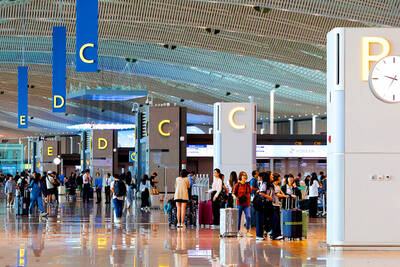
South Korea has adjusted its electronic arrival card system to no longer list Taiwan as a part of China, a move that the Ministry of Foreign Affairs said would help facilitate exchanges between the two sides. South Korea previously listed “Taiwan” as “Taiwan (China)” in the drop-down menus of its online arrival card system, where people had to fill out where they came from and their next destination. The ministry had requested South Korea make a revision and said it would change South Korea’s name on Taiwan’s online immigration system from “Republic of Korea” to “Korea (South),” should the issue not be

Tainan, Taipei and New Taipei City recorded the highest fines nationwide for illegal accommodations in the first quarter of this year, with fines issued in the three cities each exceeding NT$7 million (US$220,639), Tourism Administration data showed. Among them, Taipei had the highest number of illegal short-term rental units, with 410. There were 3,280 legally registered hotels nationwide in the first quarter, down by 14 properties, or 0.43 percent, from a year earlier, likely indicating operators exiting the market, the agency said. However, the number of unregistered properties rose to 1,174, including 314 illegal hotels and 860 illegal short-term rental
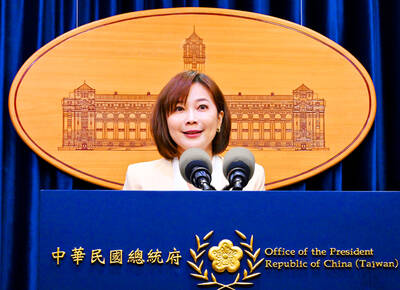
ECONOMIC COERCION: Such actions are often inconsistently applied, sometimes resumed, and sometimes just halted, the Presidential Office spokeswoman said The government backs healthy and orderly cross-strait exchanges, but such arrangements should not be made with political conditions attached and never be used as leverage for political maneuvering or partisan agendas, Presidential Office spokeswoman Karen Kuo (郭雅慧) said yesterday. Kuo made the remarks after China earlier in the day announced 10 new “incentive measures” for Taiwan, following a landmark meeting between Chinese President Xi Jinping (習近平) and Chinese Nationalist Party (KMT) Chairwoman Cheng Li-wun (鄭麗文) in Beijing on Friday. The measures, unveiled by China’s Xinhua news agency, include plans to resume individual travel by residents of Shanghai and China’s Fujian
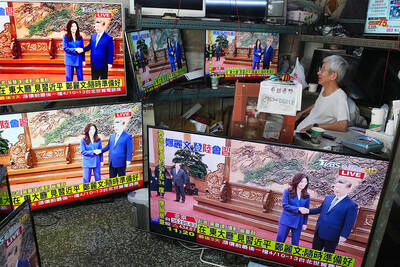
Chinese President Xi Jinping (習近平) and Chinese Nationalist Party (KMT) Chairwoman Cheng Li-wun (鄭麗文) met in Beijing yesterday, where they vowed to bring people on both sides of the Taiwan Strait closer to facilitate the “great rejuvenation of the Chinese nation.” The meeting was held in the East Hall of the Great Hall of the People, a venue typically reserved for meetings between Xi and foreign heads of state. In public remarks prior to a closed-door meeting, Xi, in his role as head of the Chinese Communist Party (CCP), said that Taiwan is historically part of China, and remains an “inalienable” and


 RSS
RSS