


Unionized pilots at Asiana Airlines, South Korea's second-largest carrier, began a strike yesterday after negotiations with management failed. The airline said it canceled one domestic flight but expects few initial disruptions.
The walkout began at noon, union official Lee Sang-jun said. Asiana's unionized pilots have presented a wide range of demands to management, including more rest days, a greater say in management decisions and a higher retirement age.
"Until we achieve our demands, we'll continue the strike," Lee said, describing the possible duration of the walkout as "unlimited."
The strike comes as South Korea enters its peak summer-travel season. Asiana plans to utilize non-union pilots, any unionized pilots who don't strike and its foreign pilots to operate flights, as it did during a one-day walkout by 300 unionized pilots earlier this month. No disruptions were reported then.
Asiana has 839 pilots, with 516 belonging to the union, airline spokesman Jason Kim said. The total number of pilots includes 63 with foreign nationality, none of whom belong to the union, he said.
The union says it has 527 members.
Kim said the airline had to cancel one domestic flight yesterday so the pilot and co-pilot could replace ones that didn't show up on a flight scheduled from the southern city of Pusan to Beijing.
Earlier, Kim said the airline didn't expect any disruption to its domestic and international flight schedules during the first two to three days of the strike and little for the first two weeks.
"We won't have that much of a problem for two weeks," Kim said. After that, "we'll be facing some trouble shifting around the remaining pilots' schedules," he said.
The airline had 158 domestic, 116 international and 13 cargo flights scheduled yesterday, Kim said.
Asiana management and the union were still trying to reach a settlement after the strike began.
The airline's human resources director met union officials at company headquarters in Seoul. Asiana's president, C.H. Park, had intended to meet the union, Kim said, but that plan was canceled.
The meeting broke up without a resolution and another was planned for this morning, both Lee and Kim said.
The decision to strike was made after company officials refused to attend a meeting on Saturday to discuss pilots' demands for increased job security and reduced flying hours, said Lee Hack-ju, another union official.
Asiana's strike comes amid a work-to-rule slowdown launched this month by unionized pilots at Korean Air, the nation's largest carrier.
The pilots are asking for better benefits and job security, including extending the retirement age to 59 from the current 55. No major disruptions have been reported from the slowdown, which includes taxiing at slower speed on runways.

National Taiwan University (NTU) yesterday said it disqualified a person from an entrance examination for using AI smart glasses to cheat, along with two others for making untruthful statements in their curriculum vitae. The three applicants were given null scores, Taiwan’s highest-ranked university said, calling on prospective students to be honest in the admissions process. NTU registrar Lee Hung-sen (李宏森) said that the cheating applicant wore a hat and thick-rimmed glasses to the second written exam for medical school, claiming that they felt cold. Suspicions were aroused when the applicant stared oddly at the test for long stretches while steadily bringing the paper
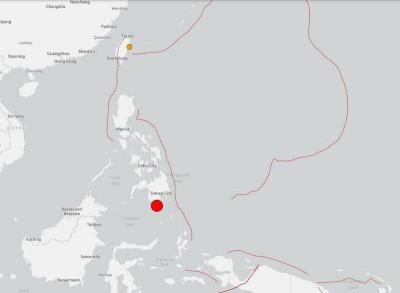
A magnitude 7.8 earthquake struck off the southern coast of Mindanao in the Philippines at 7:38am today, prompting the US Tsunami Warning System to issue an alert for neighboring countries, including Taiwan. The system issued a purple alert indicating a "tsunami threat." The potential threat zone includes Taiwan, the Philippines, Papua New Guinea, Yap and Palau. Philippine authorities were assessing the damage from the quake, with the office of civil defense seeking to verifying initial reports that 15 people had been killed and 129 injured in the region, mostly from falling debris. Arlene Hollero, disaster chief of Maasim town in the Philippines' Sarangani Province,
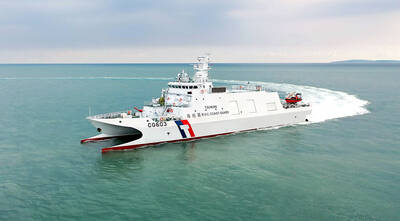
‘GRAY ZONE’ PRESSURE: Beijing’s activities are intended to create the deceitful impression that China has jurisdiction over the area around Taiwan, the CGA said Taiwan’s rights over its territorial waters and exclusive economic zone must not be violated by any country, the Mainland Affairs Council said yesterday, adding that it will not accept any unprovoked actions. The council issued the remarks in response to the China Coast Guard conducting maritime enforcement drills near eastern Taiwan and claiming to fully exercise China’s maritime administrative law enforcement authority. The Coast Guard Administration (CGA) has been closely monitoring the situation and is taking concrete steps to defend the nation’s sovereignty and secure its waters, the council said. China has no sovereign rights over the waters off eastern
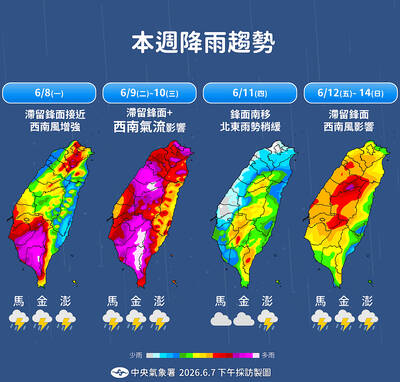
Heavy rain is expected to affect parts of Taiwan this week, the Central Weather Administration (CWA) said yesterday as a meteorologist said the active part of the annual plum rain season has started. A stationary plum rain front and southwesterly winds would bring unstable weather and abundant moisture to Taiwan from today for about a week, with the heaviest rainfall forecast for tomorrow and Wednesday, the CWA said. The agency said western and northeastern Taiwan, and mountainous areas in the east and southeast, could expect showers or thunderstorms on those two days, with localized heavy rain possible. Other parts of


 RSS
RSS