


The use of robots around the home to mow lawns, vacuum floors and manage other chores is set to surge sevenfold by 2007 as more consumers snap up smart machines, the UN said.
That boom coincides with record orders for industrial robots, said the UN's annual World Robotics Survey, released yesterday.
The report, issued by the UN Economic Commission for Europe and the International Federation of Robotics, said that 607,000 automated domestic helpers were in use at the end of last year, two-thirds of them purchased that year.
Most of them -- 570,000 -- were robot lawnmowers. Sales of vacuum cleaning robots reached 37,000.
By the end of 2007, some 4.1 million domestic robots will likely be in use, the study said. Lawnmowers will still make up the majority, but sales of window-washing and pool-cleaning robots are also set to take off, it predicted.
Sales of robot toys, like Sony's canine AIBO, also have risen. The study said there are now about 692,000 ``entertainment robots'' around the world.
Household robots could soon edge their industrial counterparts, which have dominated the figures since the UN body first began counting in 1990.
Industrial robots have nonetheless continued to recover from the slump recorded in the 2001 study.
"Falling or stable robot prices, increasing labor costs and continuously improving technology are major driving forces which speak for continued massive robot investment in industry," said Jan Karlsson, author of the 414-page study.
In the first half of this year, business orders for robots were up 18 percent on the same period a year earlier, mostly in Asia and North America.
Japan still remains the most robotized economy, home to around half the current 800,000 industrial robots. After several years in the doldrums, demand there jumped 25 percent last year.
But Europe and North America are fast catching up, the study said.
EU countries were in second place, with 250,000 robots in operation by the end of last year, mostly in Germany, Italy and France.
Demand from North American businesses rose 28 percent, with some 112,000 robots in service by the end of last year.
The machines are also taking off in richer developing countries, including Brazil, China and Mexico, spurred by plummeting prices.
The term "robot" covers any machine that operates automatically to perform tasks in a human-like way, often replacing the human workers who did the job previously.
In most cases, robots move under their own propulsion and do not need to be controlled by a human operator after they have been programmed.
Most industrial robots are used on assembly lines, chiefly in the auto industry. But increasingly, companies are using them for other tasks, the study said.
There are now some 21,000 "service robots" in use, carrying out tasks such as milking cows, handling toxic waste and even assisting in operating theaters.
The number is set to reach a total of 75,000 by 2007, the study said.
By the end of the decade, the study said, robots will "not only clean our floors, mow our lawns and guard our homes but also assist old and handicapped people with sophisticated interactive equipment, carry out surgery, inspect pipes and sites that are hazardous to people, fight fire and bombs."
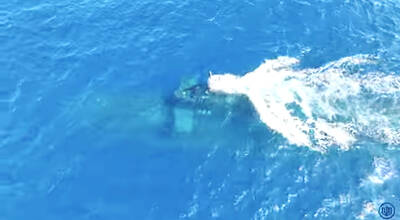
CSBC Corp, Taiwan (台灣國際造船) yesterday released the first video documenting the submerged sea trials of Taiwan’s indigenous defense submarine prototype, the Hai Kun (海鯤), or Narwhal, showing underwater navigation and the launch of countermeasures. The footage shows the vessel’s first dive, steering and control system tests, and the raising and lowering of the periscope and antenna masts. It offered a rare look at the progress in the submarine’s sea acceptance tests. The Hai Kun carried out its first shallow-water diving trial late last month and has since completed four submerged tests, CSBC said. The newly released video compiles images recorded from Jan. 29 to
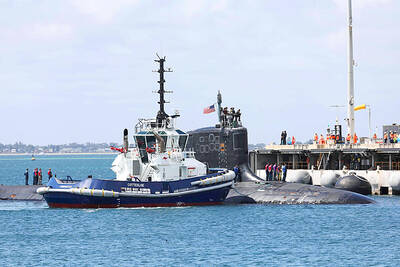
DETERRENCE EFFORTS: Washington and partners hope demonstrations of force would convince Beijing that military action against Taiwan would carry high costs The US is considering using HMAS Stirling in Western Australia as a forward base to strengthen its naval posture in a potential conflict with China, particularly over Taiwan, the Wall Street Journal reported on Saturday. As part of its Indo-Pacific strategy, Washington plans to deploy up to four nuclear-powered submarines at Stirling starting in 2027, providing a base near potential hot spots such as Taiwan and the South China Sea. The move also aims to enhance military integration with Pacific allies under the Australia-UK-US trilateral security partnership, the report said. Currently, US submarines operate from Guam, but the island could
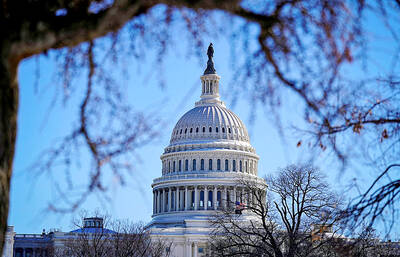
RESTRAINTS: Should China’s actions pose any threat to Taiwan’s security, economic or social systems, China would be excluded from major financial institutions, the bill says The US House of Representatives on Monday passed the PROTECT Taiwan Act, which states that Washington would exclude China from participating in major global financial organizations if its actions directly threaten Taiwan’s security. The bill, proposed by Republican Representative Frank Lucas, passed with 395 votes in favor and two against. It stipulates that if China’s actions pose any threat to Taiwan’s security, economic or social systems, the US would, “to the maximum extent practicable,” exclude Beijing from international financial institutions, including the G20, the Bank for International Settlements and the Financial Stability Board. The bill makes it clear that China must be prepared

Taiwanese trade negotiators told Washington that Taipei would not relocate 40 percent of its semiconductor production to the US, and that its most advanced technologies would remain in the nation, Vice Premier Cheng Li-chiun (鄭麗君) said on Sunday. “I told the US side very clearly — that’s impossible,” Cheng, who led the negotiation team, said in an interview that aired on Sunday night on Chinese Television System. Cheng was referring to remarks last month by US Secretary of Commerce Howard Lutnick, in which he said his goal was to bring 40 percent of Taiwan’s chip supply chain to the US Taiwan’s almost


 RSS
RSS