


Consumers and seafood workers stand to lose while a small group of processors and fishermen would reap a financial windfall if duties are imposed on shrimp, said a group that represents restaurants and distributors.
The group was responding to the Southern Shrimp Alliance's antidumping petition, filed Dec. 31 against six nations. It alleges that Thailand, China, Vietnam, India, Ecuador and Brazil have been dumping shrimp on the US market at unfair prices.
The Consuming Industries Trade Action Coalition voiced its opposition to the petition in a news conference Thursday in Washington. The group, known as CITAC, represents grocers, restaurants, distributors and processors.
"When it boils down to it, this trade case is nothing more than an attempt by a small group to convince the US government to place a food tax on consumers, which in turn provides petitioners with a hefty financial windfall -- all at the expense of American consumers," said Erik Autor, a board member with CITAC and vice president of the National Retail Federation.
The six Asian and South American nations mentioned in the petition account for about 75 percent of imports with a value of US$2.4 billion, CITAC said.
Shrimpers seeking tariffs overcame their first hurdle in February when the US International Trade Commission ruled that the domestic industry has been harmed by imports. By this summer, the US Department of Commerce is expected to rule on whether shrimp has been dumped.
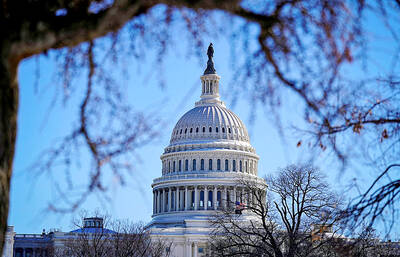
RESTRAINTS: Should China’s actions pose any threat to Taiwan’s security, economic or social systems, China would be excluded from major financial institutions, the bill says The US House of Representatives on Monday passed the PROTECT Taiwan Act, which states that Washington would exclude China from participating in major global financial organizations if its actions directly threaten Taiwan’s security. The bill, proposed by Republican Representative Frank Lucas, passed with 395 votes in favor and two against. It stipulates that if China’s actions pose any threat to Taiwan’s security, economic or social systems, the US would, “to the maximum extent practicable,” exclude Beijing from international financial institutions, including the G20, the Bank for International Settlements and the Financial Stability Board. The bill makes it clear that China must be prepared

Taiwanese trade negotiators told Washington that Taipei would not relocate 40 percent of its semiconductor production to the US, and that its most advanced technologies would remain in the nation, Vice Premier Cheng Li-chiun (鄭麗君) said on Sunday. “I told the US side very clearly — that’s impossible,” Cheng, who led the negotiation team, said in an interview that aired on Sunday night on Chinese Television System. Cheng was referring to remarks last month by US Secretary of Commerce Howard Lutnick, in which he said his goal was to bring 40 percent of Taiwan’s chip supply chain to the US Taiwan’s almost
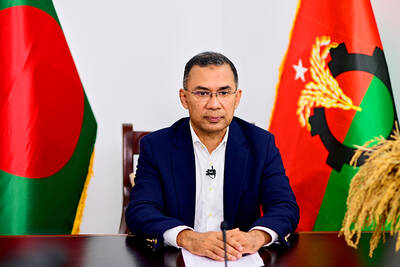
PEACE AT LAST? UN experts had warned of threats and attacks ahead of the voting, but after a turbulent period, Bangladesh has seemingly reacted to the result with calm The Bangladesh Nationalist Party (BNP) yesterday celebrated a landslide victory in the first elections held since a deadly 2024 uprising, with party leader Tarique Rahman to become prime minister. Bangladesh Election Commission figures showed that the BNP alliance had won 212 seats, compared with 77 for the Islamist-led Jamaat-e-Islami alliance. The US embassy congratulated Rahman and the BNP for a “historic victory,” while India praised Rahman’s “decisive win” in a significant step after recent rocky relations with Bangladesh. China and Pakistan, which grew closer to Bangladesh since the uprising and the souring of ties with India, where ousted Bangladeshi prime minister Sheikh Hasina
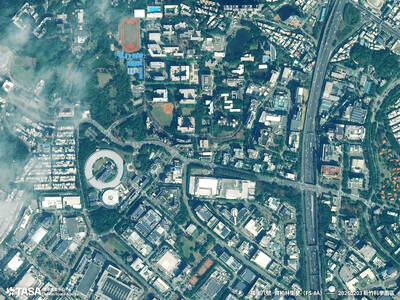
The Taiwan Space Agency (TASA) yesterday released the first images from its Formosat-8A satellite, featuring high-resolution views of Hsinchu Science Park (新竹科學園區), Tainan’s Anping District (安平), Kaohsiung’s Singda Harbor (興達港), Japan’s National Stadium in Tokyo and Barcelona airport. Formosat-8A, named the “Chi Po-lin Satellite” after the late Taiwanese documentary filmmaker Chi Po-lin (齊柏林), was launched on Nov. 29 last year. It is designed to capture images at a 1m resolution, which can be sharpened to 0.7m after processing, surpassing the capabilities of its predecessor, Formosat-5, the agency said. It is the first of TASA’s eight-satellite Formosat-8 constellation to be sent into orbit and


 RSS
RSS