


The Taiwan Space Agency (TASA) yesterday released the first images from its Formosat-8A satellite, featuring high-resolution views of Hsinchu Science Park (新竹科學園區), Tainan’s Anping District (安平), Kaohsiung’s Singda Harbor (興達港), Japan’s National Stadium in Tokyo and Barcelona airport.
Formosat-8A, named the “Chi Po-lin Satellite” after the late Taiwanese documentary filmmaker Chi Po-lin (齊柏林), was launched on Nov. 29 last year.
It is designed to capture images at a 1m resolution, which can be sharpened to 0.7m after processing, surpassing the capabilities of its predecessor, Formosat-5, the agency said.
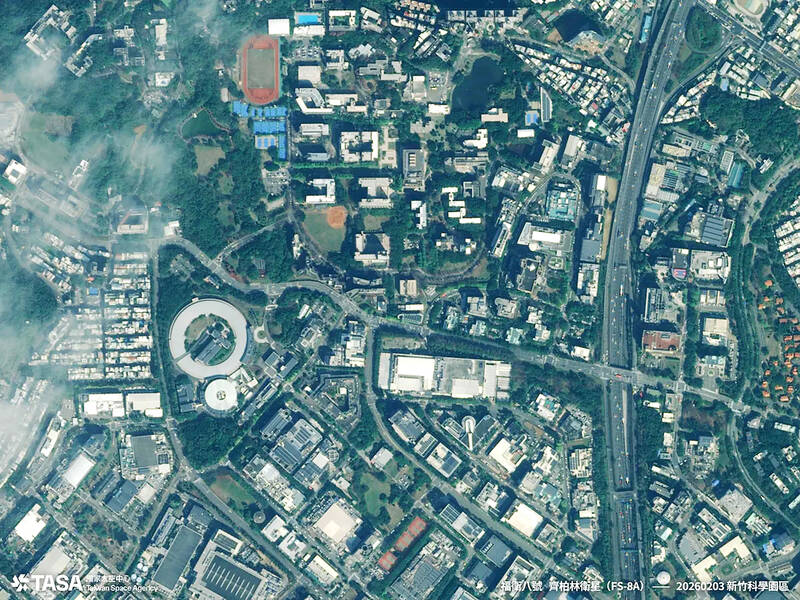
Photo courtesy of Taiwan Space Agency
It is the first of TASA’s eight-satellite Formosat-8 constellation to be sent into orbit and is intended to help Taiwan monitor natural disasters and security threats, it said.
The images featured detailed surface features, such as ocean waves and boat wakes, highlighting the satellite’s ability to capture urban and natural landscapes, TASA said.
Unlike Formosat-5, which can only capture blurred images of traffic flow, Formosat-8A can photograph airplanes and vehicles in detail, it said.
The next-generation satellite can also capture “red edge” images sensitive to vegetation, which can be used for monitoring forests, water resources and agricultural conditions, Formosat-8 project lead Cynthia Liu (劉小菁) said.
Achieving 1m resolution took eight years of testing and development, TASA Director-General Wu Jong-shinn (吳宗信) said, adding that Formosat-8A was made using 16 Taiwan-developed components.
Of the eight satellites in the Formosat-8 constellation, six would have 1m resolution capability and two would have 0.5m resolution, TASA said.
Once fully deployed in 2031, the constellation would provide global coverage and capture Taiwan three times a day, it said.
The second satellite, Formosat-8B, is scheduled to be launched aboard a Space Exploration Technologies Corp rocket by the end of this year.

SILENCING CRITICS: In addition to blocking Taiwan, China aimed to prevent rights activists from speaking out against authoritarian states, a Cabinet department said The Ministry of Foreign Affairs (MOFA) yesterday condemned transnational repression by Beijing after RightsCon, a major digital human rights conference scheduled to be held in Zambia this week, was abruptly canceled due to Chinese pressure over Taiwanese participation. This year’s RightsCon, the world’s largest conference discussing issues “at the intersection of human rights and technology,” was scheduled to take place from tomorrow to Friday in Lusaka, and expected to draw 2,600 in-person attendees from 150 countries, along with 1,100 online participants. However, organizers were forced to cancel the event due to behind-the-scenes pressure from China, the ministry said, expressing its “strongest condemnation”
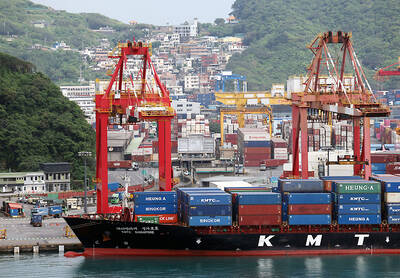
Taiwan’s economy grew far faster than expected in the first quarter, as booming demand for artificial intelligence (AI) applications drove a surge in exports, spilling over into investment and consumption, the Directorate-General of Budget, Accounting and Statistics (DGBAS) said yesterday. GDP growth was 13.69 percent year-on-year during the January-to-March period, beating the DGBAS’ February forecast by 2.23 percentage points and marking the most robust growth in nearly four decades, DGBAS senior official Chiang Hsin-yi (江心怡) told a news conference in Taipei. The result was powered by exports, which remain the backbone of Taiwan’s economy, Chiang said. Outbound shipments jumped 51.12 percent year-on-year to
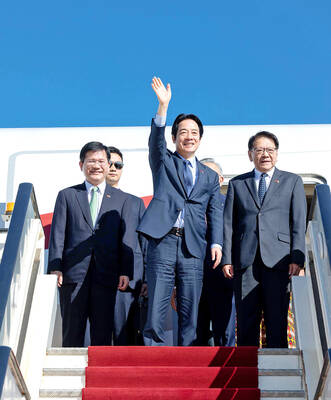
DELAYED BUT DETERMINED: The president’s visit highlights Taiwan’s right to international engagement amid regional pressure from China President Willaim Lai (賴清德) yesterday arrived in Eswatini, more than a week after his planned visit to Taiwan’s sole African ally was suspended because of revoked overflight permits. “The visit, originally scheduled for April 22, was postponed due to unforeseen external factors,” Lai wrote on social media. “After several days of careful arrangements by our diplomatic and national security teams, we successfully arrived today.” Lai said he looked forward to further deepening Taiwan-Eswatini relations through closer cooperation in the economy, agriculture, culture and education, as well as advancing the nation’s international partnerships. The president was initially scheduled to arrive in time to celebrate
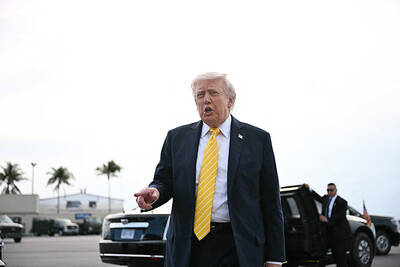
Iran’s Islamic Revolutionary Guard Corp (IRGC) yesterday said the US faced a choice between an “impossible” military operation or a “bad deal” with Tehran, after US President Donald Trump disparaged Iran’s latest peace proposal. Negotiations between the two countries have been deadlocked since a ceasefire came into effect on April 8, with only one round of direct peace talks held so far. Iran’s Tasnim and Fars news agencies reported that Tehran had submitted a 14-point proposal to mediator Pakistan, but Trump was quick to cast doubt on it. “I will soon be reviewing the plan that Iran has just sent to us, but


 RSS
RSS