


China's banks have made great strides in cutting their non-performing loans (NPLs), but finishing the job remains an "arduous" task, the country's top industry watchdog said yesterday.
Even as the country's state-run lenders try to rid themselves of old NPLs, new ones are still emerging, Liu Mingkang (
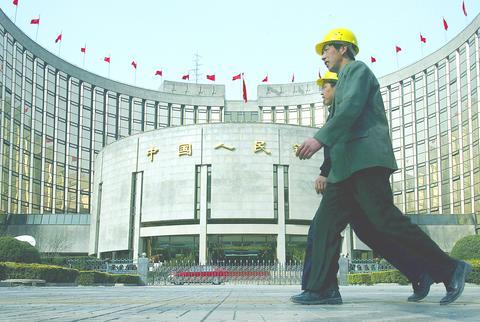
PHOTO: AP
"Our fight against NPLs will be an arduous and long one," the former deputy central bank governor said. "That's why we are trying very hard to foster a credit culture among our banking institutions."
China's state banks can ill afford an explosion in bad debt, as they are estimated to already be saddled with at least 3 trillion yuan in NPLs, or one quarter the size of the entire national economy.
Liu said the reduction in the banks' average NPL ratio to 17.8 percent from more than 23 percent in the course of last year was less of an achievement than it seemed.
Much of it had simply come about as a wave of new lending diluted existing NPLs, he said.
Each time the NPL ratio falls by 5 percentage points, the expansion of credit accounts for four percentage points, he said.
Alarm bells have been ringing in recent months about real estate, where it is feared a bubble is developing, despite measures by the authorities to curb lending for the sector.
However, Liu said the new perils for the banks were not limited to one industry.
"The risk is not only in the property area," he said. "We're also facing risks coming from auto loans and credit cards.
"If the banks fail to identify, assess and gauge the assets risk, it could be very perilous for the entire sector."
The Chinese government late last year made a concrete contribution to the solution of the NPL problem, taking US$45 billion out of its foreign exchange reserves and handing it to the state banking industry.
The money was shared evenly between Bank of China and China Construction Bank, which both plan a stock market listing but have to make themselves more attractive to investors before doing so.
Liu said the US$22.5 billion cash injection each bank received in December to kick-start their reforms would be the last hand-out from the government.
"There will be no new cash injections for the Bank of China or China Construction Bank from foreign exchange reserves," he said.
Liu, who came to the banking commission from a post as president of the Bank of China, the country's largest foreign exchange bank, said he understood the problems of the sector, which is why he had to be tough on the banks.
"You could compare me to a referee who used to be an athlete. That's why I understand perfectly the mentality and the desire of the athletes," he said.
"After all the training and practicing, once they participate in professional games, they won't suffer injuries, they won't break the rules and they won't lose."

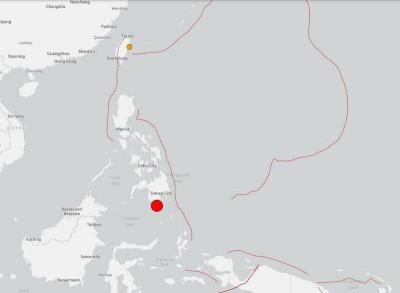
A magnitude 7.8 earthquake struck off the southern coast of Mindanao in the Philippines at 7:38am today, prompting the US Tsunami Warning System to issue an alert for neighboring countries, including Taiwan. The system issued a purple alert indicating a "tsunami threat." The potential threat zone includes Taiwan, the Philippines, Papua New Guinea, Yap and Palau. Philippine authorities were assessing the damage from the quake, with the office of civil defense seeking to verifying initial reports that 15 people had been killed and 129 injured in the region, mostly from falling debris. Arlene Hollero, disaster chief of Maasim town in the Philippines' Sarangani Province,

RESILIENCE: Taiwan plays a key role in semiconductors, energy, information infrastructure and advanced manufacturing, AIT Director Raymond Greene said Taiwan’s continued investment in deterrence and resilience remains vital, especially in uncrewed systems and other emerging technologies, American Institute in Taiwan (AIT) Director Raymond Greene said yesterday. Greene made the remarks at the annual National Strategic Summit on Supply Chain Resilience held by the Research Institute for Democracy, Society and Emerging Technology (DSET), a government-backed think tank. As Taiwan last year became the US’ fourth-largest trading partner and supply chain security is becoming more important, cooperation in emerging technologies continues to deepen between the two countries, he said. The US is committed to accelerating innovation, building key infrastructure, strengthening cooperation

The National Chungshan Institute of Science and Technology yesterday showcased its locally developed variants of the Vision 60 robotic patrol dog, which it plans to deploy on the nation’s outlying territories in the South China Sea. The variants were produced under the Joint Lab project — created by the institute and domestic companies — and assembled with domestically produced motors, lenses and artificial intelligence (AI) systems alongside licensed tech from the US, Missile and Rocket Systems Research Division deputy director Jen Kuo-kang (任國光) told the media event at a military base in Taipei’s Dazhi (大直) area. Taiwan has built up its strengths

RIGHT DIRECTION: Taiwan’s efforts to prevent forced labor include a proposal to ‘fully prohibit’ employers from withholding workers’ documents, an official said Taiwan is to establish a mechanism to restrict imports of goods linked to forced labor, the Executive Yuan said yesterday, after the US proposed imposing additional tariffs on Taiwanese goods over labor concerns. “The Ministry of Labor and the Ministry of Economic Affairs are to establish an interministerial review procedure,” Executive Yuan spokesperson Michelle Lee (李慧芝) said at a news briefing in Taipei. “The government is to use the Foreign Trade Act [貿易法] as the legal basis to restrict imports of goods produced with forced labor” and bring its supply chain governance more in line with international standards on human rights, resilience


 RSS
RSS