


■ US economy
Trade deficit his record
The US economy reached a record-high trade deficit in January, importing goods and services worth US$43.1 billion more than its exports, the Commerce Department said Wednesday. Exports of meat, consumer goods and auto parts declined, while the value of imports of oil surged to the highest level since March last year. The trade deficit rose from US$42.7 billion in December, the agency said. Exports fell 1.2 percent, while imports declined 0.5 percent. Many countries have stopped importing beef from the US following the December discovery of a single case of mad cow disease, adding to the trade deficit. Meat and poultry exports fell 40 percent, reaching their lowest level since November 1993.
■ Mobile phones
China to invest 252bn yuan
Companies will invest 252 billion yuan (US$30 billion) in high-speed cellular networks in China in 2006, after the government starts granting licenses for the service this year, the China Daily reported, citing Lu Guoying, an analyst with government-backed research company CCID Consulting. The establishment of so-called third-generation services, which enable mobile-phone users to hold video conferences over handsets and access the Internet at faster speeds, will create a new mobile-phone market worth about 100 billion yuan a year, the newspaper said. China's mobile-phone subscribers will exceed 400 million in 2006, up from last year's 269 million, the report said, citing data from the country's Ministry of Information Industry.
■ Gas
China pipeline faces delay
Russia may delay building a US$17 billion gas pipeline to China and South Korea by four years on concern there won't be enough demand in northeast China, which gets most of its energy from coal, a Russian government adviser said. Russia's gas pipeline monopoly OAO Gazprom wants to send gas from Siberia's Kovykta field, which has 10 times Asia's annual gas demand, to Western Europe instead and delay delivery to China until 2012, said Andrei Korzhubaev, an economist at the Institute of Petroleum Geology in Siberia. BP Plc, the field operator and Europe's biggest oil company, said government support may boost demand enough in the northeast to warrant its preferred route to China. The tussle with Gazprom, the world's biggest gas producer, is delaying supplies to China.
■ South Korea
Defaults likely to increase
Standard and Poor's said yesterday that South Korea's corporate and individual defaults may rise further, raising questions about trends in the country's credit quality. South Korea's corporate default rate hit a record high 133,195 in January, up 14 percent from a year earlier, according to the Korea Federation of Banks. Individual defaults also hit a record high, the international credit rating agency said without providing details. "In Korea, default rates are likely to continue to increase for some time," Standard and Poor's credit analyst Takahira Ogawa said. Since early last year, domestic demand was hit hard by credit card turmoil, the chief culprit behind South Korea's economic slump last year. In addition, higher costs stemming from global raw material prices and a rise in interest rates have also served to further depress the pace of economic growth, the credit ratings agency said.

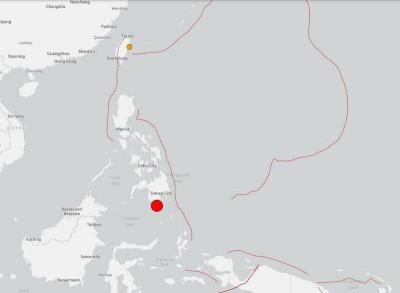
A magnitude 7.8 earthquake struck off the southern coast of Mindanao in the Philippines at 7:38am today, prompting the US Tsunami Warning System to issue an alert for neighboring countries, including Taiwan. The system issued a purple alert indicating a "tsunami threat." The potential threat zone includes Taiwan, the Philippines, Papua New Guinea, Yap and Palau. Philippine authorities were assessing the damage from the quake, with the office of civil defense seeking to verifying initial reports that 15 people had been killed and 129 injured in the region, mostly from falling debris. Arlene Hollero, disaster chief of Maasim town in the Philippines' Sarangani Province,

RESILIENCE: Taiwan plays a key role in semiconductors, energy, information infrastructure and advanced manufacturing, AIT Director Raymond Greene said Taiwan’s continued investment in deterrence and resilience remains vital, especially in uncrewed systems and other emerging technologies, American Institute in Taiwan (AIT) Director Raymond Greene said yesterday. Greene made the remarks at the annual National Strategic Summit on Supply Chain Resilience held by the Research Institute for Democracy, Society and Emerging Technology (DSET), a government-backed think tank. As Taiwan last year became the US’ fourth-largest trading partner and supply chain security is becoming more important, cooperation in emerging technologies continues to deepen between the two countries, he said. The US is committed to accelerating innovation, building key infrastructure, strengthening cooperation

The National Chungshan Institute of Science and Technology yesterday showcased its locally developed variants of the Vision 60 robotic patrol dog, which it plans to deploy on the nation’s outlying territories in the South China Sea. The variants were produced under the Joint Lab project — created by the institute and domestic companies — and assembled with domestically produced motors, lenses and artificial intelligence (AI) systems alongside licensed tech from the US, Missile and Rocket Systems Research Division deputy director Jen Kuo-kang (任國光) told the media event at a military base in Taipei’s Dazhi (大直) area. Taiwan has built up its strengths

RIGHT DIRECTION: Taiwan’s efforts to prevent forced labor include a proposal to ‘fully prohibit’ employers from withholding workers’ documents, an official said Taiwan is to establish a mechanism to restrict imports of goods linked to forced labor, the Executive Yuan said yesterday, after the US proposed imposing additional tariffs on Taiwanese goods over labor concerns. “The Ministry of Labor and the Ministry of Economic Affairs are to establish an interministerial review procedure,” Executive Yuan spokesperson Michelle Lee (李慧芝) said at a news briefing in Taipei. “The government is to use the Foreign Trade Act [貿易法] as the legal basis to restrict imports of goods produced with forced labor” and bring its supply chain governance more in line with international standards on human rights, resilience


 RSS
RSS