


Sun Microsystems Inc and its subsidiaries are paying US$291,000 in fines to settle allegations that the computer giant exported computers to China that were used for military purposes, the Department of Commerce announced.
Santa Clara, California-based Sun is one of the best known technology companies to be fined in a Commerce Department crackdown on illegal exports, which intensified in the fall. The department's Bureau of Industry and Security is conducting roughly 1,500 investigations into illegal exports.
Federal officials are particularly concerned about shipments of so-called dual-use technology -- computers, software, telecommunication devices and other equipment with both military and civilian uses. Officials say dual-use exports are on the rise to China, India, Russia, Pakistan and other countries with known or suspected nuclear weapons programs.
"The Sun case shows that license conditions matter, and we're aggressively targeting compliance," Assistant Secretary of Commerce Julie Myers said Monday. "Companies are on the hook to follow the conditions on the license."
In a statement Monday, Sun emphasized that it settled the case "without admitting or denying the allegations."
"Sun maintains comprehensive procedures to comply with all aspects of US and, where applicable, foreign export control laws,' the company stated in an e-mail. "All export transactions are closely monitored by these procedures, which have been strengthened to enhance our ability to ensure full and strict compliance with applicable laws."
According to a certified letter that the Commerce Department mailed to Sun chairman Scott McNealy dated Jan. 31, 2002, Sun shipped a powerful E5000 server without the required license in February 1997.
At the time, Sun filed paperwork stating that the server was destined for the "Automated Systems Ltd Warehouse" in Hong Kong. Federal agents found the machine at the Changsha Institute of Science and Technology in Changsha, China.
Sending equipment to an address other than the one stated in the original paperwork is a violation of export code. The Changsha Institute offers courses specializing in missile and rocket research and development technology, federal agents say.
In July 1997, according to the letter to McNealy, a Sun employee "altered" a nonproliferation compliance letter and submitted the falsified document in response to a subpoena from the Bureau of Export Administration. Alteration of license documents is also a violation of export code.
Other violations include two servers shipped to Egypt without licenses in March 1998. Those computers ended up with the Egyptian military, the Commerce Department said.
In 1999, Sun sent upgrades to high-performance computers to Colombia and Venezuela, but the department found that Sun could not verify the upgrades arrived at the intended addresses.
For 24 civil violations, Sun will pay a US$269,000 fine. Two Hong Kong-based subsidiaries, Sun Microsystems China Ltd and Sun Microsystems California Ltd, will each pay US$11,000. The subsidiaries will be banned from selling anything to Changsha Institute for one year.
In November, Future Metals Inc of Tamarac, Florida, agreed to a US$180,000 civil fine for sending aluminum bars to India without export licenses. Exports of aluminum bars to India are strictly monitored for nuclear nonproliferation reasons.
Worldwide Sports & Recreation Inc, which does business as Bushnell Corp, was sentenced in August to a US$650,000 criminal fine, a US$223,000 civil fine and five years of probation for exporting more than 500 Night Ranger night vision devices to Japan and 14 other countries from 1995 to 1997.
California-based Silicon Graphics Inc pleaded guilty in January to two felony charges for exporting computers to a Russian nuclear laboratory in 1996. SGI agreed to pay US$1 million in criminal fines and US$182,000 in civil fines.

NATIONAL SECURITY THREAT: An official said that Guan Guan’s comments had gone beyond the threshold of free speech, as she advocated for the destruction of the ROC China-born media influencer Guan Guan’s (關關) residency permit has been revoked for repeatedly posting pro-China content that threatens national security, the National Immigration Agency said yesterday. Guan Guan has said many controversial things in her videos posted to Douyin (抖音), including “the red flag will soon be painted all over Taiwan” and “Taiwan is an inseparable part of China,” while expressing hope for expedited “reunification.” The agency received multiple reports alleging that Guan Guan had advocated for armed reunification last year. After investigating, the agency last month issued a notice requiring her to appear and account for her actions. Guan Guan appeared as required,
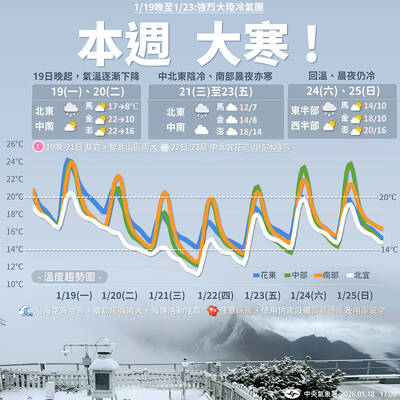
A strong cold air mass is expected to arrive tonight, bringing a change in weather and a drop in temperature, the Central Weather Administration (CWA) said. The coldest time would be early on Thursday morning, with temperatures in some areas dipping as low as 8°C, it said. Daytime highs yesterday were 22°C to 24°C in northern and eastern Taiwan, and about 25°C to 28°C in the central and southern regions, it said. However, nighttime lows would dip to about 15°C to 16°C in central and northern Taiwan as well as the northeast, and 17°C to 19°C elsewhere, it said. Tropical Storm Nokaen, currently
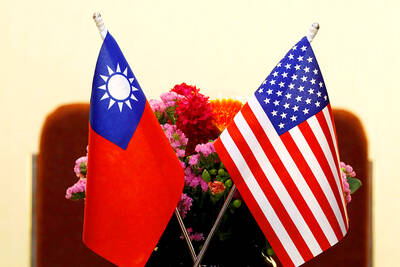
‘NATO-PLUS’: ‘Our strategic partners in the Indo-Pacific are facing increasing aggression by the Chinese Communist Party,’ US Representative Rob Wittman said The US House of Representatives on Monday released its version of the Consolidated Appropriations Act, which includes US$1.15 billion to support security cooperation with Taiwan. The omnibus act, covering US$1.2 trillion of spending, allocates US$1 billion for the Taiwan Security Cooperation Initiative, as well as US$150 million for the replacement of defense articles and reimbursement of defense services provided to Taiwan. The fund allocations were based on the US National Defense Authorization Act for fiscal 2026 that was passed by the US Congress last month and authorized up to US$1 billion to the US Defense Security Cooperation Agency in support of the
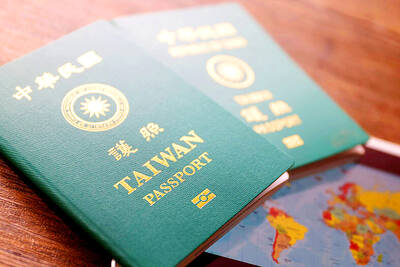
PAPERS, PLEASE: The gang exploited the high value of the passports, selling them at inflated prices to Chinese buyers, who would treat them as ‘invisibility cloaks’ The Yilan District Court has handed four members of a syndicate prison terms ranging from one year and two months to two years and two months for their involvement in a scheme to purchase Taiwanese passports and resell them abroad at a massive markup. A Chinese human smuggling syndicate purchased Taiwanese passports through local criminal networks, exploiting the passports’ visa-free travel privileges to turn a profit of more than 20 times the original price, the court said. Such criminal organizations enable people to impersonate Taiwanese when entering and exiting Taiwan and other countries, undermining social order and the credibility of the nation’s


 RSS
RSS