


The opening salvo has been fired in the game console makers' war for Christmas dollars. Nintendo has lowered the manufacturer's suggested retail price by half for its Gamecube, now down to US$99.99.
The move makes the cube-shaped device significantly cheaper than its competitors, Sony's Playstation 2 and Microsoft's Xbox. Yet some critics are not impressed. They see the price cuts as reflecting the Gamecube's poor sales figures, not a position of strength.
Some 10 million Gamecubes have been sold worldwide so far. Nintendo had hoped to reach this benchmark no later than the end of last March, however. The fact that the company fell short of its goals led to rumors that the Gamecube was slated to be discontinued.
These rumors gained support when production was temporarily halted in August. The warehouses reportedly were full of product, but demand was low. Almost simultaneously, Nintendo head Satoru Iwata announced that a "fully novel gaming product" would be released in the spring of 2004.
Axel Herr, managing director of Nintendo, nevertheless offers reassurance for nervous Gamecube fans.
"The Gamecube has a future. This can be seen in all of the new games that are planned for release in the coming weeks and months," Herr says.
Herr believes that this shows that his firm has no intentions of abandoning its troubled child in favour of a successor. He did remain mum on the mysterious coup that the Japanese video game specialists are planning for the spring. "We have a general idea, but don't know any specifics. That said, if Satoru Iwata announces something that could revolutionize the media landscape, it could really turn out to be true," he says.
Gamecube fans have had other reasons to be worried about their chosen device: Several game manufacturers, including Eidos, which makes the Tomb Raider series, and Codemasters, which produces the rally simulator Colin McRae, have indicated that they will suspend development of games for the Gamecube. On the other hand, the firms never produced much software for the device even in better times.
Even more importantly, one of the key game manufacturers, Electronic Arts (EA), has announced that it will not follow the same path. According to Joerg Trouvain, EA's business director, "EA publishes games for all platforms. We will continue to support Nintendo's Gamecube." He also sees the Gamecube as having a future "because the market is large enough for three home consoles."
The competition is determined not to let the Gamecube's price drop cause it to make mistakes. "We have already planned our promotions for the Christmas season, and the massive price cuts for the Gamecube won't affect them," says Sony's managing director Manfred Gerdes. One such measure is a bundling of the Playstation 2 and the Eyetoy, a USB camera for party games. The combination package will cost US$199.95. Bought separately, the two devices normally cost US$260.
Xbox manufacturer Microsoft seemed similarly unconcerned about the Nintendo move. PR manager Boris Schneider-Johne felt that there was no call for a similar price cut on the Xbox. His firm has plans to put together some sort of bundle for the Christmas season, likely with a family-friendly jump-n-run game, costing in the range of US$250. Such a packet would consist of the console with one controller and two games. Given that games cost US$60 on average, that represents a savings of US$70.
Like Nintendo, Microsoft and Sony are presuming that the coming year will see no successors for the third-generation consoles coming to market. Sony is planning to release two new products, including the so-called PSX console and a version of the PS 2 expanded to serve as a multimedia machine. The latter would have a hard drive and be able to record television programs.
Sony also plans to continue its forays into the market for handheld consoles. "The Playstation Portable is expected in the second half of 2004," Gerdes announced. The device will be matched up against Nintendo's Gameboy and the N-Gage game console/cell phone combination from Nokia. A PS 3 cannot be expected before 2005 at the earliest, Gerdes reports.
For its part, Microsoft plans on using the coming year to concentrate on its online gaming platform Xbox live. "We want to network the online gaming world with cell phones and handhelds very soon," explains Schneider-Johne. This would let gamers keep up to date on things like the current standings for online games via text messaging. Or perhaps even the latest round of price cuts.

NETWORK-MAPPING PROJECT: The database contains 170 detailed files of Taiwanese politicians and about 23 million records of household registration data in Taiwan China has developed a network-mapping project targeting political figures and parties in Taiwan to monitor public opinion during elections and to craft tailored influence campaigns aimed at dividing Taiwanese society, according to documents leaked by Chinese technology firm GoLaxy (中科天璣). The documents, collected by Taipei-based Doublethink Lab, showed a database was specifically created to gather detailed information on Taiwanese political figures, including their political affiliations, job histories, birthplaces, residences, education, religion and a brief biography about them. Several notable Taiwanese politicians are in the database, including President William Lai (賴清德), former president Tsai Ing-wen (蔡英文), Minister of Foreign Affairs Lin Chia-lung (林佳龍),

RECOGNITION: Former Fijian prime minister Mahendra Chaudhry said that Taiwan’s New Southbound Policy serves as a stabilizing force in the Indo-Pacific region Taiwan can lead the unification of the Chinese people, Nobel Peace Prize laureate and former Polish president Lech Walesa said in Taipei yesterday, adding that as the world order is changing, peaceful discussion would find good solutions, and that the use of force and coercion would always fail. Walesa made the remarks during his keynote address at a luncheon of the Yushan Forum in Taipei, titled “Indo-Pacific Partnership Prospects: Taiwan’s Values, Technology and Resilience,” organized by the Taiwan-Asia Exchange Foundation with the Ministry of Foreign Affairs. Walesa said that he had been at the forefront of a big peaceful revolution and “if
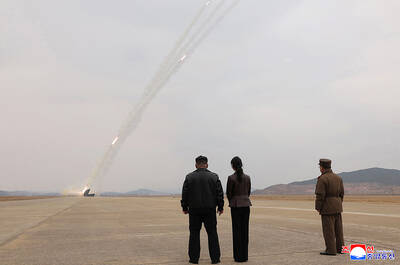
North Korea tested nuclear-capable rocket launchers, state media reported yesterday, a day after Seoul detected the launch of about 10 ballistic missiles. The test comes after South Korean and US forces launched their springtime military drills, due to run until Thursday. North Korean leader Kim Jong-un on Saturday oversaw the testing of the multiple rocket launcher system (MRLS), the Korean Central News Agency (KCNA) said. The test involved 12 600mm-caliber ultra-precision multiple rocket launchers and two artillery companies, it said. Kim said the drill gave Pyongyang’s enemies, within the 420km striking range, a sense of “uneasiness” and “a deep understanding

UPGRADED MISSILE: The Chungshan Institute of Science and Technology is reportedly to conduct a live-fire test of the Hsiung Feng III anti-ship missile on Thursday next week The US Army is planning to build new facilities to boost explosives production and strengthen its supply chain, a move aimed at addressing munitions shortages and supporting obligations to partners including Taiwan, Ukraine and Israel, Defense News reported. The army has issued a sources sought notice for a proposed Center of Excellence at the Blue Grass Army Depot in Kentucky, the report said. The facility would serve as a hub within the US industrial base for the production of key military explosives, including research department explosives (RDX) and high melting explosives (HMX), while also supporting research and development of next-generation materials. The proposed


 RSS
RSS