


Thailand yesterday opened its first full-time clinic specializing in traditional and alternative cannabis-based medicine, as part of a move by the government toward developing a medicinal cannabis industry.
“This is a pilot clinic, because we cannot produce enough doctors with expertise in cannabis,” Thai Minister of Public Health Anutin Charnvirakul told reporters at the opening ceremony in Bangkok.
“Today marks the beginning. We are fighting for the better health of Thai people and fighting for a better economy,” he said, standing next to a marijuana leaf mascot wearing a doctor’s coat.
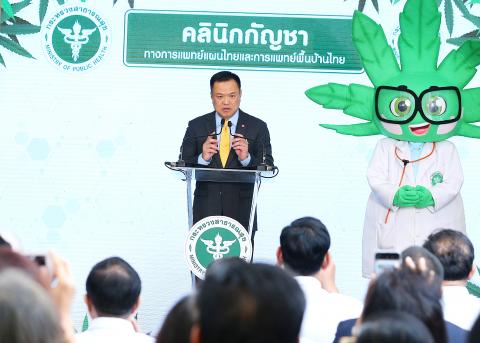
Photo: EPA/EFE
Patients are to receive treatment free of charge in the first two weeks, he added.
Hundreds of mostly elderly Thais waited to receive the 5mg to 10mg vials of oil for muscle aches, though some came bearing more serious ailments — such as Natjuta, born with cerebral palsy and confined to a wheelchair.
Her mother, Supatra Ulapatorn, said cannabis oil helps her daughter to sleep better and stay calmer.
“She does not sleep well which causes me not to sleep either,” the 60-year-old said. “She is more calm now, so I think it works.”
Thailand, which has a tradition of using cannabis to relieve pain and fatigue, legalized marijuana for medical use and research in 2017 to boost agricultural income.
There are already about 25 cannabis clinics attached to general hospitals around the nation, but, unlike the pilot clinic, they operate for just a few days a week due to a lack of specialized staff.
The largest producer of medicinal cannabis is the ministry’s Government Pharmaceutical Organization.
Kasetsart University director of medical cannabis research Natakorn Thasnas said that the university would supply 2,200kg of cannabis leaf to the ministry.
Cannabis production, cultivation and sale has been limited to licensed producers for the next four years to protect the domestic industry. Only hospitals and research facilities are allowed to apply for cannabis production and extraction licenses, but the government is reviewing regulations to enable Thai businesses to apply for permits.
Thailand last year dropped cannabis and hemp extracts from its narcotics list, and proposed a law that would allow each household to grow six cannabis plants.
Four types of drugs, containing different combinations of cannabidiol and tetrahydrocannabinol, the psychoactive ingredient in cannabis, were given to patients to treat migraine, insomnia, neck pain and muscle stiffness, the ministry said in a statement.
The pilot clinic expects to cater to between 200 and 300 patients daily.
“I was worried at first, but I studied the effects and decided it was better because it’s natural,” said Waraporn Boonsri, 69, who received four vials of cannabis oil to help her sleep.
Nearly 2,200 patients have registered at the clinic, a health official said.
Anutin said there are plans for 77 clinics to be opened across the nation, with one in every province.
Recreational use and trade of marijuana remains illegal, with anyone caught with a joint facing up to 10 years in prison.

SPEAKING OUT: After Siranudh Scott’s allegations surfaced, celebrities and public figures took to social media to share their own experiences of sexual misconduct and abuse A high-profile alleged sexual abuse case within a wealthy Thai beer brewing family has prompted a wave of painful accounts from survivors of unconnected abuse in the conservative nation. Siranudh Scott, a member of the billionaire Thai family that founded the ubiquitous Singha beer brand, posted an emotional video this month accusing his elder brother Sunit of repeatedly abusing him when he was a teenager. Sunit, who is in his 30s, later denied the allegations in a video posted online, but Singha parent Boonrawd dismissed him from his executive role with the company on Tuesday last week. “I felt I needed to speak

SEEKING ORDER: Rodrigo Paz said that ‘anyone who wants to destroy the nation will have to deal with this president and the full force of the constitution’ Bolivian President Rodrigo Paz on Wednesday said that the nation was at a “breaking point” after nearly a month of protests that have caused shortages of food, fuel and medicine. Paz, who took office six months ago amid the worst economic crisis there in four decades, is battling a groundswell of fury over his policies. The political capital, La Paz, has been besieged by low-income workers and members of the indigenous majority calling for his resignation. “The country needs order and is reaching breaking point,” the 58-year-old said at a public event in La Paz, renewing his appeal for dialogue. On Tuesday, the Bolivian
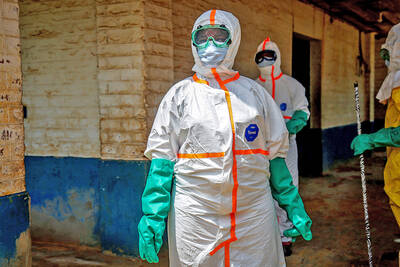
COMMUNITY CONFLICT: Concerns about disease spread from corpses has run up against friends and families’ desire to bury their dead as infection spreads in the area Angry residents of a town at the epicenter of the Ebola outbreak in the Democratic Republic of the Congo (DR Congo) attacked and burned a tent that was part of a health center where people are being treated for the virus, the staff there said Saturday. It was the second such attack in the region in a week. No one was hurt in the attack, according to reports but as patients ran out to escape the fire, 18 people with suspected Ebola infections fled the facility and are unaccounted for, a hospital director said. Angry residents arrived at the clinic in the
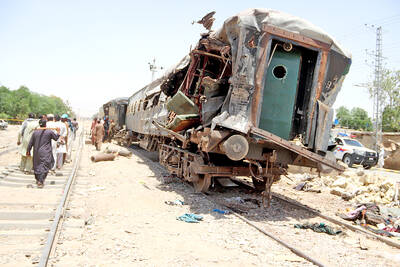
INSURGENT ACTION: A local independence movement in Balochistan, alleged by Pakistan’s government to be backed by India, claimed responsibility for the strike A suicide bomber detonated an vehicle-borne IED near a railway as a passenger train passed through the southwestern Pakistani city of Quetta yesterday, killing at least 23 people and wounding over 70, officials said. The explosion caused two of the train cars to overturn and catch fire, according to footage shared online. The attack happened in an area where security forces are usually stationed, badly damaging several nearby buildings and smashing more than a dozen vehicles parked along the road, according to witnesses and images circulating on social media. Doctors at local hospitals said they had received the wounded, with 20 in critical


 RSS
RSS