


After all the arguments and marches, opponents of Brexit faced a stark truth yesterday after British Prime Minister Boris Johnson’s likely election landslide: There would be no second referendum; divorce from Europe was inevitable.
With the Conservatives set to win their largest majority since 1987, Johnson will be able to push his divorce deal through parliament, allowing Britain to leave the EU next month.
It would be the country’s most significant geopolitical move since World War II.

Photo: AFP / PAUL HARDING -BBC
Some supporters of another Brexit vote blamed themselves for the crushing defeat. The main organization campaigning for a second referendum imploded, while the opposition Labour leader was ambivalent, pledging to stay neutral in another vote.
“I am distraught and like everyone else in the remain community wish we had more competent representation,” said Mike Galsworthy, an anti-Brexit campaigner, who was sipping a whisky before going to bed after seeing the exit polls come in.
The 2016 referendum on EU membership has been the most polarizing issue in recent British history, crystallizing divisions between cities and towns, young and old, and supporters and skeptics of globalization.

Photo: Reuters
For many pro-Europeans in Britain, another referendum represented the best chance of ending the turmoil and political paralysis. If they had united into a single political force, they might have stood a chance of overturning the result.
In addition to their own shortcomings, so-called “remainers” were outmaneuvered.
Over the past three years, support for remaining in the EU has led in almost every opinion poll, prompting some of the largest street protests in recent Britain’s history. Parliament twice forced Brexit to be delayed, but the main opposition parties failed to work together to forge a functional cross-party alliance.
While the Conservatives consolidated the vote of those who want to leave the EU, building a coalition of pro-Brexit voters across regional and class lines, campaigners for another referendum struggled to win converts or agree on a unified plan.
Gina Miller, a prominent campaigner for a second referendum, was among those who accepted that there was no way back.
“There is certainly not another vote,” she said, adding that Brexit would “get passed as an act of parliament, it will then be ratified as an international treaty and we will be out.”
Key to the defeat for the “Remain” camp was Labour’s refusal to join an initiative aimed at encouraging tactical voting, whereby people back a candidate to block another, rather than out of genuine support.
By contrast, the newly created Brexit Party agreed not to run against Conservatives in about half of constituencies to avoid diluting the pro-Brexit vote.
Many campaigners said the fate of their movement was inextricably linked with Labour leader Jeremy Corbyn, the least popular opposition leader in living memory.
The most likely route to a second referendum would have been if Corbyn had become prime minister.
Other campaigners blamed strategic errors, such as agreeing to an early election when the prime minister was trapped in parliament, unable to pass his Brexit deal unamended.
Johnson got the election he wanted when the opposition parties’ united front against a vote broke.

A plan by Switzerland’s right-wing People’s Party to cap the population at 10 million has the backing of almost half the country, according to a poll before an expected vote next year. The party, which has long campaigned against immigration, argues that too-fast population growth is overwhelming housing, transport and public services. The level of support comes despite the government urging voters to reject it, warning that strict curbs would damage the economy and prosperity, as Swiss companies depend on foreign workers. The poll by newspaper group Tamedia/20 Minuten and released yesterday showed that 48 percent of the population plan to vote

PARLIAMENT CHAOS: Police forcibly removed Brazilian Deputy Glauber Braga after he called the legislation part of a ‘coup offensive’ and occupied the speaker’s chair Brazil’s lower house of Congress early yesterday approved a bill that could slash former Brazilian president Jair Bolsonaro’s prison sentence for plotting a coup, after efforts by a lawmaker to disrupt the proceedings sparked chaos in parliament. Bolsonaro has been serving a 27-year term since last month after his conviction for a scheme to stop Brazilian President Luiz Inacio Lula da Silva from taking office after the 2022 election. Lawmakers had been discussing a bill that would significantly reduce sentences for several crimes, including attempting a coup d’etat — opening up the prospect that Bolsonaro, 70, could have his sentence cut to

A powerful magnitude 7.6 earthquake shook Japan’s northeast region late on Monday, prompting tsunami warnings and orders for residents to evacuate. A tsunami as high as three metres (10 feet) could hit Japan’s northeastern coast after an earthquake with an estimated magnitude of 7.6 occurred offshore at 11:15 p.m. (1415 GMT), the Japan Meteorological Agency (JMA) said. Tsunami warnings were issued for the prefectures of Hokkaido, Aomori and Iwate, and a tsunami of 40cm had been observed at Aomori’s Mutsu Ogawara and Hokkaido’s Urakawa ports before midnight, JMA said. The epicentre of the quake was 80 km (50 miles) off the coast of
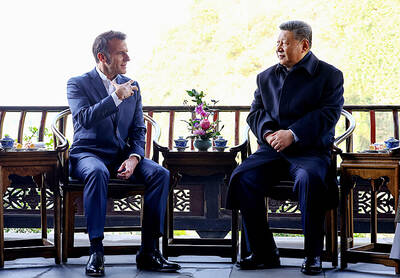
RELAXED: After talks on Ukraine and trade, the French president met with students while his wife visited pandas, after the pair parted ways with their Chinese counterparts French President Emmanuel Macron concluded his fourth state visit to China yesterday in Chengdu, striking a more relaxed note after tough discussions on Ukraine and trade with Chinese President Xi Jinping (習近平) a day earlier. Far from the imposing Great Hall of the People in Beijing where the two leaders held talks, Xi and China’s first lady, Peng Liyuan (彭麗媛), showed Macron and his wife Brigitte around the centuries-old Dujiangyan Dam, a World Heritage Site set against the mountainous landscape of Sichuan Province. Macron was told through an interpreter about the ancient irrigation system, which dates back to the third century


 RSS
RSS