


Indonesia’s little-known glaciers are melting so fast that they could disappear in a decade, a new study has said, underscoring the imminent threat posed by climate change to ice sheets in tropical countries.
As the COP25 summit wraps up in Madrid, nations are struggling to finalize rules for the 2015 Paris climate accord, which aims to limit global temperature rise.
Thousands of kilometers away, glaciers on a mountain range in Indonesia’s Papua region — and a handful of others in Africa and the Peruvian Andes — are an early warning of what could be in store if they fail.
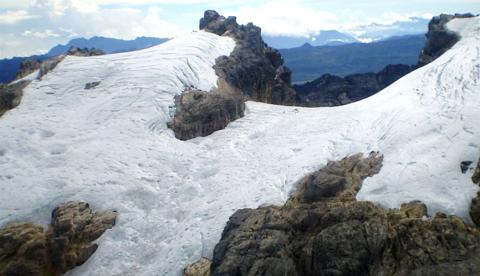
Photo: AFP
“Because of the relatively low elevation of the [Papua] glaciers ... these will be the first to go,” said Lonnie Thompson, one of the authors of the study published in the Proceedings of the National Academy of Sciences this week. “They are the ‘canaries in the coal mine.’”
This summer, Iceland mourned the passing of Okjokull, its first glacier lost to climate change, amid warnings that about 400 others on the subarctic island risk the same fate.
Meanwhile, a team of researchers in Switzerland warned that unchecked greenhouse gas emissions could see more than 90 percent of glaciers in the Alps disappear by the end of the century.
Accelerating melt-off from glaciers and especially ice sheets in Greenland and Antarctica are driving sea level rises, threatening coastal megacities and small island nations. Glaciers are also a key water source for tens of millions of people.
While they are usually associated with colder-weather countries, the glaciers in Papua, on the western half of New Guinea, are a key marker of the impact of rising global temperatures, researchers said.
“Tropical glaciers are mostly smaller and so their response time to variations in climate change is faster compared with larger glaciers and ice sheets,” said Indonesia-based glaciologist Donaldi Permana, also an author on the study.
While earlier estimates suggested that Papua’s glaciers have shrunk by about 85 percent in the past few decades, this week’s study said that glaciers, which once covered about 20km2 have shrunk to less than half of 1km2.
There has also been a more than fivefold increase in the rate of ice thinning over the past few years.
“The situation has reached worrying levels, because ice formation is no longer happening — only glacier recession,” Permana said. “The glaciers are in danger of disappearing within a decade or less.”
Aside from any environmental impact, their disappearance would also be a cultural loss for some indigenous Papuans, who consider them sacred.
“The mountains and valleys are the arms and legs of their god and the glaciers are the head,” said Thompson, a professor at Ohio State University. “The head of their god will soon disappear.”

A plan by Switzerland’s right-wing People’s Party to cap the population at 10 million has the backing of almost half the country, according to a poll before an expected vote next year. The party, which has long campaigned against immigration, argues that too-fast population growth is overwhelming housing, transport and public services. The level of support comes despite the government urging voters to reject it, warning that strict curbs would damage the economy and prosperity, as Swiss companies depend on foreign workers. The poll by newspaper group Tamedia/20 Minuten and released yesterday showed that 48 percent of the population plan to vote

PARLIAMENT CHAOS: Police forcibly removed Brazilian Deputy Glauber Braga after he called the legislation part of a ‘coup offensive’ and occupied the speaker’s chair Brazil’s lower house of Congress early yesterday approved a bill that could slash former Brazilian president Jair Bolsonaro’s prison sentence for plotting a coup, after efforts by a lawmaker to disrupt the proceedings sparked chaos in parliament. Bolsonaro has been serving a 27-year term since last month after his conviction for a scheme to stop Brazilian President Luiz Inacio Lula da Silva from taking office after the 2022 election. Lawmakers had been discussing a bill that would significantly reduce sentences for several crimes, including attempting a coup d’etat — opening up the prospect that Bolsonaro, 70, could have his sentence cut to

A powerful magnitude 7.6 earthquake shook Japan’s northeast region late on Monday, prompting tsunami warnings and orders for residents to evacuate. A tsunami as high as three metres (10 feet) could hit Japan’s northeastern coast after an earthquake with an estimated magnitude of 7.6 occurred offshore at 11:15 p.m. (1415 GMT), the Japan Meteorological Agency (JMA) said. Tsunami warnings were issued for the prefectures of Hokkaido, Aomori and Iwate, and a tsunami of 40cm had been observed at Aomori’s Mutsu Ogawara and Hokkaido’s Urakawa ports before midnight, JMA said. The epicentre of the quake was 80 km (50 miles) off the coast of
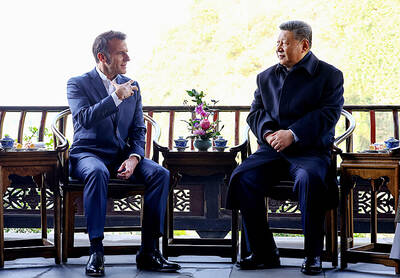
RELAXED: After talks on Ukraine and trade, the French president met with students while his wife visited pandas, after the pair parted ways with their Chinese counterparts French President Emmanuel Macron concluded his fourth state visit to China yesterday in Chengdu, striking a more relaxed note after tough discussions on Ukraine and trade with Chinese President Xi Jinping (習近平) a day earlier. Far from the imposing Great Hall of the People in Beijing where the two leaders held talks, Xi and China’s first lady, Peng Liyuan (彭麗媛), showed Macron and his wife Brigitte around the centuries-old Dujiangyan Dam, a World Heritage Site set against the mountainous landscape of Sichuan Province. Macron was told through an interpreter about the ancient irrigation system, which dates back to the third century


 RSS
RSS