


Elite soldiers yesterday retrieved six bodies from New Zealand’s volatile White Island volcano, winning praise for a “courageous” mission carried out under the threat of another eruption.
At first light, two military helicopters set off from the Whakatane Airport for the offshore volcano, where an eruption on Monday killed at least 16 people and severely injured dozens more.
The goal of the team from the bomb disposal squad was to recover the remains of eight people still on New Zealand’s most active volcano, which sits 50km out to sea.
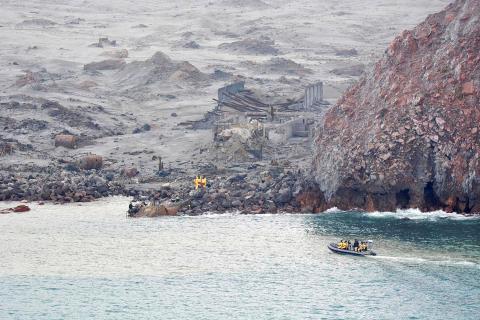
Photo: AFP
After a four-hour wait, while vulcanologists monitored live seismic feeds for signs of another explosion, police said that most of the bodies had been safely airlifted to a naval frigate anchored off the coast.
“Those staff showed absolute courage in order to ensure those six people were returned to their loved ones,” New Zealand Police Commissioner Mike Bush told reporters, saying that they were operating in an “unpredictable and challenging” environment.
Efforts to locate the two remaining bodies were ongoing, with divers searching nearby waters after a corpse was seen floating in choppy seas on Tuesday, Bush said.
Helicopters were also searching over the Bay of Plenty and Bush did not rule out a return to the island when conditions were safer.
Drone flights helped locate the six bodies on the caldera before the operation began, and the six-strong team labored to reach them in heavy hazmat suits and breathing gear that restricted movement.
New Zealand Special Operations Component Commander Rian McKinstry said he was “incredibly proud” of the team, who dealt with heat stress as they prepared the bodies to be airlifted out.
“It was a unique operation, but unique operations are what organizations like the Explosive Ordnance Disposal Squadron gets involved in,” he said.
On the eve of the operation, GeoNet vulcanologist Nico Fournier said that the dangers facing recovery teams if an eruption occurred included magma, superheated steam, ash and cannonball-like rocks thrown from the caldera at supersonic speed.
As the military began their grim task, police took grieving families out near the volcano on a boat to perform a Maori blessing and locals chanted karakia, or prayers, on the shore as the island smoldered in the distance.
Despite the risk of an eruption inside 24 hours being put at 50 to 60 percent, New Zealand Prime Minister Jacinda Ardern said that those involved wanted to help grieving families.
“Today was all about reuniting them with their loved ones,” she said, adding that she was on tenterhooks when the military team was on the volcano.

A plan by Switzerland’s right-wing People’s Party to cap the population at 10 million has the backing of almost half the country, according to a poll before an expected vote next year. The party, which has long campaigned against immigration, argues that too-fast population growth is overwhelming housing, transport and public services. The level of support comes despite the government urging voters to reject it, warning that strict curbs would damage the economy and prosperity, as Swiss companies depend on foreign workers. The poll by newspaper group Tamedia/20 Minuten and released yesterday showed that 48 percent of the population plan to vote

PARLIAMENT CHAOS: Police forcibly removed Brazilian Deputy Glauber Braga after he called the legislation part of a ‘coup offensive’ and occupied the speaker’s chair Brazil’s lower house of Congress early yesterday approved a bill that could slash former Brazilian president Jair Bolsonaro’s prison sentence for plotting a coup, after efforts by a lawmaker to disrupt the proceedings sparked chaos in parliament. Bolsonaro has been serving a 27-year term since last month after his conviction for a scheme to stop Brazilian President Luiz Inacio Lula da Silva from taking office after the 2022 election. Lawmakers had been discussing a bill that would significantly reduce sentences for several crimes, including attempting a coup d’etat — opening up the prospect that Bolsonaro, 70, could have his sentence cut to

A powerful magnitude 7.6 earthquake shook Japan’s northeast region late on Monday, prompting tsunami warnings and orders for residents to evacuate. A tsunami as high as three metres (10 feet) could hit Japan’s northeastern coast after an earthquake with an estimated magnitude of 7.6 occurred offshore at 11:15 p.m. (1415 GMT), the Japan Meteorological Agency (JMA) said. Tsunami warnings were issued for the prefectures of Hokkaido, Aomori and Iwate, and a tsunami of 40cm had been observed at Aomori’s Mutsu Ogawara and Hokkaido’s Urakawa ports before midnight, JMA said. The epicentre of the quake was 80 km (50 miles) off the coast of
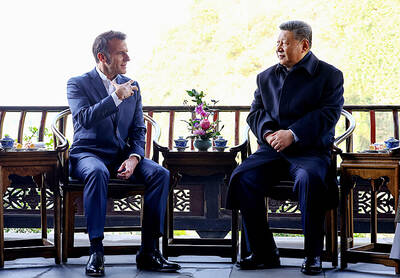
RELAXED: After talks on Ukraine and trade, the French president met with students while his wife visited pandas, after the pair parted ways with their Chinese counterparts French President Emmanuel Macron concluded his fourth state visit to China yesterday in Chengdu, striking a more relaxed note after tough discussions on Ukraine and trade with Chinese President Xi Jinping (習近平) a day earlier. Far from the imposing Great Hall of the People in Beijing where the two leaders held talks, Xi and China’s first lady, Peng Liyuan (彭麗媛), showed Macron and his wife Brigitte around the centuries-old Dujiangyan Dam, a World Heritage Site set against the mountainous landscape of Sichuan Province. Macron was told through an interpreter about the ancient irrigation system, which dates back to the third century


 RSS
RSS